Living with Honest Girl is like living with a slightly smaller, and angrier, Joe Pesci.

Here’s a small reenactment of earlier today.

Honest Girl: You’re trying to put me down for a nap?  I do not understand this, as I do not see Green Monkey anywhere around.  You’re trying to put me down for a nap without Green Monkey?  You’re trying to put me down for a nap without Green Monkey??  Where is Green Monkey?!  WHAT DID YOU DO WITH GREEN MONKEY?? Ma, I swear, this is why nobody likes you.  This is why you can’t finish that dissertation.  You’re a failure.  You’re an ignoramus.  You’re a joke.  This whole family’s a joke. You suck like a Hoover.  DON’T YOU TRY TO GIVE ME THAT SOCK MONKEY! You think I am fooled by a sock monkey?? That’s it.  Say goodnight to goodnight.  I will never let you sleep again.  I will never let your husband sleep again.  I will never let Grammy and Doodah sleep again.  Do you hear me? I will take your . . .

[Grandma comes in with Green Monkey, “Sorry.  I took him downstairs earlier and forgot to bring him back up here.  Here ya go, sweetie.”]

Honest Girl: Ehhhhh.  Look at this lady, huh? Will you look at this lady?  C’mon, Ma, it was a joke.  A joke.  You know I love ya.  C’mere.  You want some sloppy baby kisses? Huh?  C’mere and let me give you some sloppy baby kisses.  Awww, there, that’s better.  Ha!  Do I love this lady or what?  Okay, Mommy, nighty-night.

That is, truly, only a small exaggeration of the last half hour.

The thing is, I know that Honest Girl’s recent tendency to have multiple, violent tantrums and freak outs over everything is a sign of her growing understanding of the world, as Dr. Harvey Karp (the amazing, genius, somebody-give-this-man-a-damn-Nobel-Prize brains behind The Happiest Baby on the Block, and the only person who ever managed to get my then-newborn to stop crying and actually sleep) explains in his The Happiest Toddler on the Block.  He claims that, developmentally, toddlers are at the level of “cave men.”  They don’t have the developed frontal lobe that helps them to logically understand their emotions, and this stunted growth also means that they certainly don’t have the language skills to talk it through (and that, like a Wise Guy, leads them to lack morality, empathy, and sympathy.  They really are little criminals).  But at the same time, they are at a point where they’re starting to understand that some things are out of their control.  And, what’s worse, that a LOT of things are out of their parents’ control (it’s like finding out that God really is Alanis Morissette in plaid boxers).  So toddlers will go from going “ape shit” to going “Jurassic” in the span of about 3.4 seconds (of course, I’m paraphrasing Dr. Karp’s words here, but the ideas are basically the same).

It just proves that, 64 millions years of evolution later, my precious, intelligent, totally-smarter-than-your-kid-though-I’d-never-say-it-out-loud-or-to-your-face daughter is really still just a walnut-brained Tyrannosaurus who’s frustrated because she has an itch on her belly that her tiny T-Rex arms can’t reach.

So it’s a sign of development.  It’s a sign of her maturing brain and its awesome assortment of complex connectivities.  It’s a sign that my daughter will, someday very soon, get a grasp on the concept of a world bigger than her, and she will be able to start tackling it, and articulating it in her very own words, in her very own way.  Hooray.  Yay. I have a normal toddler.  Let me break out the punch bowl.

And then drown myself in it.

I wrote this while sitting in the parking lot at my OB/GYN this past Tuesday, immediately after my twelve-week prenatal appointment.

Dear Baby,

Today, I’m twelve and a half weeks pregnant with you. This morning, I had my alarm set for 6am, but I was so nauseous when I woke up that I stayed in bed, nibbling saltines and praying that the Zofran would kick in, until quarter to eight. Even with the medicine and taking it easy, I still managed to be violently ill, both in the toilet and, later, in the kitchen sink while I was making your big sister’s breakfast. If I didn’t have a doctor’s appointment this morning, I would have undoubtedly stayed home today.

I vacillated between crying in despair, and dry heaving in the van while driving big sissy to daycare this morning (and hour and a half late, because every time I moved, I once again became dizzy and nauseous).  I kept telling her, “Your baby sibling hates me.”  I was really only half joking at that point.

When I got her dropped off finally, and was actually at my 12-week appointment, I spent the first half of it complaining:  “We’re moving.  The house is a mess.  Honest Girl’s having diarrhea this week, and we can’t figure out if it’s Rotavirus or just transitioning to whole milk.  I’m popping Zofran like TicTacs, which means I’m more bound up than the Marquis de Sade.  I can’t. Stop. Puking.” Dr. Handsome nodded empathetically.  This was obviously a pregnant woman in misery.

Then, he couldn’t find your heartbeat.

For ten minutes, he pressed and prodded, asking me to shift one way or another.  We’ll try a little lower. Maybe off to one side.  Was that it?  No, that’s your bloodstream, your heartbeat (it sounded slower on his machine than it felt in my chest).  I tried to focus on the ceiling tiles, willing that microphone to pick up the wonderful, bilge-pump sound of you, living inside of me.  Then, I stopped focusing, and just closed my eyes. “C’mon, c’mon,” I whispered, tears silently running from my eyes back into my hair, my ears. Please, baby.  Please.  Baby?  Please.  Please?

Eventually, he gave up and took me the next room, where there was an ultrasound machine.  I was trying to not think.  The doctor said something about how hard it sometimes is to find a heartbeat at 12 weeks.  After all, you’re still so small.  I said nothing, and waited for him to turn on the machine.  I stared at the ceiling tiles again.  Then he said, “There it is!”

I started sobbing when I saw you.

Tucked up in the extreme right side of my uterus, too close to my bloodstream for your heartbeat to be heard over my own, there you were.  And there was your heartbeat.  I laughed as the doctor tried to get to you face us, tried to get you to turn your little body towards us so we could flick on the microphone and actually get a reading on your heart.  But you refused.  You just kept rolling away from us, showing us your butt and spine (it was a beautiful spine.  That has always been the best part of the ultrasounds for both me and daddy, seeing every single vertebrae, watching it curl and straighten.  It was a good spine.  A strong spine.  And it was a pretty nice little butt, too).  The doctor tried to get me a picture of you, but between my gasping and weeping, and your stubborn refusal to pose for him, the best he could do was a blurry blob, with that perfect little spine glowing, straight as an arrow, in the middle.

“The baby’s strong.  The baby looks perfect.  It’s okay.” I had never seen Dr. Handsome so gentle as he squeezed my hand while I was leaving.

I’m crying as I write this, little baby.  I’m crying because, in the middle of all the craziness and insanity and stress of the last few weeks, I’ve found myself forgetting to stop and think about you.  Oh, sure, I’ve thought about this pregnancy, and I’ve thought about my symptoms, but you, you, my little child, keep slipping my mind.  You are the closest thing to a miracle I may ever experience.  You are a life, a soul, a being, and you are inside of me.  Tucked up in the corner, but still there.  I realized this morning that I love you.  I love you without reason.  I love you without condition.  I love you without logic or sense.  I just want you.  I just want you here with us, healthy and happy.  I want to watch you play with your big sister.  I want to wipe that teeny little butt.  I want to watch that spine grow stronger, taller, and straighter.

I want you to know that your Mama is crazy about you, and I want you to know that I’m sorry it took this scare for me to realize this.  I suddenly realized that my life would not be the same, ever again, if you weren’t in it.  I realized that, in spite of the nausea and the weight loss, and the dizziness, and the pregnancy-induced car sickness, everything in my world is better because you, tiny little thing, are in it.  Everything. I love more because of you.  I laugh more because of you.  I cry with joy at my typical suburban life more because of you.  Life without you?  That would be misery.  So, do me a favor.  Don’t scare your Mama like that ever again, okay?  Because for those ten minutes, the walls were falling down.  The Earth was preparing to swallow me whole.  Everything was going black.  I need you.  You are my light, little baby.  My sunshine.  And I need my sunshine.  Every day.

Mama loves you.

Love,

Me

Today is International Women’s Day.  In honor of today, I’ve written this.  This is for you, my daughter.

Perhaps, since I don’t personally have any specific religious convictions, it’s not quite accurate to call this a “prayer.”  Perhaps these are just a list of “hopes.”  But I’ve found that prayer, unlike hope, contains, intrinsically, the dual qualities of desperation and certainty.  Prayers, unlike hopes, are desperate. They transcend the realm of wanting and desiring, and enter into necessity, into requirement and essential.  They are desperate, because they are needed.

But prayers are also certain.  They are shouted in the dark by the lonely voice, but contain with them the comfort of being heard.  It doesn’t matter by whom.  A higher power.  A friend.  A kind neighbor.  Even people who stumble upon a mother’s blog post.  The person who prays is certain that, though their voice may echo in the silence, someone is listening on the other side.

This is my prayer.

I pray that one day, soon (very soon, please. It must be soon), all young girls will know, without question, without equivocation, without hesitation, that they are loved.  I pray that they will know that their clomping, loud, eager footsteps are their mothers’ favorite sounds.  I pray they will feel the admiration and amazement and awe that their fathers experience whenever they look at their little girls, their mysterious and tormenting, yet perfect little girls.

I pray that every single girl will feel safe in a space that she can call home.  I pray that her sense of “love” does not have to include violence, or abuse, or insult, or anger.  I pray that if such horrors do befall her, that she will have people who will take her away from such things, and bring her to a place of light, and joy, and popcorn and movies on Saturday nights.

I pray that she gets hugged.  Every day.

I pray that every booboo gets kissed better.

I pray that her grandparents will comb her hair into pigtails and braids, and her aunts and uncles will push her, higher higher and higher, on a swing.

I pray that every single little girl will gaze with wonder at the stars, and know that they, in their incomprehensible magnitude and distance, do not even contain a small percentage of the potential that she has in the tips of her eyelashes.  I pray that every little girl will be taken to see the stars, especially if she’s never seen them before.

I pray that every little girl will be told that she’s strong.  That she’s the strongest person in the world.  That she can pick up a house, and break a tree.  Because she is, and she can.

I pray that every little girl, when asked what her favorite book is, can’t make up her mind.  I pray that she never runs out of people who want to read them all to her.  People who will ask her to turn the pages.  People who will ask her what she thought.  People who will be unashamed to use the funny voices.

I pray that every little girl will have someone to kiss the nightmares away, and make her favorite foods on her birthday.

I pray that every little girl has a happy birthday.  Every year.

I pray that every girl knows she’s beautiful.  And that she believes it. Really and truly, and for the rest of her life.

I pray that every single little girl knows the lie contained in the words “You can’t.”

I pray that every girl knows she has value, regardless of her gender identity or reproductive ability.  She has value because of who she is, not what she’s expected to do.

I pray that every little girl grows up being unafraid to dream.  Dream big, girls.  Dream ridiculous, and colossal, and silly, and insane, and inane.  Just dream.

I pray, my small daughter, that you know these things.  I pray that I’m smart enough and good enough to teach them to you.  I pray that you know you are the reason for my today and all of my tomorrows.  I pray that when you’re a teenager and hate me, when I have to punish you, when I have to tell you that you can’t go to the movies with that boy, or you can’t wear that sweater, or that you have to eat your peas (even though we both know that I don’t eat peas myself), you still know that I would give my life, my health, my future, my all for you.  Because I will.  Without question, without equivocation, without hesitation.  My darling Sophia.  I’m yours.  Please know that.

This I pray.

Yesterday was my daughter’s first birthday, and in honor of her, I’ve been doing some serious reflection on her birth, and the process I went through to bring my crazy awesome Honest Girl into the world.  So, while she sits in her crib and plays with her toys, pulls off her socks, tries to peel the vinyl decal off the wall, repeatedly makes mysterious, loud banging noises that sound suspiciously like construction, and essentially does everything but take a nap, I thought I’d do a little reminiscing.

<Sidebar> In the grand tradition of Mommy Bloggers (most notably, Amber from Parenting: Illustrated with Crappy Pictures—awesome, hilarious blog, by the way. I am in full support of her creativity and amazing sense of humor), and for the sake of maintaining a little bit of privacy for my tiny growing family, I’m going to start calling my family members nicknames that are related to the topic of my blog.  I know this may be a silly thing to do, since basically only my father and sixth grade teacher (Hi, Mrs. Crick!) reads this blog, but I still like to pretend I’m playing with the big kids.  Since the blog is “Honest to a Fault,” and I am the Brutally Honest Mom, I decided that my husband would heretofore be called Honest Dad, and our daughter would be Honest Girl (I originally wanted to go with “Honest Toddler,” but for some reason, I feel as though I’ve heard that somewhere before.  Hmmmm.  Well, I’m sure it’ll come to me).  I don’t care about my privacy (hell, you’ve all already heard about my bowel movements), so, when I do get all metanarrative and address myself in the third person, I’ll still just be Rachel. </Sidebar>

By my due date, I was dilated to exactly zero centimeters, and Honest Girl was showing absolutely no interest in making her appearance.  My OB was already planning on inducing me two days after my due date if I was showing no signs of progress. (Dr. Handsome. That’s seriously what I call him.  He’s good looking.  Like, ridiculously so.  Like, even nine months pregnant, I still shaved my legs and wore mascara for every prenatal appointment.  There was a short-lived series on Lifetime called “One Born Every Minute” that was filmed at Riverside Hospital in Columbus, and he was the doctor they put on TV.  Yeah, that good looking.)  I was happy that Dr. Handsome wasn’t going to wait a whole week or two before getting the show going.  First of all, I was crazy uncomfortable (as all hugely pregnant women are).  Second of all, I’m basically a tall little person.  I’m about 4’11” and before I got pregnant I weighed in the one hundred twenty-five to one hundred thirty-pound range (not scrawny, but not big either).  Honest Girl was measuring right around seven and half pounds, and neither Dr. Handsome nor I wanted to let her get much bigger.  Because of my size, he knew that any baby bigger than about eight pounds would need to be delivered via C-section, and at that point, there was no reason to assume that I’d have to deliver any other way than vaginally.  At least, that’s what he thought.  I never assumed that the vaginal delivery was going to happen, honestly.  My mother (also a “Fun Sized” woman) was 17 days past her due date with my big brother when the doctors attempted to induce her (My brother was fat, happy, warm, and lazy.  Why the hell would put in all that effort to leave this cozy place where food was being pumped in to him at regular intervals?  If it weren’t for medical intervention, I’m fully convinced he would have Feng Shui’d that place and called it home.).  So they hooked her up, started pouring rivers of Pitocin into her bloodstream, and eagerly watched for any sign of labor.  The nurses watched her monitors, warned her of an impending contraction, and my mother stared blankly at them as the minutes ticked by, focusing on her stationary uterus as my brother lazily swatted flies with a pudgy, overfed hand.  “Is it happening?  Did I have one?”  She was a medical anomaly.  She was registering contractions, but couldn’t feel a single one of them.  Eventually, they had to pull all ten pounds of big brother out through a Caesarian.  It just wasn’t going to happen any other way.  My pregnancy had progressed almost exactly like my mother’s had, so I thought my labor would as well.

Though I didn’t really think that I would be incapable of going into labor, I was certain that at some point, one of the obstetrical nurses would do the math, look at my tiny body with its non-existent core strength, and conclude that a vaginal delivery just wasn’t for me.  Sure, Honest Girl was only measuring about seven and a half pounds, but I’m a midget, people!  I’d go in and go through the whole induction thing, but I just knew that somebody would say, “Doctor, this woman needs a C-section!  We can’t expect her to push a full-term baby out through her cootchie!  I mean, is that even physically possible??”  Hell, rough sex makes me sore for days (high five, Honest Dad).  How the hell am I supposed to handle a human being hurtling through there?

I was scheduled to arrive at 6am on the morning of my induction. Neither Honest Dad nor I slept the night before, but we were too keyed up to feel tired the next day.  I was measuring maybe a half centimeter dilated (which, again, is essentially zero.  I could dilate myself more from a good hard sneeze right now), but once the midwife had checked my cervix, she ran out the door (She was none too gentle by the way.  Those cervical checks were some of the most painful moments I experienced that day.  No kidding, it felt like she was trying to punch through my cervix and yank my daughter out by the hair).  Soon, a nurse came in, ran an IV, and explained to me that everyone had been called away for an emergency C-section of a woman who had been in active labor since the night before.  “Someone will be with you soon,” she promised as she walked out, starting my Pitocin on the slowest, smallest drip possible, right around 8am.

It wasn’t until 10am that I saw anyone again.  It was the midwife, still dressed in her scrubs and pulling her face mask off as she entered my room.  I got another (painful) cervix check.  1 centimeter. (One of the reasons that check was so painful, by the way, was because the midwife told me she was trying to manually “open” my cervix all on her own, poking her fingers through and trying to split them.  As I was gasping and clinging to the bed rails in pain, it took all I had to not yell, “Well, stop fucking DOING that!  Jesus tap-dancin’ CHRIST!”)  This was seriously going to take forever.  I needed drugs.

But the epidural wasn’t quite ready yet.  They wanted to wait until I got to 4 centimeters.  That’s when the Medieval torture device came out: The Foley Bulb.  A Foley Bulb, for those of you who don’t know, is a device created by Satan himself (or maybe it was God.  The Old Testament God.  You know, the fire, brimstone, pillars of salt, stab-your-kid-and-get-a-prize curmudgeony deity.  He could have totally been responsible for the Foley Bulb).  It’s this deflated balloon that the midwife shoves into your cervix, then starts pumping water into.  They inflate this balloon, forcing your cervix to open, and while it inflates, it also pinches the opening of your cervix down until you’re all nice and effaced (thinned out, so there’s nothing between your birth canal and your newborn).  If it does its job, you are 100% effaced, and dilated to 4 centimeters.  Certainly, this non-drug intervention and induction is a wonderful medical advancement (at least on paper), but the real prize at the end of the Foley Bulb torture rainbow is that afterwards, you finally get your epidural.  Sweet, sweet epidural.  But that’s only if and when they can tug the Foley Bulb out without any trouble (it’s designed to inflate to 4 centimeters exactly).  The nurses were explaining this whole process to me, and said that my slow progress indicated that it would probably be about twelve hours before the Foley Bulb would fall out.  Twelve.  Hours.  They were all placing bets, thinking that Honest Girl was going to be a Leap Day Baby.  I was really wishing I had taken a Benadryl the night before and gotten some sleep.

When they inserted the Foley Bulb, I literally saw stars of pain explode behind my eyelids.  Two nurses had to hold down my legs while it was being placed, because I was instinctually trying to kick, trying to escape, trying anything to make it stop.  The midwife’s hand came out covered in blood from my poor, battered cervix, and we were both panting and sweating from the exertion.  Honest Dad was by my head, trying to comfort me, while he asked our nurse in that so-angry-you’re-calm voice that probably shook her to the core, “Was there nothing you could give her for that?  Did she have to feel that much pain?  She’s in pain.”  Tears were streaming down my face, and I tried to focus on breathing.  I think my mother was in the room at that time, frozen just out of the spotlight they had put on me, both hands covering her mouth as she watched her youngest daughter writhe in pain.

It sucked.

But then it passed.

And quickly too.  After it was in place, the Foley Bulb just felt like a small menstrual cramp.  Annoying, but manageable.  It really made me want to pee, which was hilariously hard to do with a giant gown falling off my shoulders, my husband carrying about 7 tubes, monitors, and other devices that were strapped on, pinned in, or hanging off me, and while pushing an IV drip of Pitocin and fluids.  I’m certain that I accidentally pissed on something.  And when I tried to stand up, I lost my balance and almost yanked the emergency help cord right out of the wall.  My nurse promised that once I got my epidural, I’d get a catheter, so I probably wouldn’t have to make that awkward bathroom trip too many more times.  I’d never been so happy to hear the word “catheter” in my life.  C’mon, epidural!  C’mon, cervix! Dilate, dilate, dilate! Woo, efface like a mother fucker, lady parts!

And it did.  After just an hour of the Foley Bulb, the nurse came in, gave a slight tug, and out popped what looked like two glass balls—the inflated Foley Bulb (remember Davie Bowie as the Goblin King in The Labyrinth?  Remember that he had these glass balls he was always throwing around, twisting in his hands, and doing evil magic with?  That’s exactly what it looked like, emerging from my vagina.  Like two of David Bowie’s balls, stuck together and attached with a tube.).  I was 100% effaced, and 4 centimeters dilated.  But even better than that, I didn’t have to interact with the midwife at all anymore (We were going full-on medical now!  Keep your vagina-punch to yourself, lady!), and I got to have my epidural.

I started getting a steady stream of visitors.  My cousin, who brought everyone Starbucks and bagels to stave off boredom and hunger (Honest Dad used her entrance as an excuse to take an hour to go have breakfast.  The Foley Bulb was a little too much for him to handle.  I didn’t and still don’t blame him).  My dad, smiling his “happy frown,” and wrinkling up his eyes with so much joy, I wondered how he could even see me.  My mother, offering to get me water, and rocking back and forth with her hands behind back, relaxed but on the ready.  My mother-in-law, snapping pictures at the speed of sound and smiling with her lips sealed, as though she was holding in an inappropriate laugh.  And my father-in-law, watching the monitors with so much excitement he actually suggested to the hospital staff that they make an iPhone app for the people in the waiting room, so they could watch the numbers sweep up and back down again.  “Here it comes!”  He would grin as the machines registered my contractions, then look at me in the hopes of seeing my reaction.  “Do you feel it?  Oh!  That was up to 80!  Did you feel that one?  That was a good one!”  I was handling it pretty well, until the labor started to intensify.  I asked him to stop giving me a warning before every contraction (I was in labor, I KNEW I was contracting, thanks so much), but he couldn’t keep that giddy grin off his face every time the numbers climbed again.  I had to kick him out.  He kept texting Honest Dad, asking what my “peaks” were, and my husband dutifully reported back to him (“97 on that last one!  We’re getting closer!”).

The epidural made me feel warm and drowsy.  It was exactly what I needed after the stress and pain of the Foley Bulb.  I was given a little button, and told to push it whenever the pain “started to get too much.”  I dozed for about twenty minutes, but I couldn’t really sleep, feeling, sensing, knowing that my little girl was going to be here any minute.  The sharp, eyeball-bursting pain of the Foley-Bulb was my basis of comparison with my epidural.  But, shit, after that thing, labor was a cake walk.  At some point, I hit the button, and felt a cool wetness run down my back.  “Neat,” I thought, as I enjoyed its relaxing tonic, and asked if my visitors could come back in.  Melissa, my nurse, looked concerned.  She wanted me to rest more.  I insisted that I was fine.  I couldn’t sleep.  I didn’t know how to explain to her that I’m an extrovert.  I need people around.  I feel the most relaxed when I’m interacting with people, when I’m talking, when I’m communicating.  The empty room, with the lights turned off, was stressful for me.  It was like someone was leaning over my ear, screaming, “Sleep!  Sleep!  Sleep! Why aren’t you sleeping?  Isn’t this relaxing?!”  They brought my family back in, and we talked and laughed, until the contractions were making me catch my breath, and I had to quietly breathe through them, instead of smiling and nodding to my father-in-law, “Yes, I’m definitely feeling that.”  I called Melissa back in.

“I didn’t know if I should push the button for more epidural.  It’s a lot of pressure.”

Melissa checked my cervix.  After the epidural, the cervical checks were no problem.  There was pressure, but no sharp pain.  Hell, she could’ve dragon kicked that bitch!  That’s the magic of the epidural.

“You’re at nine and a half centimeters!  You’re almost ready to push!  So, you’ve hit your button, like, six times or so by now?”

The color drained out of my face.  “I’ve hit it once.”

Melissa looked horrified, “Hit the button! You’re going to have a baby soon! You don’t want it to run out!  Hit the button!  Hit it immediately!”

“Oh, God!” I frantically started hitting the button repeatedly (luckily, it only works on the first hit and won’t give you another dose until you hit it 15 minutes later).

Melissa told me to hit it again in fifteen minutes, then one more time fifteen minutes after that. Then, it would be done.  I’d be pushing.  In the meantime, I had to figure out who was going to stay in the room with me, and who would have to sit in the waiting room.

I was allowed three visitors.  I already knew that it would be my mother, my husband, and my mother-in-law (Honest Dad is an only child, and I wanted to give her the opportunity to see her granddaughter being born.).  Mom and my husband would be in charge of leg-holding and coaching, while my mother-in-law would stand back, by the head of the bed, quietly watching the whole thing (and, of course, taking pictures).  It was all worked out.  But then my mother piped up.

“Your father really wants to give you a last kiss before you start pushing.  Can you just let him come in and give you a kiss first?”

Contraction.  So intense my eyes squeezed shut. Yeah. Whatever.  Do what you gotta do.  Just shut up and quit asking my opinion.

My mother-in-law left, and my father entered the room.  Meanwhile, Nurse Melissa had clicked on her “No Bullshit” hardhat.  “That’s it.  No more coming and going.  The people in here are staying in here.”

Dad was trapped on the inside.  My mother-in-law on the outside.  The giant stone door had fallen closed and Indiana Jones’ hat was still on the other side.  My father, my father was going to watch me give birth.  My father was going to watch me shove a kid out through my vagina.  If it weren’t for the incredible, hard labor, I would have protested.  Instead, I looked at my father, “Dad, just stand still and don’t talk.”

But Dad has a nervous tick.  A few nervous ticks.  He puts his hands in his pockets and jiggles his change.  He paces.  He breathes out heavily through his nose like a dragon puffing out sulfurous smoke.  He picks his nails.  After ten minutes of pushing, while my mother yelled at me repeatedly to “Push like you gotta poop!” I was ready to throw my father out the window.

“Quit jiggling your goddamn change!”

And after the next push. (“Just like that.  Like you gotta poop!”)

“Dad, I’m gonna staple your feet to floor!”

And the next push. (“Like you gotta poop! Pooooop!!”)

“Dad! Your change! Jesus!”

And the next.  (“Push, push! Pushpushpushpushpush!”)

“STOP. MOVING. DAD!”

<Sidebar>That’s not a creative interpretation of the dialogue.  That is literally, honestly, actually what happened</Sidebar>

The only thing keeping me sane was my husband, holding my knee up against my chest, and whispering in my ear, “You can do this.  You’re doing this.  You can do this.  She’s almost here.”  He was the quietest thing in the room (by then, Dr. Handsome had entered, along with about ten other people, and he took over with the assertive attitude of a football coach), but at every push, I held my breath, I made sure to not cry out or scream, and I listened for my husband’s words.  I needed those words more than anything else.

At 6:36pm, I felt my daughter’s head come out.  Dr. Handsome said that the “next contraction” would be the one, but I knew I didn’t want to wait for the contraction.  I knew that I just had to give one more push.  I knew the hardest part was over.  I took a breath, and pushed.

And there she was.

And she was perfect.

Somehow, about 15 people were suddenly in the room, and my mother-in-law was back in, snapping pictures (my father-in-law was also in there, but he was not happy that they had let him back in while I was still naked on the bed, getting my episiotomy stitched up.  He tried desperately to look at the baby on my chest without actually seeing my chest).  A bunch of nurses appeared, taking measurements, writing things down, assisting my OB, doing . . . well, okay.  I have no idea what any of them were doing.  I had my girl.  There she was.  I was only vaguely aware that other people were in the room.  She looked into my eyes with such calm and certainty, as though she trusted me right from the start, right from that moment.  She blew all of us away.  The nurses took her to get her final measurements, and while she was laying  on the warming table, she picked her head up and looked around.  The nurses burst out laughing, and one of them said, “Oh, baby, you’re not supposed to be able to do that yet!”  But Honest Girl was curious about her world.  And she still is.
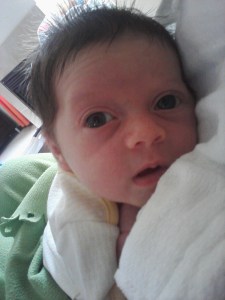
Honest Girl, three days old. Complete trust. Complete love.

Honest Girl, three days old. Complete trust. Complete love.

The rest of the day was a confusion of smiles and tears.  I was moved to a new private room (While I was being wheeled over there on a chair, Honest Dad walked next to our girl.  She held his finger the entire way.  He was in love). Someone got me takeout.  We opened a few presents.  I tried to breastfeed for the first time.  Honest Girl got a bath, and got the birth gunk combed out of her long, dark hair.  Finally, the family all left, and all three of us got ready for a little sleep.

And then it hit me. Pitocin, and Foley Bulbs, and epidurals aside, the hard part wasn’t over.  But I also knew the happy part wasn’t either.

<Sidebar> After my daughter was born, my now-traumatized father, holding his new granddaughter, walked over to my mother and whispered, “When did they shave Rachel?  I didn’t see them do that.”  My mother had to very delicately and gently tell him, “Uhh, honey?  They don’t shave women anymore.”  “But then how–?”  She pursed her lips, waiting for him to get.

Then he got it.

Seriously. Traumatized. Grandfather. </Sidebar>

I’m knocked up again.  This was an “accidentally on purpose” development for us.  You see, back in the middle of November, after eight months of breastfeeding my daughter, I weaned her.  I was trying to wean her for six weeks prior to that, honestly, but the stubborn little butt just wouldn’t take any formula, even mixed in with her mashed up bananas.  I had always thought I’d breastfeed for the entire first year, but here’s the God’s-Honest: breastfeeding was making me a crazy person.  I felt trapped by my own child.  I couldn’t have a day off, an evening off.  It didn’t help that I also had a crazy over-production of breast milk that made everything painful, wet, and leaky if I didn’t shove my nipple in some kind of sucking device every three hours or so.  I was stressed, exhausted, and, though I was a stay-at-home mom, I felt like I had been stapled to my baby, my “spot” on the couch, and my living room.  I was in prison.  Worse, I was in solitary.  I was snapping at my husband, feeling like I was the only one responsible for keeping our child alive and healthy, which was unfair to him and way too intense for me to handle on my own.  Weaning was hard decision to come to, but ultimately it was the best decision for us.

<Sidebar> This overproduction of milk, though, let me do something really rewarding, but really difficult while I was nursing.  I donated 240 ounces of breast milk to Mother’s Milk Bank of Ohio.  That’s almost two full gallons of human breast milk.  It was a very time-consuming and hard process, but I’m glad I did it, if only to have had the experience.  Also, it was a great way to use up my extra milk.  There was no way that my daughter would have been able to drink all of my milk that I had pumped and stored up before it started to sour [every day, I was pumping an additional 8-10 ounces, on top of the 30 or so she was getting every day. I’m apparently part bovine on a genetic level], and this way, I get to have a great story of how the woman in charge of the local milk bank smiled at me and said that my donation was “like Christmas” for her.  “Until you came in, we didn’t have enough to run our pasteurizing tanks.  Now we do!”  That made all of the hassle of sanitizing and pumping and cleaning and freezing and labeling really seem worth it.  I don’t think I’ll do it again, though.  Because it really *was* a gigantic hassle. </Sidebar>

But then the decision to wean was just kind of made for me, several ways.  First of all, early in November, I contracted the worst UTI of my life.  Delivering my daughter vaginally damaged my bladder (I’ll talk more in depth about that in a later post).  My nerves on the inner sphincter to my bladder (the part that connects your urethra–your “pee tube”–to your bladder) got damaged from the delivery, and consequently, they atrophied.  It was a process that started during pregnancy (I had both stress incontinence [Oh, shit! I sneezed and peed myself!] and urge incontinence [Oh, shit! I had to pee and couldn’t make it to the toilet!] while I was pregnant), and one that can’t be fixed with Kegels (So, friends and ladies, though I know you mean well, kindly quit chirping, “Just do Kegels!!” to me when I open up about my recent and lasting relationship with Poise Pads.  I get it.  I do ’em.  All the time.  And still just pissed myself. Thanks for the tip.).  Anyway, these weakened bladder muscles mean that I am more susceptible to UTIs and other infections because I’m more “open” down there and exposed to any wandering bacteria that want to move in and take up residence (and they actually do call it “walking bacteria.” No shit. That’s a real medical term.).  So I got this UTI.  Within an hour, I went from, “Hmmmm.  I feel like something may be a little off” to pissing blood.  My pee looked like cranberry juice.  It was midnight on a Friday, and my husband had to pack me and our daughter into the van and take me to the emergency room, me now doubled over in pain and certain that I had cancer in my lady-parts.

The ER doctor said that my urine was the worst she had ever seen.  “Awful.  Just awful.”  She gave me an IV drip, and started Morphine, because I was in so much pain (Morphine, by the way, made me completely stone.  I kept telling my husband that I was wearing football shoulder pads.  That my shoulders were out in front of my body.  I wanted my shoulders back in place.  But on the plus side, I had forgotten about my burning peepee.).  Then she started prescribing antibiotics.  A lot of antibiotics.  And then four days later, the hospital called me and said that they wanted me to continue my current run of antibiotics, but start an *additional* round of them, because it turned out that my UTI was drug resistant to the other two I was already on.  Technically, they said, I could continue breastfeeding, but my daughter would get diarrhea.  Bad diarrhea.  And my body wouldn’t be able to filter out all of the meds.  So she would get those too.  I decided that was it.  Before I started my third round of antibiotics, I breastfed her for the last time, crying into her hair and trying to explain to her why she was going to be unhappy the next few days, why this had to happen so suddenly, and apologizing for not living up to my end of the bargain, apologizing for secretly being relieved that I had a legitimate excuse to stop this beautiful, but exhausting ritual we had.  Three minutes into her feeding, while I was still blubbering, she was already asleep.  I put her in her crib, and I knew that she would be okay with this next phase, this new development.  “It’s okay, Mama.  I just want you.  Just you.”  And I was right.  Three days after I started my antibiotics, our little girl was taking all of her bottles with ease, and my husband could finally start putting her to bed at night. (He is now the champion of bedtime.  I can put her down, and she’s up and crying after an hour.  If he puts her down, she’s comatose until 9am.  I don’t know how he does it, but I will make him continue to do it forever.)

But as I said before, it wasn’t just the UTI that inspired me to wean my daughter.  It was also motivated by talk of conceiving #2.  You see, in order to get pregnant the first time around, my husband and I had to undergo fertility treatments.  We tried on our own for six months, after which I happened to mention to my gynecologist that there was nothing regular about my cycles, and he recommended us to a fertility specialist.  After a battery of tests, we were given a 4% chance of conceiving on our own.

<Sidebar>Remember in Sex and the City when Charlotte was having trouble getting pregnant, and she went to her doctor and started sobbing and freaking out because she *only* had a 15% chance of getting pregnant?  Well, now I know that Charlotte can suck a big donkey dick, because 15-20% chances for pregnancy are about the monthly odds for healthy, normal couples without fertility issues.  I was given 4% odds when they were able to make me ovulate.  After being on the drugs for a few months, we figured out that my lazy-ass ovaries weren’t all that interested in ovulation, even with medical intervention. I would have tap-danced on my doctor’s desk if he had said 15% odds.  I would have been able to just have sex.  Hell, I could have fucked.  Instead, I was having reproductive intercourse.  On schedule.  No funny business.  Let’s get this going, babe.  So, yeah, I loved that show, but that scene just makes me cringe when I see it now. </Sidebar>

I was on Clomid for six months, then we tried an Intra-Uterine Insemination (IUI).  As far as infertility goes, it’s the easiest and cheapest of the procedures you can do for pregnancy issues.  The doctor takes your husband’s, ahem, sample (spunk), spins it up in a centrifuge so that only the good, strong swimmers get concentrated at the top, then takes a little pipette, and injects the boys directly into your uterus, bypassing the cervix altogether (which can also be murderous to sperm.  Really, it’s amazing that anyone is able to get pregnant, because the female body is NOT nice to those things!).  A few days beforehand, I got a shot of hormones directly into my ass, then had to undergo a transvaginal ultrasound to look at my ovaries and see if and how many eggs I had ready to release.  Our doctor didn’t have a lot of faith in this procedure for us.  He told us that we’d try it four times, then move on to IVF (to give you a sense of the scale of infertility treatments, let me point out that the IUI costs about $300 per session.  IVF, after insurance, is about $13,000 per session.  And you often need more than one.).  Bobbie and I were already discussing in a joking-but-not-really way the possibility of adopting a Chinese daughter (“They come with their own abacus!”).  But, then, I felt funny.  Just nine days after the procedure, five days before I was “supposed” to take the test, I woke up and took a pregnancy test.  And there it was.  Boom.  A blue line.  Our daughter.

When our daughter was six months old, my husband and I began talking about starting the process for our next baby.  We talked to our fertility doctor, and he said that before we began anything, we’d have to have our baby completely weaned from breastfeeding for at least two full months, then we could start the process again, jumping straight into the IUI if we so desired and skipping those months with Clomid (I so desired.  Clomid is wonderful, but I was an insane bitch on it).  I decided I would start the slow process of gently weaning my little girl, with the hopes that she would be fully off the breast in October, and we could start 2013 with a fresh outlook and a fresh goal for a new baby.  Well, like I said, my girl did NOT want to be rushed into weaning, and by November, we were still pretty much breastfeeding (and I mean *breast* feeding.  She often wouldn’t even take my milk from the bottle if she knew that Mama was at all close by).  Then, the strange godsend of that horrible IUI forced both of us to put an end to it.  By November 15th, I could say that my daughter was fully weaned from the breast.  The countdown was on.  By January 15th, we could start our process for baby #2.  Even though we knew that the odds of us getting pregnant again so quickly were slim, we began to talk in excited tones about me taking a pregnancy test on our daughter’s birthday at the end of February, and seeing that gorgeous blue line.  We’d have so much to celebrate!

In the first week of January, I started taking Provera, a hormone to make me start my period (my cycles have never made any kind of sense, so Provera helped while we were trying to conceive to at least give me some kind of a schedule).  I took it for ten days.  And waited.  No period, which was weird, because it always used to make me start right away.  But the nurse said that it would take up to two weeks for my period to begin.  So I waited some more.  Then, on a Thursday afternoon, while my daughter napped, I just decided to take a test.  Just to see.  Just in case.  And there it was.  That blue line.  I was six weeks pregnant.  I had been pregnant since New Years.  Without medical intervention.  Without drugs.  Without reproductive intercourse.  Without a pipette and an ultrasound wand.  It had just happened.  All on its own.  In spite of 4% odds.

And now I’m almost 10 weeks along.  My babies will only be 18.5 months apart in age by the time this one comes along (oy vey), which is almost exactly how far apart my big sister and I are in age (double oy vey).  Because this is my second pregnancy, I started showing almost instantly, and I realized today that I already can’t see my vagina anymore (hence, the title of this post).  I was planning on writing a hilarious post about the trials and traumas of the first trimester (I’ve thrown up in my kitchen sink, while feeding my daughter breakfast, more times than I’ve thrown up in the toilet thus far), but I guess sometimes I don’t have as much control as I think I do.  And as I look down at my little round belly, I guess that’s not always a bad thing.

This is going to be a little departure from mommy blogging.  You see, outside of my family, writing, reading, and learning how to cook, my next biggest passion has got to be watching and analyzing commercials.  No joke.  They’re like short, intense signifiers of culture.  Just full of meaning.  Recently, I’ve seen several commercials, all for insurance companies, that all base their “cleverness” on blatant sexism and sexist assumptions.  And while I know that many viewers are currently in an uproar about Volkswagen’s latest commercial, depicting a dad teaching his son how to throw a baseball (and doing a terrible job, to say the least), I have to say that the sexism depicted in that commercial just doesn’t compare to the sexism depicted in the ones I am going to talk about today.  True, there are many things wrong with the “Idiot Dad” caricature that has gained so much popular currency in the last fifteen years or so, and I fully believe that reversing a sexist dichotomy does nothing to eliminate the dichotomy itself.  However, remember that even a blundering father is still an involved father, a loving father, a caring father, and very much a product of the twenty-first century’s relaxing gender stereotypes concerning father involvement in child-rearing.  These Idiot Dads are insulting to many capable, strong, competent, and talented fathers that I know, but they are the over-simplified, pop-culture result of what many see as the “sudden” transition from a woman-centered domestic sphere to a shared space of partnership.  The Idiot Dad is the guy who grew up never thinking he’d have to know where the forks are, or how to buckle a rear-facing car seat, but has unexpectedly found himself in a progressive home where such tasks are not exclusive to the wife-and-mother character.  The dad in the Volkswagen commercial is not comical because he’s failing as a father.  On the contrary.  He has obviously just come home from work (the assumption being that he financially supports his family).  He’s playing with his son.  He’s outside, talking and bonding.  Also, the insinuation is that he otherwise makes responsible, good decisions (like buying a Volkswagen). He’s just not athletic, and therefore “failing” only in terms of a patriarchal expectation for masculinity.  The same thing cannot be said for the depictions of femininity that I am going to address here.


Congratulations, State Farm and GEICO, you are Rachel’s Asshole(s) of the Day!

Both of these companies have recently released commercials depicting women who are idiots.  But not just “Oh, I didn’t know that” idiots, and not well-meaning idiots either, but persistent, unflappable, kind of bitchy idiots who don’t understand basic concepts of modern life, and who apparently have never heard of The Internets.  Both commercials are promoting these companies’ new insurance applications (that’s the full name for “apps,” for all you ladies out there) that can be downloaded onto a smart phone.  A large company developing mobile-friendly software as a way of responding to our increasingly multi-use device-driven modern world?  Ooooh, unique.  Honestly, State Farm and GEICO, both of which are multi-billion dollar companies (State Farm was ranked #37 in the 2011 Fortune 500, and GEICO—a much smaller company—makes about $9 billion annually), are a little behind the curve with the introduction of their mobile apps, in my estimation.  Numerous other banks, credit cards, and regular-payment-needed services developed quick online paying and banking services years earlier.  Way to respond to demands, State Farm and GEICO.  Maybe in three years you can Rickroll us all, too.

But I digress.

In the State Farm commercial, a man is seen, snapping pictures of an automobile accident with his cell phone.  A woman walks out of a nearby building, and asks him what he’s doing.  When he explains that he’s documenting the accident in order to send it to State Farm, the ditz flat-out refuses to believe him.

Woman: I thought State Farm didn’t have all those apps.

Man: Where’d you hear that?

Woman: The Internet.

Man: And you believed it?

Woman: Yeah.  They can’t put anything on the Internet that isn’t true.

While the man chuckles over the bimbo’s obliviousness, another man slouches up, wearing a forward facing fanny pack, large glasses, and a three-day scruff.  The woman smiles, saying that this man is her date she “met on the Internet,” and that he’s a “French model.”  When the ungainly man shrugs, “Uhh, bon jour,” the blonde woman smiles/smirks at the original man before going off with her date.

GEICO’s commercial takes a slightly nastier, meaner approach to the dumb-woman-as-humorous-shill/shrew sketch taken on by State Farm.  In this, the “little piggy” who appeared in an earlier GEICO advertisement is on an airplane.  Two flight attendants (both female) ask him to “power down his little word game” (an obvious reference to Alec Baldwin’s notorious Words with Friends incident).  When the pig (whose name, apparently, is Maxwell) points out that he’s not playing the game, but is rather paying his GEICO bill, the flight attendants (or should I stop being politically correct and just call them “Cabin Bitches,” as GEICO obviously wants me to?) act with downright cruel condescension and utter disbelief that such a mysterious, magical tool could possibly exist. (Paying your bill online?  With your cell phone??  But mine still runs off of my car battery and has a magnetic antenna I have to put on the roof when I want to call my Auntie!! Sidebar: Anybody remember those?  My Uncle John had one, and I thought it was the most amazing piece of technology ever.  My cousin, John, and I also used to pull the perforated edges off of Uncle John’s printer paper.  We would fold up the long strips to make accordion necklaces and bracelets.  Uncle John would get SO PISSED because we wasted miles and miles of printer paper!  Aunt Cyndi just liked her necklaces.)

Maxwell: [I can] pretty much access GEICO 24/7.

Cabin Bitch 1: (Smiling and wrinkling her nose) Sounds a little too good to be true, sir.

Cabin Bitch 2: Mmm-hmm.  I’ll believe that when pigs fly.

Cabin Bitch 1: (Rolls eyes at Cabin Bitch 2 in acknowledgement)

Maxwell: (To the [Male] passenger sitting next to him) Okay, did she seriously just say that?

Unlike the involved-but-perhaps-a-little-less-than-ideally-masculine-according-to-patriarchal-standards-that-are-impossible-for-any-individual-to-live-up-to-regardless dad from the Volkswagen commercial, these Idiot Women have zero redeeming qualities.  They aren’t smart, they aren’t attractive, they aren’t good citizens, or even good neighbors (of course not, because State Farm is our “good neighbor,” right?).  They are merely shells of humanity, embodying all that is wrong with “womenfolk” as it has been defined by patriarchy for generations.  They talk too much, give their opinions too freely, don’t know or understand technology (on any level), don’t listen enough, are so self-centered that they have become comically oblivious to any aspect of their situational surroundings: the blonde ditz was so narcissistically enamored of her ability to nab a “French model” that she couldn’t see her date’s hideousness; while the flight attendant was so convinced that she was right, she couldn’t make the connection between her closing adage and the fact that, literally, a pig was flying.

These women are dumb, and what’s more, they’re dangerous to themselves and others.  They are the stereotypical women who need to be “saved” by the much smarter, more mature, more knowledgeable and worldly men around them.  But the men don’t even want to save them, because, frankly, there’s not a whole lot of good in any of them.  They are examples of all that is wrong with a modern, more progressive world.  These commercials insinuate that these women need to be confined to their home-spaces, to their tiny domestic lives, so that they can be taken care of, treated as the mentally deficit drains on society they are.  They need to have husbands who can deal with harsh, overly opinionated harpies, and who will get knowing, empathetic looks from the “real” men who pass by (and they will pass by.  Because a “real” man will know that he doesn’t want a woman like that).  But instead, these women are out and about in the world, in charge of airplanes and allowed to venture out with strangers.  Outside.  Without an adult present or anything.  These women are idiots who are choosing their own destinies, and that pisses us all off.

Of course, we can all be happy that these women are only living up to the very low expectations of a masculinist culture, and pursuing a life in the public sphere that fits in nicely with sexist expectations of women.  The blonde ditz from the State Farm commercial is going on a date.  She’s actively looking for a man to take care of her. Whew!  Thank goodness, sweetie.  We don’t want you to get hurt out there.  The two flight attendants in the GEICO commercial?  Well, they’re stewardesses.  They aren’t pilots, or fellow passengers.  In fact, look at that commercial closely.  Go ahead.  There is one woman on the plane, far in the background behind the man who looks sympathetically over at Maxwell (not even sitting next to him!  Nobody’s sitting next to either that man or Maxwell.  Because men need, nay deserve space.).  Right in the beginning, the flight attendant is standing in front of a person with long hair, which I suppose we can assume may be a woman (and since everything else about this commercial is so stereotypical, then, yes, I’m going to say that they won’t have any long-haired hippie type of men on this flight), but, outside of the flight attendants, and the one woman out of focus, way in the back, the plane is solely peopled by men.  Because men are important.  Only men fly.  Women just serve them drinks and give safety presentations that nobody pays attention to anyway.  Because nothing women say is ever important anyway.

State Farm and GEICO, perhaps you need to know that the “they” putting “things” on the Internet are, actually, women.  According to an article published in The Atlantic in June of 2012 (that’s over eight months ago, again for any girls out there whose heads start hurting a little whenever math’s introduced), women—not men—are the leaders in adopting new technologies, outstripping their male counterparts:

Let me break out the categories where women are leading tech adoption:

  • Internet usage
  • Mobile phone voice usage
  • Mobile phone location-based services
  • Text messaging
  • Skype
  • Every social networking site aside from LinkedIn
  • All Internet-enabled devices
  • E-readers
  • Health-care devices
  • GPS

Also, because women still are the primary caretakers of children in many places, guess who controls which gadgets the young male and female members of the family get to purchase or even use?

Women aren’t idiots who don’t know how to use technology.  We’re the ones using it, and at a faster and more adaptable pace than men.  Yet, these commercials would have the entire world believe that women don’t grasp the basics of a technologically-driven world.  Worse, these women are fighting technology, putting up a resistance to it that seems to suggest they want to remain in the past, when things were simpler, and a woman didn’t have to do all of this independent stuff on her own.

These are the attitudes that are keeping young girls out of the hard sciences, and scaring them away from technology fields.  These commercials are a symptom of a larger cultural disease that insinuates that women are only “good” when they are attractive, silent, family-driven, unambitious, and know where their place is (the home, with their heterosexual, bread-winning husband and their 2.3 children).  Even the trope of the Idiot Dad plays into this disease, for, while he is lost in the domestic sphere, that is where the woman reigns supreme.  One day, Idiot Dad will learn where the forks are, and how to change a dirty diaper (because at the end of the sitcom, he always learns a lesson, doesn’t he?), but Idiot Woman will always be useless outside of her home, because she’s incapable of listening long enough for the lesson to sink in.  She needs to be in her home, shut away, isolated from the scary, big world of technology and interconnectedness.  And, what’s more, that’s exactly where we want her.

So, congratulation again, State Farm and GEICO! You are Rachel’s Asshole(s) of the Day!


Now, suck my ovaries, you sexist asshats.

It’s time to talk about poop.

And I’m not talking about baby poop either.  That’s for another day.  I’m talking about real, grown up, dropping-the-kids-off-at-the-pool, I-really-need-to-eat-more-fiber-what-has-fiber?—Kale?-What-do-you-even-do-with-kale? adult dookies.  Specifically, female dookies.  Specifically, mommy dookies.

My entire adult life, I’ve been fascinated with birth stories.  I still love birth stories.  They’re amazing.  I love hearing how women go through pregnancy, create a life, then figure out a way to transform that life from the wriggling gut parasite of fetus-hood into an actual, independent, full human being.  I ask every woman that I know about their pregnancy and birth experiences.  Now that I have pregnancy and birth experiences of my own to share, it all becomes a wonderful bonding moment, full of laughter (Yes! Birth is often funny!  My birth story is hilarious.  I love telling it), tears, emotion, and lots of smiles.

And they have all lied to me.

I know that my girlfriends have all been lying to me, because I am the only woman I know who has produced a child who admits to shitting the bed during delivery.  I did it.  I was trying to push out a baby, and a big brown snake came out instead.  To be fair, it didn’t help that my mother, holding my right leg, was repeatedly shouting in my ear, “Push like you gotta take a poop!  Like you gotta poop!  POOP!!”  It’s hard to ignore that kind of advice.  Also, I didn’t know what the hell I was doing.  The nurse was trying to coach me how to push (that’s another thing they never tell pregnant women.  When the time comes to actually deliver your baby, you feel like you have to push, and you suddenly realize that the whole “How to Actually Get the Baby Out of Your Body” was a chapter that was sorely missing from What to Expect and your eight thousand or so parenting classes).

<Sidebar> Even with an epidural, you *will* feel it when you need to push.  You may not quite trust yourself: “I think I have to push?”  But you’ll feel it. Don’t believe those usually-holier-than-thou, home birth, all natural, have-the-baby-in-the-bathtub women who claim that epidurals make you “numb.”  That’s bullshit.  Epidurals are amazing.  You’re going to feel it.  You’re just not going to feel like you’re dying the in the process.  They take away the sharp pain, leave the pressure and the dull, persistent, cramping pain, and make your butt cheeks feel like they had a shot of Novocain, which is just kind of awesome in and of itself.  Get the epidural. </Sidebar>

So I pushed like I had to poop.  And it made me poop.  After that, I realized that 1. My mother has never delivered a child vaginally.  She had three Cesareans, and had never even experienced a contraction in her life, so listening to her birthing advice was probably going to be useless (My mother, by the way, still swears, in spite of my, my husband, and my father’s testimony, that she never repeatedly yelled, “Push like you gotta take a poop!” while I was delivering.  “Well, that wouldn’t have been very helpful,” she now states.)  I also realized that 2. Pushing to give birth to a baby is a different kind of pushing to any other pushing anyone has ever experienced ever.  It’s not from the top or bottom, but almost from the center of your abdomen, starting with your oblique abdominal muscles and moving into the center of your belly and down.  When I was delivering, it took a long time to figure out how to actually push this way, and I could feel when I did it correctly.  But then my mother would yell about pooping again, so by the next contraction, I was usually right back at square one.

But back to the poop itself.

Honestly?  I would have never known I had pooped while delivering had my nurse (Melissa, who was a giant bucket of Awesome the whole time, except for this one moment) not insisted upon setting up a mirror right in front of my horribly misshapen vagina.  “No, no, I don’t want the mirror,” I pleaded with her, fighting through insane contractions and starting to sweat from the realization that I really WAS going to have to shove this baby out THROUGH MY VAGINA (Yeah, yeah, I know.  Technically, I knew that it was customary to give birth this way, but I really didn’t quite grasp the reality of the whole thing until about ten minutes before I started pushing. I was still, frankly, convinced that the Doctor would buzz in, take one look at me, and say, “Well, this woman can’t possibly deliver vaginally!  To the c-section room with you!  Don’t you worry about a thing.  We’ll knock you out good and hard, so you won’t wake up until the kid’s three.”  I think at one point I even said, timidly, hopefully, “You don’t think we should do a c-section?” I’m pretty sure they just laughed at me.).

“You don’t think you want the mirror, but, trust me.  Lots of women find it inspirational.  You get to see the baby coming out!”

It was not inspirational. 

Sweat, weird patches of hair, stretch marks.  Some papery piece of almost translucent skin they told me was my “perineum” (When you’re a mom, you have “perineum.”  When you’re a normal person, you have a “taint”).   Apparently, I have a birth mark vaguely shaped like Russia on the inside of my upper right thigh that I didn’t know about until that moment.  And in the middle of it all was the top of my daughter’s head, covered with a long thatch of dark hair.  Her head was cool to see for about thirteen seconds.  Hey!  There it is!  The head!  I’m doing it!!  Then, my contraction ended, I took a breath, and she scooted right back inside of me.  Gone.  Two minutes later, I had another contraction, her head started coming through, then, whoop! back in.  I was completely distraught.  This was useless.  Pushing was doing nothing.  We were making no progress.  I hated that mirror.  Then, I watched myself shit the bed.

This is why I think that many of my girlfriends are not intentionally lying to me about their birth poop stories, or lack thereof.  Melissa had that stuff wiped up, cleared away, and changed out before the smell could hit my nose (my husband claims he smelled it, but he’s smart enough to not mention these things to a woman in active labor.  Or a woman in post-baby aftermath.  In fact, he only admitted that he was aware that I had pooped months later, when I was talking about watching myself do it).  If I hadn’t actually seen it happen, I would have never known that it happened.  And that’s what amazing, awesome nurses do.  They deal with blood, and shit, and piss, and puke, and snot all day long.  It’s not a big deal to her, and it wasn’t a big deal to anyone else.  Hell, I was having a baby.  Who cares about poo? 

<Sidebar> If your husband makes stupid comments about you pooping while giving birth to his baby, now is the time to file divorce papers.  If he cares at all about the variety of fluids and solids emerging from all the parts of your body while you are bringing life into this world, unless he does it specifically to make you laugh, or relax you, or for any other reason than he is genuinely disgusted by your body at that moment, take half his shit and move on. </Sidebar> 

I was honestly more fascinated than embarrassed by the whole thing myself.  After all, I had never seen an actual poop coming out of me (Though I guess it looked exactly as I assumed it would).

Here’s the big secret about poop that I learned from my birth experience: Poop is no big deal.  It isn’t.  Really.  Even children’s books tell us that everybody poops, and it’s true.  Everybody does it.  And if you’ve had a vaginal delivery, odds are really good that you’ve done it too.  In front of a room full of people.  And they didn’t care.  Because shit happens.

During one of my gazillion or so parenting classes, we were going around the room asking any questions that we had.  The very first woman who raised her hand said, “Now, I heard that it’s common to poop . . .”  She didn’t even have time to finish before the instructor interrupted her.

“Ahhh, yes, the whole ‘pooping on the table’ question.  Well, first of all, I don’t know why everybody says ‘table.’  You’re not going to be on a table.  You’ll be on a bed,” chuckling to herself.  “But everybody says, ‘poop on the table.’  I don’t really know why!”

It was clear to all of us by the way she dodged the question with this semantic discussion that her real answer was, “Oh, yeah.  Totally.  You are going to poop in front of about 15 strangers.”  The woman who had asked the question looked genuinely horrified at this thought, and I get it.  Poop skeezes people out.  It’s gross.  It’s warm, it’s smelly, it’s everything that your body has rejected.  But that kind of makes it like giving birth in the first place.  It’s not a beautiful process, but it maintains life.  So, ladies, be proud of your birthing poop.  And be happy if you do get that final bowel movement in before the main event. That first poop after baby can be one of the scariest of your life, especially if you had to get an episiotomy.  You WILL be grateful to anything that delays *that* experience, trust me!


My final word on Mama Poop right now is this: The SECOND you find out you’re pregnant, call your OB and ask to be prescribed (right now, I’ve only seen this available via prescription, but the vitamin companies need to get in on this immediately because it is a miracle, right up there with double rainbows and microwaves) the prenatal vitamin with the stool softener already mixed in.  I saw my OB after I hadn’t had a bowel movement in eleven days, and I thought I was literally going to blow up.  After I got that prenatal, I pooed every day of my pregnancy, and THAT is a beautiful, beautiful thing.

So, what say you, mamas?  Did you poop on the table while giving birth? Don’t be shy.  There aren’t any rules here.  It’s the Internet!


My hands are ugly.

The skin over the back is thin, papery, rough, and wrinkled.  The knuckles are swollen, red, and scabbed over from decades of untreated eczema that often leaves them looking like the knuckles of a prize-fighter, or a drunk with a violent streak.  The palms are flaking and cracking.  The nails are uneven.  They break easily, or peel off, leaving thin, delicate strips just begging to be bitten off.  I cut my nails short.  Blunt.  I don’t even use a file to shape them.  I say that it’s so that I can play guitar and type more easily, but, really, it’s because they’re so thin and soft, if I did let them grow out, they’d just prove too tempting. I’d chew them into non-existence.

DSC04690

My hands today. A very good day. Just a few cuts on the knuckles.

I know my hands look bad, and I know that, since giving birth to my little girl back in February of 2012, they’ve only gotten worse.  Scalded by steam used to sanitize her bottles and pacifiers.  Sliced by kitchen knives as I clumsily concoct homemade purees for her, and attempt to create elaborate, edible dinners for my husband (I have actually cut off large chunks of my left thumb several times now. I’m amazed that I don’t have a permanent dent on the top of it).  Plunged into soapy sink and bathtub water.  Exposed to vicious cleaning agents and a never ending parade of cloth diapers needing to be rinsed, scrubbed, bleached, and scrubbed again.  My hands have not fared well the past ten and a half months.  Their increasing ugliness is part of my physical transition into motherhood.  My bloody, dry, battered hands are as much a part of my body changing from childbirth as my soft, empty breasts and opened hipbones are.

To be fair, my hands were never the best part of my body. I remember being a kindergartner, living with the embarrassment of having to sleep with gloves on, filled with slimy lotion prescribed by my pediatrician. The bottle said “unscented,” but there was a slippery residue, a faint whiff like medicinal olive oil that I can still remember as clearly as I remember the smell of my father’s Old Spice, the odor of which would enter the room before him, waking me up in the mornings before he ever had a chance to pat my shoulder, rub my back, and whisper, “Get up, sleepy head.”  I hated those gloves, and would frequently lie to my mother, saying that I went to bed with them on but woke up without them.  I must have pulled them off in my sleep.  It was wishful thinking. I wanted my subconscious to despise those gloves as much as I did.

Even now, on the driest, coldest winter days, when my hands crack and bleed and scab, my husband holds them gently, pityingly.  “Poor hands.”  I’ll catch him sometimes, rubbing his fingertips across my knuckles, feeling the texture of their roughness.

And now, every day I look at my daughter’s hands.  Soft, round, plump, warm.  Her knuckles are small dimples on the back of her hands.  I count them. Four.  Four dimpled knuckles. Then again.  Four knuckles.  Five fingers.  I could count them all day.  I love when she touches my face, my cheeks, my lips, and I can feel the incredible smoothness of her fingertips, untouched by work or stress or strain.  Cherubic.  I love to trace the lines on her palm with my eyes, roving back and forth.  Love.  Life.  Success.  All mapped out in her perfect, perfect hands.

Just recently, I’ve noticed that I pull my hands away from hers.

It’s not that I don’t love to hold her hands.  I do.  It’s that I don’t want her to hold mine.  I don’t want her to feel my embarrassment.  Her angelic hands shouldn’t have to touch mine.  They shouldn’t have to feel their unloveliness.  This blatant aesthetic dichotomy shouldn’t exist.  My hands aren’t worthy of touching her, of rubbing over her body like fine grain sandpaper.  I don’t want her to remember her mother’s touch like this.  They’re not good enough for her.  I don’t take care of myself.  I don’t get them manicured, rubbed, scrubbed, and polished.  They aren’t feminine.  They aren’t what a woman’s hands are supposed to feel like.  They are a sign of my failure.  I’m not good enough for her.

But, recently, several blogs have made me realize my recoil and reassess my ungainly hands.  Amy Morrison’s “Why You’re Never Failing as a Mother,” Allison Tate’s “The Mom Stays in the Picture,” and Retronaut’s “The Invisible Mother” (a collection of Victorian-era photographs where mothers actually completely cover their physical bodies with large bolts of fabric, so they can hold their children still while the film develops and keep the child the central focus of the image) all reminded me that my changing, developing, rapidly altering body should not be a source of pain or embarrassment or shame.  Are my ugly hands a sign of my failure of womanhood?  Or a sign of the failure of “womanhood” to account for a new mom?  Do I think that hands need to be long, slender, and callous-free in order to be valued?  Do I think that I still have value, with my loose abdominal skin and stretch marks and no clear career path?  Who is failing whom?

I don’t want to be invisible to my child.  I don’t want to resist her touch because I’m uncertain about my own.  And I’d rather have my daughter know the roughness of her mother’s skin than to not know any touch at all.  Looking back over the years, I want my daughter to remember her (somewhat) energetic, youthful mother, cracked knuckles and all.  I want to tell her, again and again, that I am crazy in love with her.  Speech is not enough. Language fails during these times.  Through my touch, through my smile and laugh and hugs and kisses, that’s how I show her that I love her more than anything, more than myself.  And through my hand holding.  I’m 30 years old, and when I walk down the street with my aging parents, I still instantly grab their hands whenever we come to a crosswalk.  You hold hands when you cross the street.  You hold your mommy’s hand.  That will always keep you safe.  You can’t cross the street unless you have somebody’s hand.  Everybody knows that.  My child will know that.  Small though they might be, her mommy’s hands will be there to stop traffic, to banish monsters, to wipe tears, to turn the tides, to pluck the moon out of the sky for her.  She needs to know that I’m not invisible.  She’s the central focus, but I’m standing right next to her.  And I’m holding her.

It’s time to stop being ashamed of my hands.  Broken, calloused as they are, they are mine.  And this perfect little child standing before me?  She’s mine too.  Her hands are in many ways my hands.  And maybe one day, I’ll have to put lotion on them that smells like medicinal olive oil, place them in white cotton gloves, and send her to bed, miserable and obstinate.  I’ll pretend to believe her when she comes to me in the morning, claiming to have pulled them off while she slept.  Even if she inherits her mother’s eczema, she will be perfect.  I’ll show her that by example.  By being proud of my own hands.  By being bold and unafraid of what they represent for me as a woman, as a wife.  And I’ll kiss her little hands.