Okay, so to be fair, I don’t actually own a Squatty Potty. But I do own about 8,000 step stools. And most of them are strategically scattered throughout my bathrooms, and, really, a toddler stool works just as well as the Squatty Potty for a portion of the cost—and a fraction of the embarrassment. (Let’s face it, explaining an Elmo stool sitting in front of your toilet is a lot easier than walking around, hugging the very recognizable dookie enhancer that is the Squatty Potty.)
She’s hugging it, you guys. HUGGING it.
You see, according to the makers of the Squatty Potty (and now backed by some serious scientists as well), when we sit on a traditional Western indoor toilet with our hips bent at a 90° angle, we create a huge kink in our sigmoid colons (that’s the last 6-10 inches or so of your large intestine). This kink makes it harder to poop. Imagine a full tube of toothpaste, pinched in the middle by a tight wire tie. If you keep the tube straight, you can squeeze all the toothpaste out through the wire tie, right? Now, bend the tube at the wire tie, and try to squeeze it all out. It takes a lot longer, and it’s a lot harder. Think about the tube as your sigmoid colon. The wire tie is your puborectalis muscle (a muscle that wraps around your colon by your anus to help keep it snapped shut). And the toothpaste is . . . well, you get it. You see, our digestive systems evolved as the result of dropping deuces in nature: by squatting. When we squat, the tube gets pulled straight through the wire tie, and the toothpaste just slides out in one, curly, minty pile of oral hygiene goodness (or something like that). About 1.2 billion people in the world still squat, without the use of modern toilets. And, here’s the real kick in the sigmoid: they’re healthier than we are.
Poop is one of my favorite topics of conversation, and a bit of an obsession of mine. You see, for years, I lived with the diagnosis of “chronic constipation.” I only pooed about 3, maybe 4 times a week. It runs in the family, and I’ve always been healthy, so nobody ever thought anything about it. I even had a few people tell me that my sluggish system sounded very “European” (the theory being that only Americans are as obsessed with poop as we are, and that only we care about pooping every day. I say that, if that’s true, Europeans don’t know what they’re missing!). Studies are now coming out, however, showing that my slow system, my repeated straining, and my inability to ever feel fully finished on the toilet was hurting my digestive tract. Diverticulitis, polyps, inflammation, IBS, ulcerative colitis, all colon conditions and diseases that run rampant around the developed world (Canada boasts #1 in cases of Crohn’s Disease, while Denmark and Iceland are vying for the top spot for Ulcerative Colitis diagnoses). These are also conditions that are nearly unheard of in the undeveloped world. No shit. Why? Diets? Activity levels? Genetic quirks dating back to our collective trek across the Bering Strait? Maybe a little bit of all of these things.
And maybe part of it is the way we’re all presenting our tushies for evacuation. Maybe we tried too hard to fancy up our experiences of baking stink brownies. Maybe we applied too much technology to something that just didn’t need to be improved upon.
What the hell? Worth a try, right?
For a week, I’ve been using my daughter’s step stools anytime I’ve felt like the kids needed to be dropped off at the pool.
Holy. God.
For the first time in my life (without medicinal intervention—a daily stool softener), I’ve been able to dook every day.
For the first time in my life.
And they’re all things of beauty. The first time I tried it, I ran to my husband afterwards. “I can’t believe this poop I just had! It was a ninja poop. I was sitting there, and I realized that I had already gone. I barely even felt it! And when I looked down? Three logs! Three! Logs! Not rabbit turds. L.O.G.S.”
Every time is like that now. I sit down with my feet propped up, open my tablet, and before I can even fire up my Sudoku game, I’m done.
(I’ve clogged the toilet twice this last week alone. You don’t actually need to know that. I just wanted to brag a little.)
It’s so complete. It’s so easy. It’s so satisfying.
It’s so . . . fast.
So I obviously can’t keep doing it. I need those five solid minutes of alone time. Where’s my Rachel time? Where’s my excuse to lock the door on my children? Didn’t you think about that, Squatty Potty, before you started teaching us all about your incredible butt voodoo?
I mean, yeah, it’s great that I can get off the toilet, and actually feel emptied out. That I know things aren’t slowly calcifying inside my guts. That my pants fit better. That I feel lighter. It’s awesome. It’s impressive. It’s efficient.
But where’s the struggle? Where’s the sweat? Where’s the work? The strain? Where’s the feeling of having conquered the unconquerable?
Where’s the love?
I used to have such a great reason to sit quietly, by myself, and surf Facebook while I did something disgusting that nobody else wanted to get near.
Hmmm . . . maybe this means I need to take up smoking again?
On a serious note: Clogged it twice in one week. Twice! If you want some impressive numbers too, I highly recommend trying the elevated/squatting position. It really is surprisingly satisfying. That joy alone is enough to keep me doing it, even if it eventually comes out that the reported “health” benefits are bogus.
Josh Duggar is a pedophile. Period. Any definition of the term will bring you right back to this incontrovertible fact. He not only admits to a lengthy period of attraction to girls significantly younger than himself (as young as 4 years old) and when he was of an age to be aware of “normal” or “healthy” sexual activity and attractiveness, but he participated in and orchestrated serial sexual assaults. He repeatedly, regularly molested girls for the sake of his own sexual gratification, and without their consent. Whether or not he has since acted upon such desires is irrelevant (though unlikely, given the nature of human sexuality). This is not a case of adolescent “confusion” or “curiosity.” It is a case of predatory behavior, calculated and clandestine, hidden in the dark knowledge of its own wrongness. He knew that what he was doing was morally wrong, irreversibly damaging, illegal, and reprehensible. Furthermore, he performed all of these acts with his own sisters. His closest relatives. The girls who loved and looked up to him, who saw in him a protector and an example. He took advantage of this vulnerability, and he reports that he is ashamed of these actions now. His actions of incest and assault.
But he still got off. He put his fingers inside of his sisters, stimulating them against their wills, sometimes while they slept, while he jerked himself off. He pulled their clothes aside, put his hands on their bodies, his dick got hard, and he came.
Does that visual make you feel sick? Does that make you feel uncomfortable? Does that make you feel just wrong? It should.
That, my friends, is pedophilia. Period.
Me recognizing and naming Josh Duggar’s pedophilia is not in any way an admonishment against Christianity in general, nor should it threaten your faith. To insinuate that the Duggars’ very vocal, very evangelical, and very conservative Christianity is somehow responsible for his pedophilia is not only overly simplistic, but psychologically and socially irresponsible. And to treat his actions as strictly a result of his Christianity is a perversion of Christ’s teachings (at least as I understand them). I want to make it clear that I do not hold to the pop psychology explanation for pedophilia as a product of solely social circumstances. For years, the concept of underage sexual attraction as “taught” and “learned” behavior has dominated popular representations of pedophilia (any number of episodes of “Criminal Minds” or “CSI” discuss the “learned” nature of pedophilia, and report that the dangerous adult was often once a victim themselves who learned the “wrong” way to be a sexual person), yet recent research has suggested that the “nurture” argument for pedophilia is mostly incorrect, or at the very least incomplete. As recently as 2012, neurologist James Cantor has discovered convincing data arguing in favor of a biological precedent for pedophilia. Pedophiles frequently share certain biological/physical attributes (slightly lower IQ, smaller brain mass, slightly smaller stature, and—head-scratchingly enough—left handedness), which suggest a biological precedent for their sexual predilections.
This argument makes sense, especially if we apply the logic of biological pedophilia to a growing cultural understanding of heterosexuality and homosexuality as genetically determined (the “Born this Way” movement has done a great job educating the public on the issue of naturalized sexual desire). Of course, if we consider genetics as partly responsible for pedophilia (the “nature” argument), this does not invalidate or discount the importance of the theory of learned or taught patterns of pedophilic behavior (the “nurture” argument). After all, sexologists and psychologists have for decades observed that a significant portion of pedophiles were themselves victimized by a sexual predator at some point (35% reported being abused as children), often within their own families (something like 30% of child molestation cases—of the few which are reported—are committed by a family member, but many people suspect that only about 1-10% of all child sexual abuse cases are ever reported, so the odds of that percentage being significantly higher are very likely). If there is a genetic component to pedophilia, certainly the likelihood of a pedophile man fathering a pedophile child (or uncle, or grandfather, or third cousin, etc.) would be high, and the likelihood of said older individual (95% of the time, a man) sexually abusing the child who is already biologically predisposed to pedophilia would also be high.
What is more, the “nature” argument doesn’t really seem to take into account the environmental factors that must certainly come into play before the pedophile takes the fantasy of his desire and acts upon it, bringing it into the realm of reality. Unlike heterosexuality (and, increasingly, homosexuality), which is protected as “normal” in Western culture, the step between the sexualized fantasy of underage attraction and the reality of a pedophilic assault is for many an impassable chasm. Indeed, ask most homosexuals or bisexuals or even straight people, and they will often tell tales of the fear, the uncertainty, and the courage they felt the first time they decided to act upon their socially “unacceptable” desires, the bringing into being of their long-time secreted fantasies.* It takes a lot to move from thinking about—even masturbating to and sexually enjoying—the fantasy of what one believes is “deviant” to the physical consummation of said deviance.
And this is where we can start examining Josh Duggar’s pedophilia. What, if anything, was present in his upbringing (that was visible to viewers, at least) that empowered him to act upon his desires? Can we glean anything unusual from his formative experiences that made him feel courageous enough, powerful enough, and unthinking enough to injure his young sisters as much as he did?
The Duggars are openly proud members of the evangelical “Quiverfull Movement,” their reality-TV-worthy large family the result of a loosely Biblical belief that they must create an “army” for Christ (based on Psalm 127, which declares that children are analogous to arrows in the quiver of a “mighty man”). This movement is not in and of itself inherently “bad” or immoral. Nor are large families. Just as sexual desire is itself not inherently wrong, but finds wrongness in its potential to violate others, the Quiverfull Movement contains within it the potential for victimization and abuse through its reduction of women to a collection of reproductive parts. Josh Duggar’s ability to separate his sisters from their biological relation (by treating them as sexual objects instead of sisters) and their psychological personhood (by assuming that his pleasure was more important than their victimization) demonstrates the potential to abuse that is within extreme movements such as Quiverfull. The Quiverfull Movement does not see women as fully capable and realized human beings. They are not an arrow used to fight the enemies of Christ. They do not wield the bow or carefully aim towards the target of unchristian injustice. They are not even the quiver. Instead, women are seen as the womb, the vessel, the potted earth into which the man puts his seed with the hopes of creating a child who is merely a reflection of the man (We can see the evidence for this preference of the male in the Duggar’s own home. All of the children are named “J” names, after their father, Jim Bob. Mother, Michelle, has no “M’s” in her sea of progeny.). They are, figuratively speaking, war machines, responsible for churning out “arrows” that men can use to fight Christ’s enemies. They are machinery. Nothing else.
When women are reduced to symbols of (male) reproduction, it becomes natural for children, male and female, to grow up believing not only that women are themselves not full, thinking human beings, but that the female reproductive organs—the uterus, ovaries, and vagina—are the single most important part of the woman.
But only as they exist in relation to a man.
Without the man to place his “seed,” the garden of a woman’s biological reproductive function remains fallow, the quiver empty (thus removing the “mighty man’s” defenses against the powers of . . . What? Satan? Non Christians? I haven’t actually figured that one out). The Quiverfull Movement suggests through its rhetoric of militaristic Christianity that without men, women have no purpose. We are but the empty vessels. How could Josh Duggar consider his sisters, his own sisters, sexual objects? How could he then proudly strut in front of the camera, narrating his large family’s various projects, and standing in as the on-camera, national representative to their loving, large brood? How could he live with that horrible hypocrisy?
How could he not? He had the power of a belief in his personhood, of his religious movement, of being the first born son (a Christic figure in his own way), of his biological maleness, and a likely genetic propensity all to insulate him from his actions. The chasm between his fantasy of touching and the reality of his assault wasn’t impossible to cross, as it is for so many. He was given plenty of pushes along the way. And that’s the hard truth. Period.
* I would never, ever, in a million years insinuate that homosexuality and pedophilia are in any way related or connected. I’m merely using homosexual “coming out” stories as more readily and easily understandable metaphors for pedophilic desire. Many people, before they “come out” as homosexual (or any “non-normate” sexuality, as it is narrowly determined by society) spend a long time, sometimes decades, fantasizing about their preferred objects of sexual desire before working up the courage to act upon such fantasies and desires. Really, straight people do this too. So do people interested in BDSM, feet, fat, butts, moles, anything! If we understand pedophilia as a sexual preference that is as natural as (though unrelated to) homosexuality or heterosexuality, then we have to understand that pedophiles spend just as long, very likely longer, fantasizing about their sexual object choices before acting upon those desires. Usually, something triggers these actions. But what? That’s the question. That’s what we need to start understanding, in order to avoid the initial sexual attack, not just the second.
This also leaves the question of legal action very open and troubling. If pedophilia is a genetic condition, then can we truly prosecute pedophiles? Is there such a thing as treatment for biological desire? Would we want there to be? Should we be litigating people’s sexual desire? If so, which ones? Can we even make that decision as a society? These are all questions that I personally cannot answer. I just don’t know.
I don’t know if I believe in God. There. I said it.
I definitely believe in something bigger than me. I believe in something smarter than me. I believe in something that understands the mysteries of life and the universe better than me. (Insert joke about Neil Degrasse Tyson here) So, I suppose, in that sense, I believe in a god or god-figure. (And, honestly, no. Not Neil Degrasse Tyson. I actully imagine a shimmering cloud, whizzing through the universe. It has a pinkish tinge. That’s what I see. That’s my superior being. Silly, I know.)
It’s not “god” I have a problem with. It’s “God.”
The God that so many people claim as their own.
The God that listens and loves.
The God that created us to be fearful, wonderful, and fallible.
The God that is prepared to forgive, but is also ready to punish for an eternity, precisely for all of those flaws He intentionally placed inside of us from the beginning.
The God that will take the wheel.
He’s the one I just can’t seem to get behind.
Don’t get me wrong. I’d love to believe. There is something pure, whimsical, childlike, comforting in the raw, animal acceptance of that for which we have no scientific data, no hard proof. I envy my friends of faith. I marvel at their belief. Not their knowing. Their belief. Their unmistakable sense that this must be. Everything inside of me tells me. This. MUST. Be.
It’s incredible.
I applaud you. I really do. There is such a confidence (perhaps, at times, bordering on narcissism) in the unabashed faith in your own destiny as chosen, as special. Your absolute assuredness. Your unflinching knowing. I’m in awe of you.
And I need you.
My hypocrisy is that, even without this system of belief, even without this knowing, I still need people of faith around me. People of belief: I need you.
I need you to pray.
To your God.
Because I can’t.
Because my god? Well, my god’s busy. My god’s work on this planet is finished. My god has much more important things to deal with than my little dog and pony show. My god is creating parallel universes. Helping stars scatter their life-giving minerals throughout space. My god is busy writing the most beautiful symphonies into the numerical inifities of Pi. He’s microwaving a burrito so hot he can’t eat it. Just for funsies.
So I know that I can’t pray. I can’t get over the feeling that it’s just a useless gesture for me. Which is why I need you. You.
You see, my daugther is going in for surgery. Logically, I know that it’s not a big deal. Logically, I know that her odds of being struck by lightning are greater than her odds of having serious complications from having ear tubes placed and her adenoids removed. Logically, I know this.
But I also know that lightning does strike.
And I know that she is my world.
I know this.
It’s hypocritical of me. I’m asking you to waste your prayers, your favors, your limited energy and time with your Creator on the daughter of a heathen. But for some reason (and this is something that defies all logic, all science, all numeric infinities) I am comforted by the thought of you praying for my girl. It means a lot to me to know that you are taking the time, expending the energy, offering the sacrifice, engaging in the ritual, just for her. I know that when you pray to your God, it is an act of love. And love is my request. I need all of it I can get. She needs it.
When she goes into that surgery center, she’ll be given powerful drugs to make her sleep and forget. She’ll be cut into by a surgeon’s practiced hands. She’ll be monitored by anethesiologists, by nurses. She’ll be protected by science. By experience. By knowledge. By logic.
But her brown eyes contain my entire universe.
So, though it’s hypocritical of me, can you, my dear friends, help to make sure that something else will be in that center with her? Something that I can’t logically believe in, but also can’t quite argue away? Can you send her love? Can you? Can you all join together, in a single, pious chorus, and direct your God’s attention to her tiny, inert body, and ask Him, please, to maybe just smile lovingly, to blow a calming wind, to wink and nod and nudge? Can you?
I believe that you can. I have to. I must.
And I’m okay with that. For her, I will be a hypocrite. For her, I will.
Tomorrow is my husband’s 35th birthday. And I didn’t get him anything. I have no money. Really, it wouldn’t matter if I had any. I have no ideas.
But I always have music.
So, we’ll call this his birthday present. A collection of songs that will always remind me of him. A retrospective of our relationship, in music.
And, because I know how much he dreads public displays, I’ll try to keep it short.
Marshall Tucker Band, “Can’t You See”
The first song my husband ever played for me on guitar. I sang the flute part out loud while he played. It was our first duet.
John Mellencamp, “Key West Intermezzo”
The second song my husband ever played for me. I didn’t realize it at the time, but both of these songs are about unrequited love. About loving a woman you can’t have. I was dating my college boyfriend at the time, and I never realized until later just how significant these two songs must have been for my future husband.
The Allman Brothers Band, “Melissa.” The Black Crowes “Wiser Time.”
Both songs about distance. About missing the one you love so much you feel hollowed out inside. About being faithful, even through the inevitabilities of temptation. For three years, I lived 140 miles away from my husband. I was finishing up coursework for my graduate degrees, living in Indiana during the week and driving to our house in Ohio on the weekends. Some nights, I would call him, just to burst into tears at the sound of his voice, at the thought of his scent. When he proposed to me one September afternoon, I knew that I would soon become a commuter instead of an on-campus resident. When the semester ended (in a furious snowstorm), he and my parents came to my campus apartment and moved me out. Took me home.
Leonard Cohen, “Hallelujah.”
While we were dating, my husband was diagnosed with Ulcerative Colitis. He lost 50 pounds in 3 months. He was anemic. Exhausted. Ill. I feared I would lose him. One day, driving down to the hospital to meet with his doctor, we listened to Warren Haynes singing this song. It was raining, and the concrete on the Columbus loop was grey. My husband reached over and put his hand on my thigh as he steered the car towards the hospital. We were completely silent.
Nothing needed to be said.
Lucero, “Sixes and Sevens.”
A song about getting drunk and going to a strip club, then going out gambling with the strippers.
Hey, it hasn’t always been grey hospital mornings!
Warren Haynes, “Soulshine.”
This is his song. This is him. That’s all I can say.
Reverend Al Green, “Let’s Stay Together.”
As our wedding approached, we realized that we didn’t have a “song.” On a whim, we chose “Let’s Stay Together.” Classic. Grooving. Timeless. And with a sound that is almost deceptive, seems almost simple, until you begin to deconstruct it. To see just how many layers are hidden beneath.
The Black Crowes, “Oh, Josephine.”
41 weeks pregnant with our first girl, our first miracle of science child, we were driving into the hospital for my induction when this song came on. “We chose the wrong name!” I shouted in a panic.
My husband just patted my anxious knee (he always knows when to play it cool, to counteract my mania with his calm). “I don’t think that we did, but when she gets here, we’ll decide for sure. We’ll see who she looks like.”
Our daughter is not Josephine, but I sang it to her every night that first year.
Jason Isbell, “Cigarettes and Wine” and “Codeine.” James McMurtry, “Hurricane Party.”
I remember when these songs first came out, because my husband was on the phone with me, telling me to check my email. He had sent me links to songs. Excited. “Listen to this. Listen to this.” These are the songs that told the stories he wanted to tell, in the way he wanted to tell them, with exactly the right mood and sound. These are the songs that perfectly combined lyrics and composition for him. And they made him excited. Amazed. I’ll never forget his face when he played me those songs.
The Drive By Truckers, “Where the Devil Don’t Stay.” Jason Isbell, “Never Gonna Change.” John Mellencamp, “Crumbling Down.”
You are a product of science and love, of desperate hope, and about three-hundred dollars.
Your hair is the color of newly-harvested wheat.
Your eyes the color of my favorite old blue jeans.
You have a single dimple on your left cheek, like an extra stitch left in by a careless tailor.
Your first freckle appeared on your right shin. Your second under your chin.
Your first kicks were in response to your father’s band.
Your first cries in protest against the sudden chill of birth.
When you sleep, you look just like your father, but, like me, you’ll never be called an “old soul.”
You love to “write songs” with your crayons and colored paper, using only yellows, peaches, pinks, and whites, because, as you explain, “Purple is too dark for my song.”
You are both a princess and a superhero.
Your sister is your best friend.
Your sister is your biggest fan.
When around other children, you giggle and play, run and laugh, but those you truly love, you stand next to quietly, reverentially, and silently reach down to hold their hands.
You love birds, airplanes, helicopters, the Sun, the Moon, anything that touches the sky.
You believe in magic.
You believe in good.
You believe that if you just wish hard enough, you can become a fairy who carries dewdrops to spider webs.
You place raspberries on your fingertips and swallow them whole.
You don’t want to take ballet lessons. Not because you don’t love it, but because, “I already know how to dance.”
And you’re right. You do.
You have all your favorite books memorized, and all your favorite songs.
You become frustrated and angry when you don’t know the answer. Embarrassed when you have to be told twice.
You run away when we scold you, only to return, minutes later, offering “I’m sorrys” and hugs.
Sometimes, I hear you quietly correcting yourself, repeating over and over the lessons we try to teach you.
You clear small toys out of your sister’s still-unsteady walking path, take daddy’s tools away from her, hug her when she falls down.
It breaks my heart with pity and pride, seeing the responsibility you already feel.
When you have good dreams, they are filled with your favorite things: Papaw, Grammy, books, daddy’s guitar, mommy’s singing.
When you have nightmares, you are alone.
Your first instinct is always to love, to praise. Everything new is wonderful to you. Hate and distaste do not come naturally.
Every day, you run up to me and say, “Hey, I have an idea.’
You want to climb every tower.
You want to build a palace where we all could live.
You want to hide. But only because you want the thrill of being found.
You don’t know that you’re not supposed to sing in an office. Or dance at a restaurant.
You don’t know that mommy isn’t the best dancer in the world. That daddy’s guitar isn’t the sweetest sound.
You are willful.
You are opinionated.
You are stronger than I think you are.
Braver than you admit.
You tell me, over and over again, that you can do it all yourself.
And you’re right.
You’re right.
You can.
Happy third birthday, my Honest Girl. My Sophia.
To the Moon and back. To the Sun and back. To the stars and back.
Snow White, Walt Disney Corporation’s first full-length animated film, has received a bad reputation in the almost 80 years since its release, primarily from well-intentioned women’s rights advocates who see it as an all-around failure of female roles. And, really, it’s easy to see why.
Snow White has often been denigrated as the wussiest of the wussy canonical Disney Princesses. She is passive. She needs to be rescued, over and over, exclusively by men. She is capable of nothing but cleaning (and gathering woodland creatures around her). She wordlessly awakens from her sleeping death after a non-consensual kiss, and meekly embraces her Prince/sexual attacker before joining him on his castle in the clouds (literally. Take another look. His castle is in the clouds. Really, Prince Florian is like a white, uncool, completely asexual Lando Calrissian. Sidebar: How much cooler would that movie have been?? Lando and Snow White!). She’s good at looking delicate and warbling out songs that now, 80 years later, still get stuck in your damn head all day long. And that’s about it.
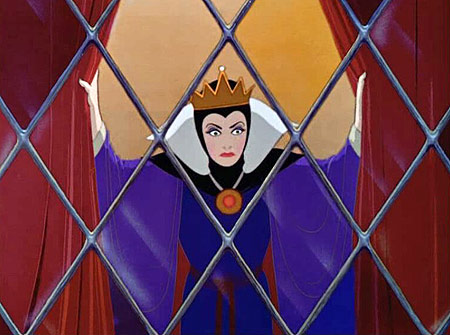
Meanwhile, the villain, the Queen, one of the scariest animated villains of all time (I still can’t watch that transformation scene without shuddering. It’s that part when her hands become all gnarled, and she gasps, “My hands!” It looks painful. It’s genuinely frightening. I grip my own hands every time), isn’t even awarded the agency of a name. She doesn’t have a true back story. She’s just another wicked stepmother. She is obsessed with looks. Because of her, the entire plot is centered around the superficiality of appearance, with the prettiest winning.
But I’m here to set up a defense of the “Fairest” maiden. To rescue her, once again, from people who keep wishing that she was someone else, something else.
First of all, I would like to start this defense with a quick re-reading of the story of Snow White. I believe that much of the animosity against Snow White (and the Queen) emerges when people take an altogether ahistorical look at the story, receiving it not as a retelling of a medieval tale—with all the linguistic and cultural baggage that entails—but as a modern story about a modern woman designed for modern audiences. When viewed from certain contexts, Snow White’s story becomes a complex grapple for power and a bildungsroman of the first quality.
“Fairness.”Fair is a complicated word. At a glance, it means a celebration or gathering of guilds, usually with games or sideshows included for entertainment (think about the lasting tradition of the county fair); pleasant weather (skies are fair today); a sense of justice or rightness based on a sense of honesty (fair dealings, fair trade); goodness in contrast to wickedness (“Fair is foul and foul is fair”); beauty (a maiden most fair).
And whiteness or paleness.
As Camila Domonoske so adeptly points out, “Fair/beautiful/good and black/not beautiful/evil – these aren’t just linguistic quirks. They’re cultural patterns.” The equation of “paleness” with “goodness” or even “justice” is certainly a problematic, pervasive, and persistent problem with standards of beauty in Western culture. It advances the racist assumption that white is right. Those who take issue with the Queen’s repeated use of “fair” to mean “beautiful” certainly have valid arguments. Yet, it is also important to remember that “fair” as a marker of not just beauty, but also power, in fact predates “fair” as equivalent to “white.”
It is no accident that the Wicked Queen asks her mirror, “Who is the fairest of them all?” As many of you already know, paleness was considered a sign of wealth and comfort as far back as the Roman Empire. Those who had financial security could afford to remain inside, shielded from the sun all day, while those whose lack of wealth or influence drove them outdoors to earn their keep were marked by their darker skin, their sunsoaked appearance. The Wicked Queen, in asking her Mirror about her shade and complexion, is not merely confirming her personal beauty, but also her position of power. She is the “fairest” and therefore, the Queen. The ruler. The one whose is rightfully/fairly in charge. The original Grimm tale (on which the 1937 film is loosely based) was published in 1812 (though the Wicked Queen was changed from a mother to a stepmother in a later edition, and this is the version that Disney uses), at a time when physical appearance was considered a reflection of one’s mental acuity (hence, why “fair” came to mean both “light-skinned” and “good” or “right.” Because our language is inseparable from the culture that uses it). The Queen’s pale skin and flawless complexion is just another sign that, though she had married into royalty (she is, after all, Snow White’s stepmother), she is, in fact, in the correct position of power. Her daily affirmation of fairness in front of her mirror must have been a daily confirmation of her position, and alleviation of her imposter syndrome. As a woman, without offspring or biological claim to the throne, the Queen’s grasp on her crown must have been, at best, shaky. The Mirror is a way for her to feel justified in her place, to drive off the doubt that emerged from what must have felt, for her, to be a tenuous rise to power. Just as she could be married into the power she enjoys, so too she can be cast off back into anonymity. By confirming her “fairness,” she is confirming that her unnatural (unbiological) closeness to the throne is merely a fulfillment of her natural (biological) inclinations. She is fair—the fairest—designed for a regal, leisurely life, even if she wasn’t born into one.
Until, that is, Snow White usurps her in the Mirror’s estimation. When Snow White takes over as “fairest,” she is not only surpassing the Queen in terms of looks or physical attractiveness. She is also reminding the Queen that Snow White is, in fact, the future rightful ruler. Snow White’s “fairness” is greater, even, than the Queen’s. She has an even great biological claim to power (reflected not only in her whiter skin, but also in her biological relationship to the King). She is the just—the “fair”—heir apparent. The Mirror telling the Queen that Snow White is “fairer” is a reminder to the Queen that her power begins and ends with her; that Snow White’s biological/natural ascent to the throne will ensure that the Queen will eventually be passed over, forgotten, a fruitless nub on the royal family tree.
The Queen’s initial response to Snow White’s usurpation is interesting. She does not immediately respond with murderous rage. Instead, she forces Snow White to perform chores around the castle, to act as servant in her own house. Doing so, the Queen attempts to reduce Snow White’s fairness. Literally. She sends Snow White outside, and forces her to perform manual labor (in the film, Snow White and Prince Florian meet while she is fetching water and singing to her own reflection in the well). Outside in the sunlight, Snow White won’t become any less the King’s rightful heir, but her appearance will more than likely become more hoary, more haggard, less apparently and obviously royal. If Snow White’s visage can be made to appear less fair, less regal, than at least the Queen would be able to live out her life, convinced of her own natural superiority. Since the Queen would undoubtedly believe that one’s outer appearance is a direct reflection—Ha! Get it? Reflection?—of one’s inner worth and ability, the physically darker Snow White would appear not as naturally suited to her future position of power. She would not be a “natural” queen; just a biological heir. By making Snow White tan, the Queen can maintain the illusion of her ultimate power.
But Snow White never loses her fairness, in spite of her manual labor. This once again irks the Queen, for it proves again that Snow White has the advantage. She is “naturally” more fair than the Queen—nothing can remove her royal destiny.
Yet, the Queen retains a passable, if cool, relationship to Snow White until the day Snow White meets and falls in love with Prince Florian. When the two meet outside the wishing well and fall in love (they share a song together, which is Disney/musical theatre code switching for “romantic/sexual love.” Generally speaking, the big waltz that Disney’s romantic duos share at the end of the movie is their act of sexual consummation—sex without sex on Disney terms), the Queen instantly becomes enraged, calling in the Huntsman and ordering him to murder Snow White. Though some bloggers would have you believe that this is a reaction to a burgeoning love triangle between the Queen, Snow White, and Florian (and there have been rumors that the original script included scenes where the Queen attempts to seduce Florian for herself), I contend that the Queen’s rage can be explained by, again, her uncomfortable, unstable grip on the power she wields. Snow White’s implied impending marriage to Florian is a reminder to the Queen that the time is rapidly approaching when her power will come to an end. Snow White is coming/has come of age. She is marriageable. She can and will inherit her father’s kingdom, have offspring, continue her family line, leaving the aging Queen nothing more than a forgotten dowager, with neither family nor power nor fame. The Queen orders Snow White murdered. Perhaps in order to create heirs of her own with the King. Perhaps to direct all attention on herself for as long as possible. Perhaps because, in her own diseased mind, the young girl’s murder will stave off the steady march of time. It’s hard to say, but it certainly is a power play.
But, then again, all of these complex, overlapping definitions of fair may all be hooey. After all, the Queen is looking into a mirror. A reflective surface designed solely for the perusal of physical attributes. “Who is the fairest of them all” appears to be about looks. Shallow, artificial, try-to-be-pretty-or-else looks. To that, I say that you may have a point. But I am inclined to believe the beauty-complexion-power story for myself. Why? If only because Snow White (and the Queen, for that matter) is not the fairest of them all. Snow White’s a brunette. She has “hair as black as ebony.” Fair when it is used to describe looks, is almost always exclusively used to describe a blonde. Think Princess Aurora (Sleeping Beauty). She’s fair. Snow White and the Queen both have black hair. They would be described as being “dark.” The Oxford English Dictionary notes that “fair,” meaning light complexioned and blonde haired dates back to homilies dating from 1175, and has been used regularly and without break to mean “blonde” ever since (“fair-haired,” meanwhile, has been a compound adjective in use since the 16th century—Meanwhile, artist Claire Hummel claims “Snow White’s time period is pretty easy to pinpoint in 16th century Germany,” a time when “fair” would undoubtedly be used to mean, among other things, blonde). If we take both Snow White and Queen at face-value (oh, the puns just don’t stop on this blog, do they?), then neither one can be considered “fair.” It wouldn’t make any linguistic sense. Both Disney and the Brothers Grimm knew that. Fair, as it is used in Snow White, is not merely a reference to good looks. It is about power, about politics, about whether or not regality can be “natural” or can be adopted. And the Queen’s constant questioning of her own “fairness,” her constant doubt, shows just how complicated her relationship to those concepts is.
Someday My Prince Will Come. (Thank god for Miles Davis. He makes this song at least listenable. Snow White’s warble earns a bigger eyeroll from me than “Stand By Your Man.”)
Now it’s time to address Snow White’s supposed passivity. Hopefully, I’ll be able to do this a little bit more quickly, so that you (and I) can get back to scrolling through Facebook.
Again, I completely understand the arguments that have arisen against Snow White in the last 8 decades. First, she is sent out into the forest with the Huntsman, who warns her about the Queen’s hatred, and tells her to run away forever, intentionally deceiving the Queen (and basically sacrificing his own life) by giving her a pig’s heart instead of Snow White’s. Rescue #1. Then, Snow White is found by the 7 dwarfs, who take her in, care for her, and protect her so that she doesn’t starve to death in the wilderness alone. Rescue #2. The dwarfs, after Snow White is poisoned, chase down the Wicked Queen and push her off a cliff, killing her and ending her reign of terror over Snow White. Rescue #3. Finally, Florian finds Snow White in her glass coffin, and performs his weird, nonconsensual, necrophiliac kiss that just so happens to awaken her so that they can ride off together to Cloud City. Rescue #4.
This chick just can’t seem to take care of herself.
Except that she can and she does.
Firstly, the Huntsman who is ordered to murder Snow White initially objects to the Queen. He kills wild game, not women. But the Queen threatens him with, essentially, death if her orders are not obeyed. Already uncertain about his task, the Huntsman takes Snow White out into the forest, where she picks wild flowers, hums songs, and, finally, helps a baby bird back into the nest. What the makers of Snow White manage to do for the film at this moment is humanize Snow White for the Huntsman and once again prove her natural inclination to rule as a future queen. Seeing her interact with nature, the Huntsman sees how different she is from the wild creatures he kills daily. She appreciates beauty (picking flowers, singing songs). She is gentle (carefully picking up the baby bird). She is bigger and physically superior to the creatures around her, but she does not take advantage of their vulnerabilities like the Queen would (or like the Huntsman does, as we see him kill a pig later). She decides to use her greater strength and size to help those beneath her, demonstrating kindness. A uniquely human trait. In exchange for her gentleness, the woodland creatures gather around her, her now loyal subjects, and help her as she is lost in the woods (and later, in the dwarfs cottage, they help her clean). Seeing all of this, the Huntsman decides to sacrifice himself, not just because she is pretty, but because she is meant to be the ruler of the kingdom, the one-day queen. He warns her to leave the castle “and never return . . . for the sake of not only yourself, but for those who love you.” Even his warning to Snow White suggests that her life needs to be spared not just for her, but for others. Her people. Her kingdom. Though she doesn’t know it (because she couldn’t have known of his intentions to kill her), Snow White proved to the Huntsman that she is the rightful—the fair—future queen.
After being left alone in the forest, Snow White gathers her faithful woodland friends/servants/subjects around her, having gained their trust and loyalty through her acts of mercy and kindness (as any good ruler would). She then comes to the cottage of the 7 dwarfs, where she makes a deal with Doc to manage the entire household in exchange for their protection. Then, she sings the irritating “Whistle While You Work” and the soul-cringing, taking-the-feminist-movement-back-50-years “Someday My Prince Will Come.”
First, let’s talk about cleaning. Yes, cleaning and cooking are “all” Snow White does. They’re her particular talents (outside of singing and training chipmunks to mop). But let’s not underestimate, or undervalue, the incredible skill and resourcefulness Snow White is able to display at this point. She maintains a house of 8, arranging all of the cleaning, the meal preparations, the laundry, keeping the grown men around her on schedule, reminding them of their manners and civility, that they are a part of a community, that they need to work for something outside of themselves. I am a stay-at-home-mother for a family of 4, and I’m barely keeping my head above water most days. Snow White delegates, orders, enforces rules, teaches, and basically domestically kicks ass. That is impressive. That is skill. Genuinely. When we denigrate what Snow White accomplishes at the dwarfs’ cottage. When we rename her accomplishments to make them sound more impressive, more official, more valuable—management, administration, domestic CEO, sous chef, hospitality specialist—what we are really doing is saying that we don’t value the truly valuable work that she and so many other stay-at-home individuals do. Those words are a microaggression against what have traditionally been feminine roles, an attempt to align them with a patriarchal worldview where only those with the biggest titles and fattest paychecks matter. Snow White is domestic. She is a maid. She is a mother figure. She does take on the womanliest of the womanly roles. To claim that adopting these roles (and being good at them) somehow makes her a poor role model for my daughters is not a failure of Snow White’s imagination. It is a failure of ours.
And as for her songs? As irritating as they are, I can’t really find fault with them. “Whistle While You Work” is an excellent lesson for children to have growing up. Even people in their dream jobs have shitty days. I get to wear sweat pants and drink coffee just the way I like it at my job. But that doesn’t mean it doesn’t suck sometimes. We all have to learn to take the good with the bad, and sometimes we have to dig in, elbows deep, into the muck. It’s good to stop and whistle, to remember to be happy for the work itself, or even to distract yourself from the yuck and think happy thoughts every now and then.
(Unless your name is Otis and you’re sitting on a dock, you are not allowed to whistle while you work.)
And as for “Someday My Prince Will Come”? Though it pains me to say it, I can’t even find fault with this. Because Snow White sings this song after she has already met and fallen in love with Prince Florian. She isn’t sighing, passively hoping that some nameless, faceless “Prince” will appear and whisk her away. She’s not just waiting for a man to rescue her. She is fantasizing about her prince, her love, the man she already knows and adores, making good on the implied promise of their song and marrying her. It’s cheesy, but it’s a lovesick fantasy, as so many lovesick fantasies are.
All told, including the Huntsman and Florian, Snow White has no fewer than 9 men gathered around her, helping her and supporting her throughout her story. Like the woodland creatures who also swear loyalty to her, these men are just another example of the natural leadership that Snow White displays throughout her story. When the seven dwarfs go after the Wicked Queen, they are essentially Snow White’s army, chasing down the aggressor who would dare to attack their princess. They all (with the exception of Florian, the creepy dead-girl-kiss-stealer) risk their lives for the sake of Snow White. True, much of this loyalty may be due to misguided sexual feelings or some masculine show of virtue (and we can see this playing out in comical ways with Dopey and his repeated requests for kisses), but there is also a sacred, reverential side to the loyalty these men display. The Huntsman kneels before Snow White and wipes his tears on the hem of her gown. The Dwarfs use their precious gold and jewels to construct a beautiful shrine to the sleeping/dead Princess, and gather around it in mourning. Snow White is somehow above them, even though she “only” cleans and cooks, “merely” acts kindly to small creatures.
Snow White is, truly, a domestic goddess. One that is worthy of praise.
The other day, I started thinking about love. I hosted a Valentine’s dinner party at my house, and I created a centerpiece with little, hand-stitched felt hearts, surrounding a vase with branches and a single, hanging heart. I thought about how trees have been used for years as an analogy for love. The Giving Tree, The Runaway Bunny, and one of my favorite quotes about unrequited love, from poet H.D.:
If I could break you
I could break a tree.
If I could stir
I could break a tree—
I could break you. (“Garden”)
“I will be a tree that you come home to.”
Maybe I’m still just a girl, living on 12 acres in Michigan’s north woods, running across the apple orchard towards the damp mystery of the forest, but, for me, love has always been like a tree. Nothing appears, on the surface, to be so solid, so strong, so independent. But it isn’t. A tree is an ecosystem, a world unto itself that both creates and is created by life and energy entirely separate from itself, entirely out of its control.
A tree, like love, only achieves its strength from the community that surrounds it.
The rain that washes away its fallen, dead leaves and replenishes its soil.
The sun that encourages its branches to bend and lift towards its smiling visage.
The birds who roost inside it, clearing away the dead branches to make their fledglings a home.
The wind that sends its seeds out into the world.
Like a tree, love does not flourish in isolation. It can’t survive without a community around it, surrounding it, supporting it, sometimes assaulting it with storms and conflict, but ultimately giving it the space to flourish, to grow, to dig deeply into the soil, and reach high into the sky.
Decorating for my party, I remembered suddenly a story about the first moment I realized I was in love with the man who would one day become my husband. And how even that intense, deeply intimate moment didn’t occur without a community, without support from outside, helping that first, small sapling to sprout.
I was dating my college boyfriend when I met my future husband. I was temping in my future husband’s department for the summer, taking over for a secretary who was out for three months recovering from carpal tunnel surgery. He sat in the cubicle behind mine. My then-boyfriend worked downstairs in the parts department. A friendship blossomed between us. Soon, I was spending every break, every lunch hour, with my new cubicle-mate. One day, while we were chatting about movies, he mentioned how much he loved Mall Rats.
“Me too! Hey, why don’t I come over tonight, and we’ll watch it at your place?”
My new friend was shy, introverted around girls, but he agreed to me coming over, splitting a pizza, and watching the movie in exchange for a ride to the shop where his car was being worked on.
Honestly, readers? My intentions were not entirely pure. But he was one of my best friends at this point. And something was drawing me to him. I tried. Really. I couldn’t keep myself away. There was a physical attraction, certainly. But also something more. His quiet smile spoke to me. His steadiness calmed my mania. I felt the most me around him, but also felt the genuine desire to be better than me. I had to be near him.
Still, I tried to justify our plans. If he was a girl, I reasoned with myself, there wouldn’t even be an issue. Of course we’d watch a movie together. Of course. There’s nothing for me to feel bad about. Of course.
I told my then-boyfriend that I had made plans, being a little too vague in the details, and I went to my friend’s house.
We talked for 6 hours. At one point, I looked up and realized that I couldn’t see his face anymore. We had been so engrossed in our conversation, neither one of us had noticed that the sun had set. That we needed to turn on a light.
We never watched the movie.
Or ordered a pizza.
I got back to the basement I shared with my boyfriend around midnight. The next morning, he very gently confronted me about my late night. Feeling guilty, I asked him if he would let me pursue the friendship I had started. Would he give me the space I wanted, so I could see my new friend more frequently?
“Of course,” my boyfriend said. “I would never tell you you couldn’t see your friends.”
I smiled as I thanked him.
He paused, and looked at me. I’ll never forget the thoughtful, careful way he said, “You know, that’s the first real smile I’ve seen you smile in months.”
It was at that moment I realized it: I was in love with my friend.
About a week later, I officially broke it off with my college boyfriend. Always kind and thoughtful, he let me rent my half of the basement for the rest of the summer (though I didn’t stay. I moved out before the next semester started. Two months after that, I was living with my future husband). He bore me no ill will, to the point of inviting me (and my new boyfriend) over to his apartment to celebrate his roommate and best friend’s 21st birthday.
Without my college boyfriend’s permission, I may never have given the small sapling that was my love a chance to grow. Or I may have realized its strength and determination too late, after it had already sprouted, and was steadily and painfully choking out my old relationship. Or, worse yet, I may have given in, dug up the small sprout, and tried desperately to cultivate it in a dark, secret corner, away from the sunlight. A joy that would give me equal parts secret pleasure and pain.
Or maybe I’m just torturing a metaphor.
My point is that love isn’t all you need.
My apologies to the Beatles.
You also need timing, support, encouragement, energy, inclination, work ethic, compatibility.
You need a whole ecosystem, working together. Like my college romance, an ecosystem includes dozens of tiny deaths—or even ground-shaking devastation. Fires, lightning strikes, earthquakes, floods. But if the ground remains fruitful, the forest will recover. Will grow again, or grow into something new. Something better.
So, thank you, college boyfriend. Thank you for making me realize the truth, and giving me the courage to pursue it. You are part of my love community. I hope you realize that.
I’m sure your gorgeous wife and three lovely children thank you, too.
You’re doing great. Really. Your baby adores you. You are as much the center of his universe as he is yours. I know. I saw that look he gave you yesterday. That one of complete trust. The one of complete love (funny how they just seem to know what love is, even when they have no real way of knowing, right?). The one that sighed with contentment, “Mommy’s here.”
And that’s what you told him, too. “Mommy’s here.”
His relief and your comfort are the same, you see.
You’re doing a great job, because you’re there. Unshowered, falling asleep mid-sentence, wafting the faintest odor of milk wherever you go, but present. Here.
When he’s crying at night, in spite of your exhaustion, you’re there.
When he needs to nurse yet again, giving you no time for a meal yourself, you’re there.
When you suspect he’s feeling warm. When his cry sounds different. When he needs to take his vitamins or his gripe water, you’re there.
And that’s excrutiating sometimes. It really is. Nobody blames you when you stare at your partner, shaking your head in delirious disbelief, “Did we just irrevocably screw up our lives? Did we just make a huge mistake? What were we thinking? Why were we wanting this? We were praying for this!”
But trust me, soon you’ll laugh about those thoughts and fears. Because you won’t remember him not being here. Or rather, you will, but it will seem empty, incomplete. You won’t remember not being needed. Not being there.
“Mommy’s here.”
Everything is going to be great. Because he knows already that mommy will be there. And because you know that nothing will ever keep you away.
So when you start to feel guilty. When you feel like you haven’t done enough (or anything at all). When you’ve snapped at your spouse, your friends, the UPS guy, well-meaning relatives. When you even start to snap at him, finally bursting out, “What do you want? What could you possibly want??” Don’t feel like a failure. You’re not. Because you’re there.
Yes, I know that Christmas has come and gone. All but a few stubbornly jolly—or just downright lazy—individuals have taken down the decorations, put the furniture back in the living room, and reclaimed their homes from the seemingly endless Christmas season. It seems unfair of me to rifle through my pictures, unpacking all of the merriment again, just as everyone was feeling a return to routine and normalcy.
But, hey, it’s my blog.
So here are some of the handmade Christmas presents I created this holiday season. If you like what you see here, don’t be afraid to place an order now for next Christmas! (Because that’s probably how long it will take me to fill it…)
Weaving, Weaving, Weaving
One of my goals this winter has been to return to my weaving with gusto. I’ve missed the beautiful simplicity of my rigid heddle loom. The regular and predictable over-under of a plain weave. The way that white-on-white weaving never seems to disappoint. It’s a very fulfilling pastime, and because it’s a little bit of a strange hobby (how many people in their early 30s do you know who own and operate their own looms?), people really seem to appreciate woven gifts.
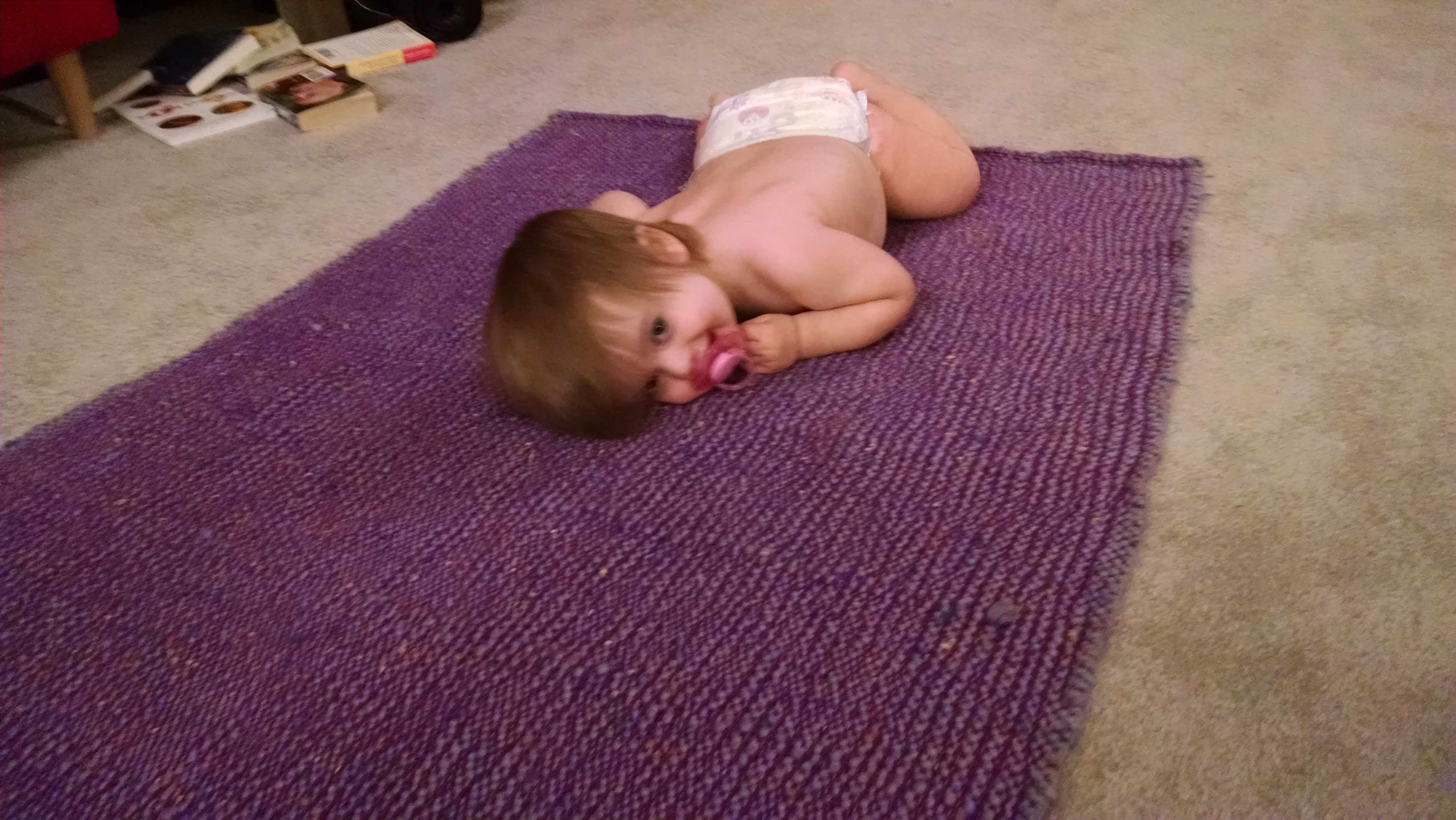
I started this past fall with a purple blanket.
100% Acrylic, 30″x 48″ finished.
I have to admit, I began with the full intention of donating this blanket to my daughters’ new preschool for their annual fundraiser. However, as I was hemming it, Honest Baby toddled in, felt the soft fabric, and immediately fell in love.
Sorry, St. Marks. This blanket belongs to my girl now. I promise I’ll make something for next year!
So the purple blanket immediately became a Christmas gift for my baby girl. Oops. Philanthropy was run over by maternity.
Right around Thanksgiving, I started on a project to make a couple of simple table runners for girlfriends of mine who had been helping me out with babysitting while I was finishing my dissertation.
This was a truly fun project, as I got to weave with 100% cotton in a really tight weave (I’m an aggressive weaver, so I like projects that require high warp tension and hard beating—that’s what it’s called when you squish the horizontal strings down together).
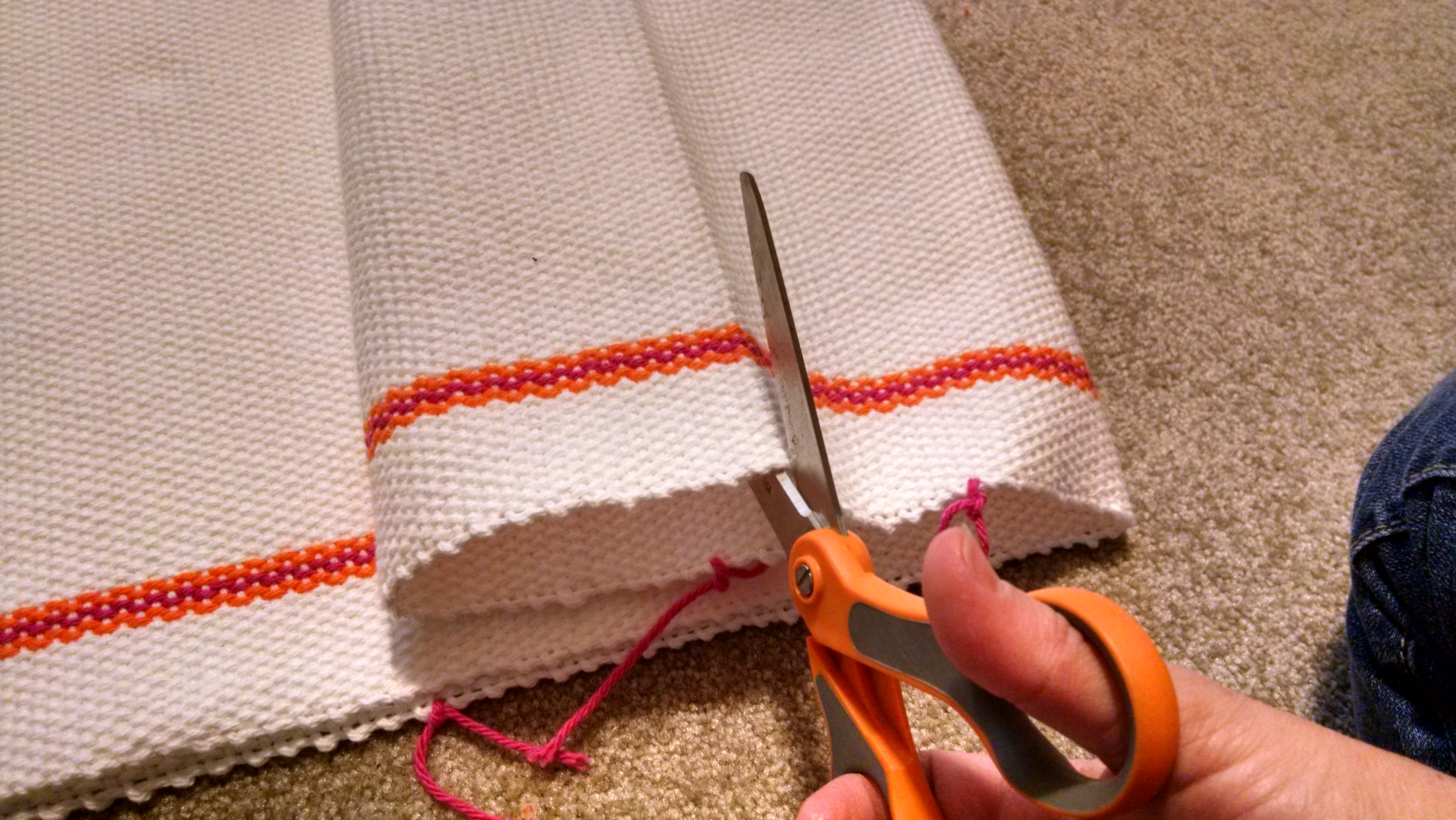
This was also the first time that I took the plunge and cut my fabric in half to make two equal sized table runners.
The first cut is the freakiest!
You don’t know terror until you take scissors to the thing you had just created! It worked perfectly, however (not entirely square, but I’ll do better next time!). I have to keep reminding myself that weaving doesn’t make strategically webbed yarn. It makes cloth. Cloth that can be cut, sewn, shaped, and turned into anything at all, just like every other fabric I’ve ever used.
The result was two table runners, each 3′ long.
Finally, I wove a turquoise blue wall hanging for my mother-in-law. She loves the beach, and has been looking for something to put in her hallway that reminded her of the ocean. This is 50% cotton, 50% acrylic.
You can see in the side-by-side shot that, though it was woven to the same measurements as Honest Baby’s purple blanket (30”x 48”), after being washed (or what weavers call “wet finishing”—just a fancy name for throwing it in the washing machine to make the fibers tighten up and bind together) it lost about 10% in both length and width.
I am in love with the turquoise cotton on the warp (vertical strands). It turned out bright and beautiful.
Also, because it was intended as a wall hanging, I made the hems a little thicker, so that her wall clamps had a good, heavy hem to hold on to. I was terrified that she wouldn’t like it (if Honest Husband is a Crafting Fascist, my mother-in-law is Mussolini!), but when I showed it to her this last week she couldn’t stop gushing about it (I had to specially order the warp yarn, so it didn’t even arrive at my house until after Christmas Day). Maybe it was all just a show for my sake, but I’ll take what I can get!
Glass Seahorse
Over Labor Day weekend, I was walking through an art fair held every year in my childhood home, Harrisville, Michigan. There, I saw a booth filled with canvases of pictures made from sea glass.
I stole the idea. Shamelessly.
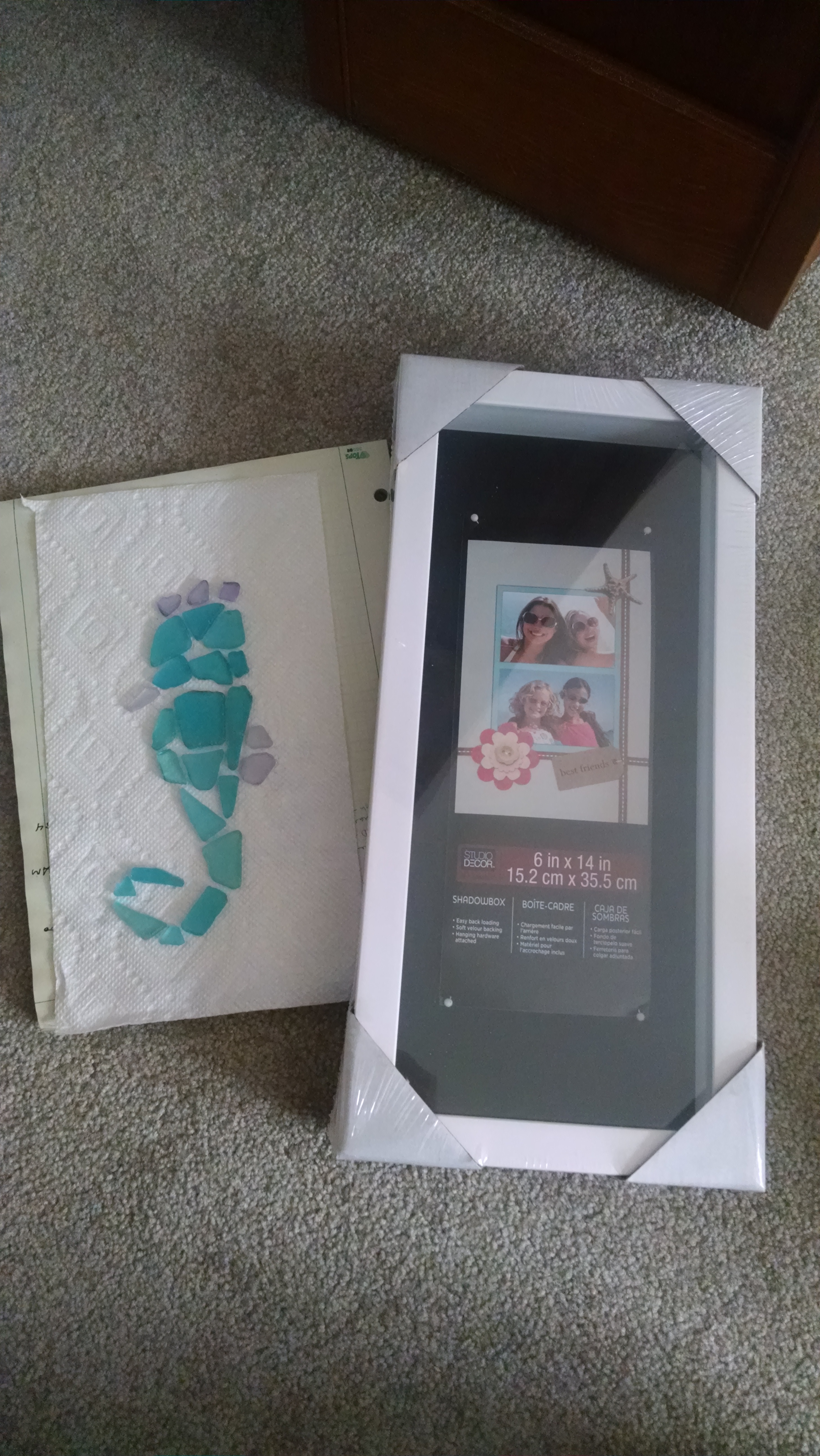
Like I said, my mother-in-law loves the sea. I decided to make something beachy for her out of sea glass. I started by buying a pound of mosaic “sea glass” from a local crafting supply store (everyone asked me where I found the sea glass, but it’s really just etched mosaic glass in pale blues and greens. I found it pretty easily once I started looking for it, honestly, and those one-pound variety packs have enough shapes and variations that you can make just about anything). After fooling around for a bit (and having to Google what seahorses look like), I came up with a pattern.
Then, I went back to the same crafting supply store, and bought a small shadowbox.
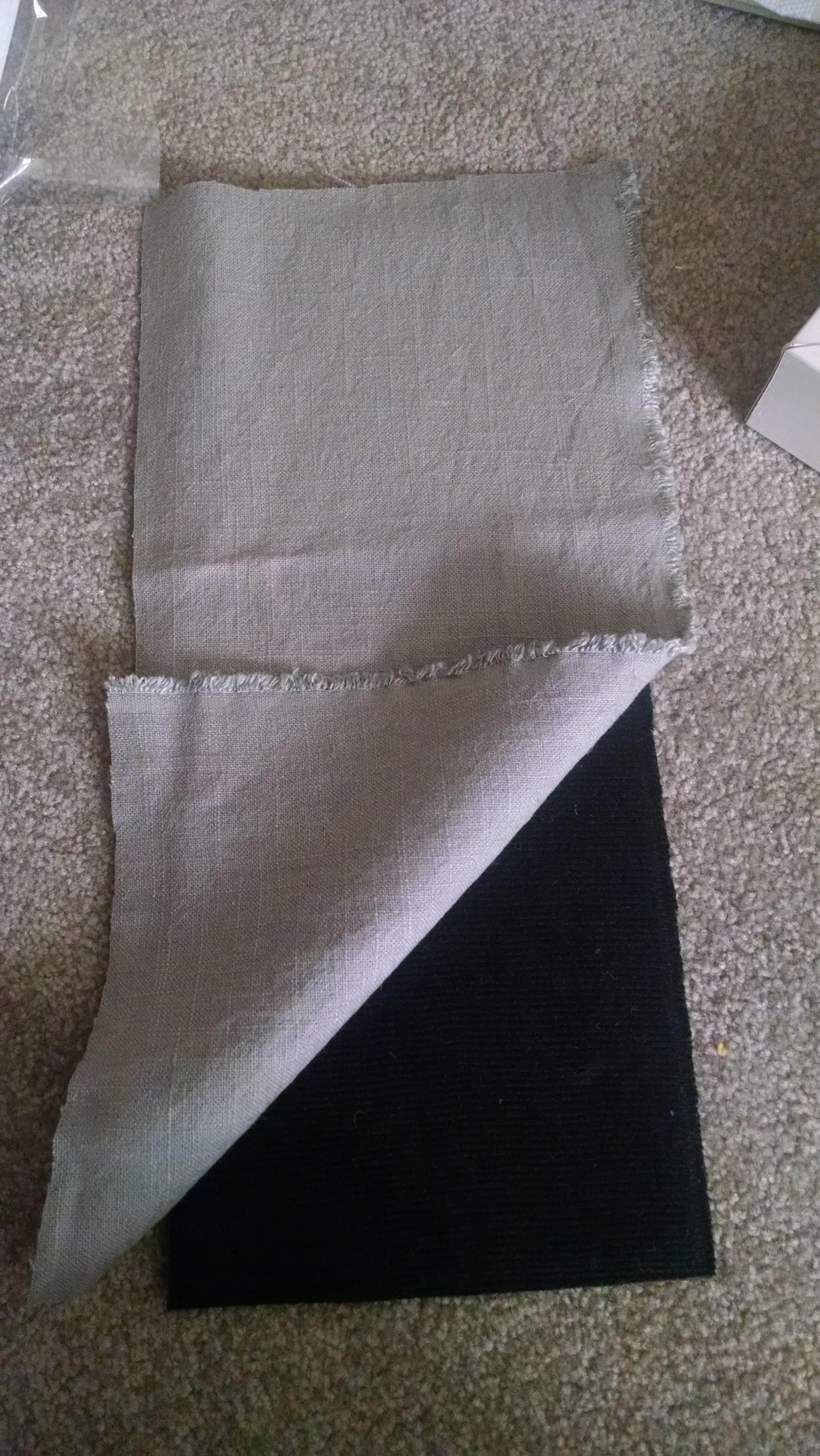
Only problem was, the fabric backing was black. So I used a little iron on Stitch Witch (LOVE that stuff!), and made it a lovely grey instead.
After that, it was just a matter of hot gluing and mounting it.
My seahorse got a little chubby in the process, and I don’t like that you can see the shadow of the glue underneath the glass, but I think that this was a very successful project, especially in terms of cost and time. It was pretty easy and fast. About two hours total, and most of that was because I realized halfway through the design stage that I didn’t know what seahorses looked like!
Name Magnets
These were the last-minutest of the last minute gifts.
December 23rd, 6:30pm. My husband comes home from work, and we start talking about the plans for Christmas Day.
“So, you’re getting Josie a gift certificate?”
“Uh huh. Just have to get it printed off!”
“And what for Carlee and Nate?”
“—Carlee and Nate?”
“Yeah. We have to get them something.”
Silence.
“You didn’t know they were coming?”
“Oh, sweet baby Jesus.”
“Exactly.”
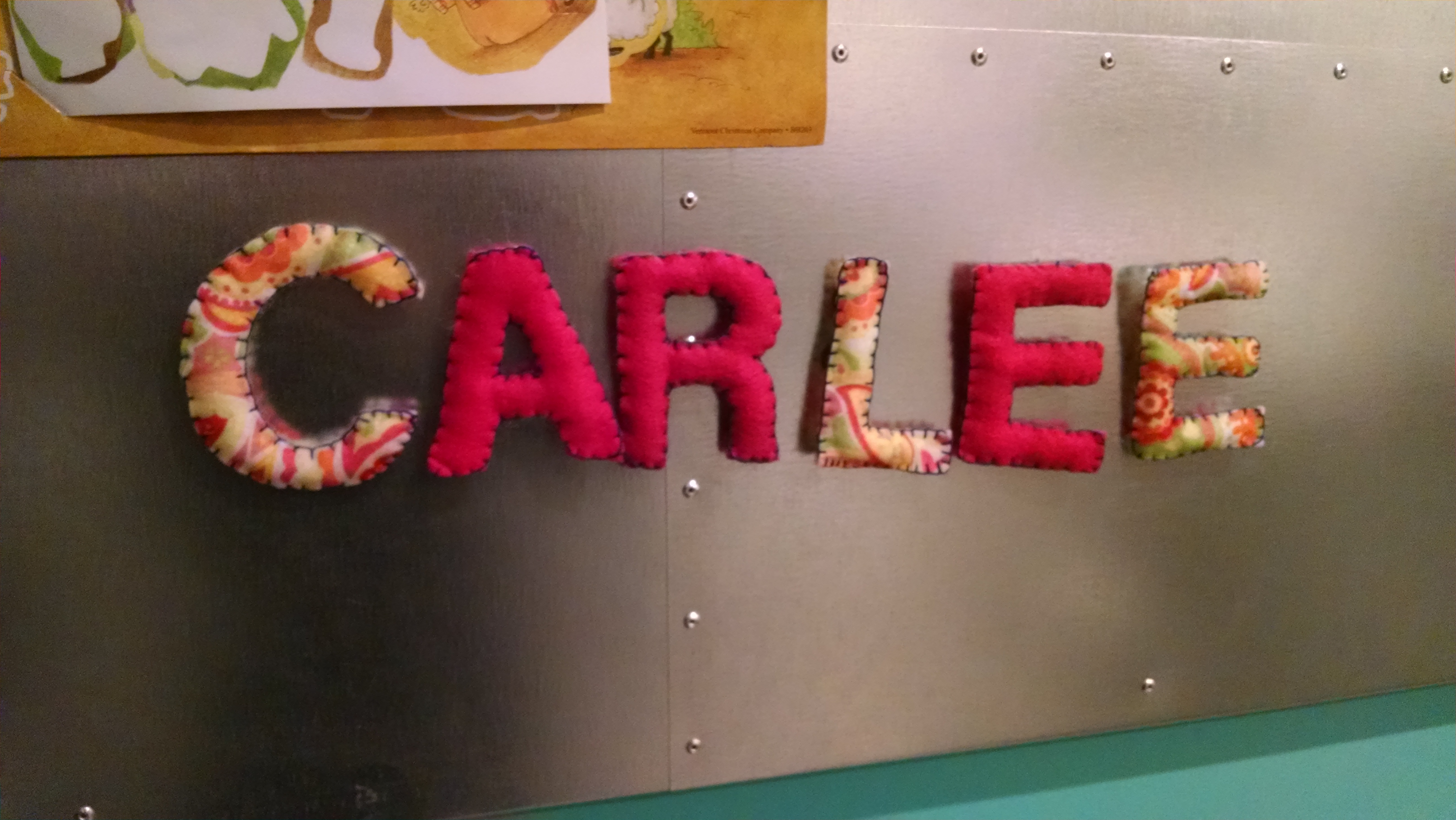
I had no time. But I had a whole bunch of felt. And some vinyl letter stickers. And poly-fill. And a pack of magnets. And a hot glue gun.
I could totally figure this out.
This has not been staged. This is just what my work table looks like right now at this very moment.
First, I placed a vinyl sticker on a paper index card and cut it out to give it some stiffness. That was my letter pattern.
Next, I traced each letter onto a piece of felt with disappearing fabric pen.
Then, I cut out two of each letter, selected which one would be the “back” and which the “front,” and glued a bunch of magnets to the back of the “back” side.
Then, I took about 3 strands of embroidery floss in a contrasting color (I just have a large multi-pack that I keep around for doing hems, little personalizations, embroidery on crocheted pieces, things like that. It’s pretty cheap, and it has been a lifesaver on more than one occasion!), and did a box stitch around the outside of each letter, carefully stuffing them with a little bit of poly-fill along the way to give each letter a pillow effect.
And voila! Over the course of a few hours, I had personalized Christmas gifts that were bright, fun, a little bit educational, and that I could make while also watching A Muppet Christmas Carol with my girls.
Score!
Please know, I did not come up with the felt magnet letters all by myself. I stole this idea as well, dear reader. For more detailed instructions and ideas, check out Hello Bee’s DIY Magnetic Felt ABCs. They also have much prettier pictures than I do.
All told, I’m pleased with the amount of Christmas crafting I was able to do this season while also finishing up my PhD and dissertation. Who knows? Maybe next year, I’ll be able to do even more! (But don’t count on it.)
Hope that you and yours had the happiest of holidays!
I’m a weaver. I received my first loom when I was 14. It was a Christmas gift from my Dedo, an artist in his own right who whittled figures out of soft blocks of wood and created stained glass pictures. The loom was a 10″ wide lap loom, capable of only plain weave (think about the over-under crisscross of a cherry pie). I loved that loom. I made dozens of scarves and table runners, belts and sashes. Every birthday party, every Christmas, I wove presents. When I was 17, instead of spending my final days of summer vacation going for long drives with friends and trying desperately to get Jason Gauthier to kiss me, I went to a weaving conference hosted by Harrisville Designs. I took classes on weaving rag rugs, spinning wool, and the basics of tweed weaving, all against the backdrop of New Hampshire in late summer. That trip was only me and my parents. Dad and I, our ears trained from musical theatre, picked up on the New England dialect almost immediately, much to my mother’s embarrassment, and we giggled uproariously at the locals who stared in confusion when we ordered “lobstah” and told them that we were from Harrisville too. Born and bred. Harrisville, Michigan, that is.
For some reason, that joke never got old.
I remember taking my wool spinning class, trying to take the soft wool fluff and turn it into usable yarn. But I couldn’t keep the rhythm of the spinning wheel going. I would forget how much pressure I was using to pass the wool through my fingers, leaving lumps and thin spots, compromising the integrity and strength of the finished product. Several times, I would get distracted, more interested in the view of the water mill and the old colonial brick outside the window than in the yarn. My fingers would slip, and the entire strand would spin madly, curling and bunching up in a tangled mess. I could never create more than a few yards of wool at a time, perhaps enough to crochet a coaster, but not nearly enough to place on a loom.
Lamenting my inability to make anything beautiful (especially when every other aspect of weaving had always come naturally to me), I became frustrated, angry at the impossibly knotted clump in front of me. My spinning instructor would come over, deftly untangle my wheel, and smile at me. “It doesn’t have to look good. It doesn’t even matter what it looks like on the cone. The goal isn’t to make a beautiful cone, but a beautiful weaving.”
I was too embarrassed to take any of my handmade yarn home. I didn’t want to make a weaving out of it. I didn’t want anyone to see it. I left all of it there. I told my instructor to give it to the school children who took tours there every fall.
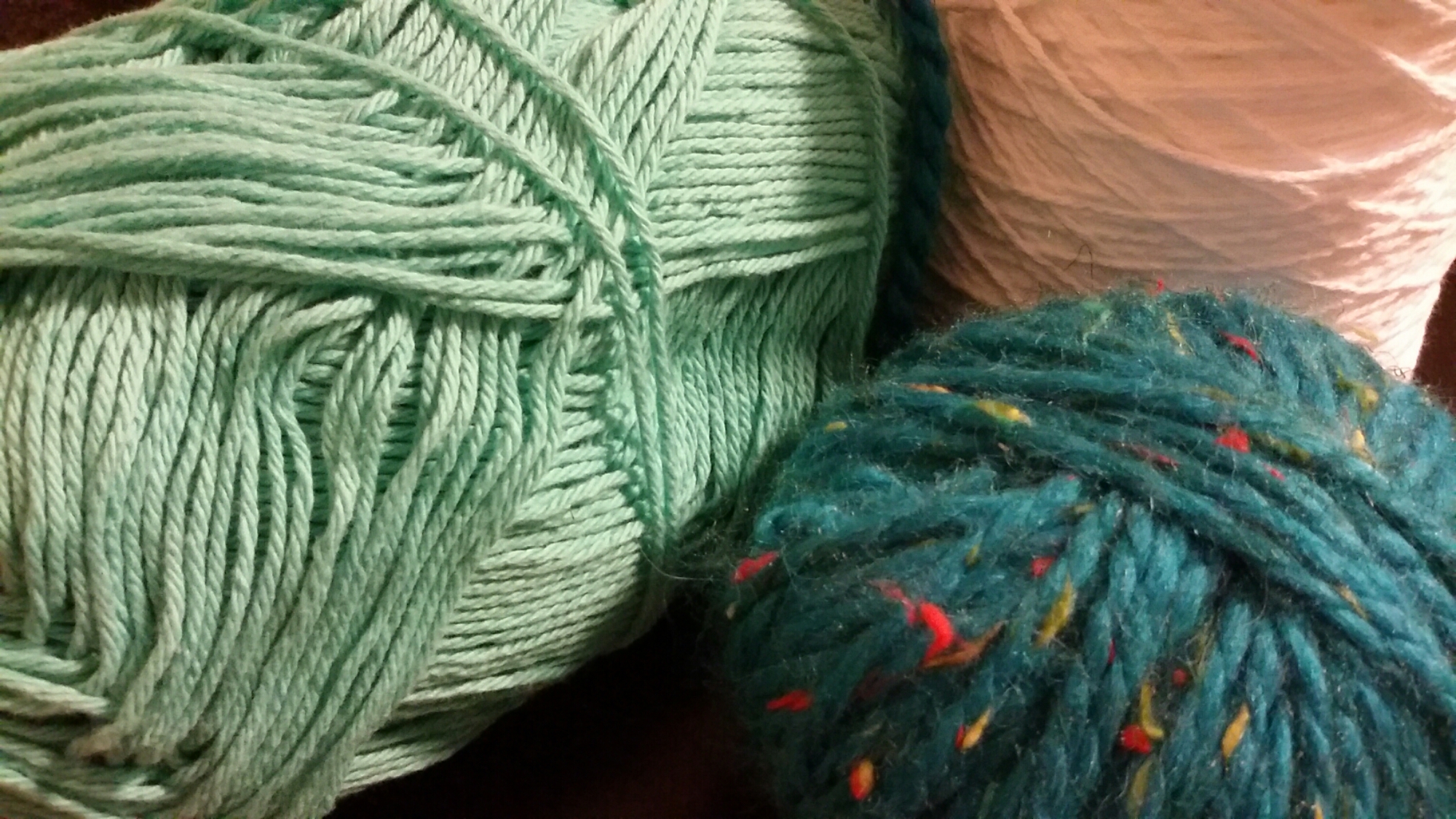
This past Christmas, while setting up my rigid heddle loom (making Christmas presents once again), I was reminded of my spinning class. I was using a large skein of yarn to warp my loom (Weavers often prefer to use cones of yarn instead of skeins, but with limited resources locally, I grabbed what I had available and just worked with it), and the whole roll was bunching, knotting, catching. Frustrated, I shouted at the skein, “Your only job is to unravel! You were made to unravel!”
I stopped.
You were made to unravel.
I’ve been thinking a lot about unraveling recently. Just off the top of my head, I can think of four girlfriends whose lives have been changed forever by a recent diagnosis of a chronic illness. Young women. In their early 30s. And their bodies are starting to fail them. There is no hope for a “cure,” just the resignation of good days mingling with the bad–days when they can play with their sons, or sing a libretto, or walk along a rocky coastline with their beloved dogs and spouse butting up against days of complete stagnation, bed rest, takeout dinners, and pain pills.
So, so many pain pills.
They feel as though they are unraveling.
And I can only watch.
It’s been hard to watch them go through these things. Hard to see them vacillate between appreciation for the good days, and crippling despair over the seeming unending bad days. Hard to see them feel bitter, cheated out of their youth, their careers, their schooling, their families, their futures. Hard to see them learn how to renegotiate the world while trapped in a body that is slowly (or quickly) losing the ability to physically experience that world.
As usual, I am no good in these kinds of serious situations. I crack dirty jokes. I tell poop stories. I change the topic. I start giggling. I defer and deflect. But then, I started working on my loom, and I shouted at a knotted clump of cotton, and I realized something:
Sometimes, beauty only comes after the unraveling.
Sometimes, we think that we are “complete” when we’re really just the raw material.
We get too caught up on being a beautiful cone, or a beautiful skein. Or a beautiful paintbrush, or a lovely pencil, or a freshly filled inkwell.
And we forget that none of us were born in a body that is complete. We are all just giant messes of potential. We’re not finished yet.
Only in the unraveling can we be made into something amazing. Only in the thinning out, spreading, scraping, chiseling, breaking down, cutting, and slicing can we metamorphose into, well, something.
Something messy.
Something broken.
Something uneven.
Something filled with flaws.
Shaped by an inelegant hand.
But something.
Because what is a cone of yarn? It is the illusion of completeness. It loves the potential of its potential. But it is nothing until it is stripped bare, rendered naked and searching, pulled taut. Remade.
Of course, the sad truth of it is that the unraveling is the easy part. The hard part is in the reassembly, the (re)creation. Making a self is no different from making art. It is painstaking, frustrating, infuriating. It keeps you up at night, embarrasses you, shames you. It makes you feel unstoppable one moment, and like a fool the next. And that’s just how it is for those of us fortunate enough to be working with undamaged tools.
But even a broken brush can paint a masterpiece.
A stub of a pencil can still write a poem.
Uneven yarn can weave tapestry.
It just takes a more patient hand.
My dear friends, you are the ones with the talent, vision, ability, intellect, and perseverance to create art, even on your imperfect canvases.
My wish for you in 2015 is not for perfect health. (I’m sorry. As much as I want it for you, I fear that would be just an empty hope.) My wish is that you will understand the potential you have in the unraveling, and that you start to make something new with your own clumsy, inexperienced, ill-prepared, broken, perfect hands.
M.L., R.S.T., M.W.U., N.W.– This post is for you. All of you are strong women made even stronger for the weaknesses you admit. I look forward to watching you kick this new year’s ass.









![20150109_150510[1]](https://thebrutallyhonestmom.com/wp-content/uploads/2015/01/20150109_1505101.jpg)




![IMG_20141225_105018938[1]](https://thebrutallyhonestmom.com/wp-content/uploads/2015/01/img_20141225_1050189381.jpg)
![IMG_20141225_104956845[1]](https://thebrutallyhonestmom.com/wp-content/uploads/2015/01/img_20141225_1049568451.jpg)

 Honest to a Fault