Every year, after the holidays begin to wind down, I suddenly become aware of just how much shit my children have. Not being particularly sentimental about toys myself, I instantly get to work on what I like to call the “purge.” Though my oldest is not quite 3 years old, I’ve already noticed a pattern to my annual (sometimes biannual) purge. Below, I give all of my stressed out parenting friends, buried and suffocating underneath mountains of kid crap, step-by-step instructions for how to de-clutter and take back your home from the children, assert your dominance over your domain.

This is about empowerment, people.

And wine. Lots and lots of wine.

1. While the small ones are sleeping, carefully go through and sort their toys into several piles. One for broken, cheap, and/or novelty toys that can be instantly discarded. One for toys in good shape that have not been touched in weeks. Another pile for popular, nice toys that are in good shape. Yet another for broken yet popular toys. At this time of year, you may also have a pile of unopened toys or repeat toys. Decide if those can be exchanged, or should be donated, regifted, or placed in the attic for last-minute birthday presents later in the year.

2. Discard all broken and/or McDonald’s Happy Meal toys. Do this immediately, without thinking about it. Make sure to pile newspapers or coffee grounds on top, to obscure any view of the toys that the toddler might notice in the bottom of the trash. Be double and triple certain that not a single molecule of the toys can be seen by the naked eye. It’s best to not even keep the bag in the house. In fact, just take the trash outside and burn it in the street.

3. Box up any toys still in good, relatively unused shape, and set them in the guest room closet, ready to be shipped to your local charity. Pro Tip: Take pictures of the contents of any boxes you donate so that you can accurately inventory your donations on your tax return without going through the hassle of actually indexing everything you give away.

4. Place all popular toys back in the play area.

5. Put any broken or ripped popular toys on a shelf. Somewhere out of reach for the children but conspicuous enough that you will see them and be reminded to repair them in a timely manner. They will now stay there until the children graduate college.

6. Survey all that you have accomplished, and open a bottle of wine to congratulate yourself. Begin contemplating a minimalist lifestyle. 100 possessions? You mean I’d still have to find 100?? P-shaw. Surely you jest. Bet I could do 85. 80, if I’m pushing it.

7. Realize that you can see your floor for the first time in a month. Pour another glass of wine. You so rock at this.

8. Toddler awakens, runs to playroom, and immediately asks where her penguin is. You freeze. The penguin…? The penguin that she got in her Happy Meal last month. The Happy Meal that her Papaw bought her that night she stayed with them. The penguin that was his special gift to her, and he gave her after she ate all her chicken nuggets. The penguin that was her prize for being his big girl. The penguin that means more to her than anything else ever in the entire world. Where is her penguin??

9. Send spouse to McDonald’s for Happy Meals, hoping to distract her with new crappy, plastic shit.

10. It works.

11. Pour more wine.

12. After two weeks, notice your toddler playing in the guest room. She finds the box of forgotten toys in the closet. Because of course they haven’t been donated yet. You’re not done yet. You still have to go through their rooms, their closets. Maybe even the kitchen. The purge isn’t finished yet. Nothing has happened since that first night. But you have plans. Big plans. Huge.

13. Watch your toddler have ALL THE FEELINGS about toys she hasn’t missed in two whole weeks.

14. Weakly protest as she unpacks the entire box.

15. Dutifully carry entire contents of the box upstairs to her room, and help her arrange the toys on her bed, strategically placed so she can cuddle them all throughout the night.

16. Open more wine. Pour a glass.

17. Hear toddler come back from arranging her now “favorite” toys on her bed, and ask you where Papaw’s penguin is. She can’t find it anywhere!

18. Start drinking straight from the bottle.
This week, I defended my dissertation at Ball State University. After seven years in a PhD program, I am finally Dr. Rachel. I honestly wouldn’t have been able to complete this project without some serious help from people I love. The joke of the academic dissertation has always been the Acknowledgments page. “Not even your committee reads it!” So the saying goes. A depressing prospect, especially since (as another joke goes), the odds of every member of your committee reading your entire dissertation are slim.

But this changes today. Below, I am publishing my Acknowledgments page, as it appears in my dissertation (names have been redacted). There are more people responsible for my degree than I even mention here, but I want to make sure that the people I love, who are primarily responsible for me finishing (and for maintaining my sanity throughout the finishing process), get at least some of the meager accolades they deserve. I love you all.

And to those whose names are missing from this list, including all of my readers here: Thank You. You have allowed me to continue this, my creative outlet, which has been essential for reminding me why I do what I do. Your readership and your responses. They have sustained me. They truly have.

Acknowledgments

I owe the completion of this dissertation to many people. Firstly, my incredible committee, who fought alongside (and with) me throughout this process to make this work a true showcase of my theoretical and academic ability. I am especially grateful to my directors, Dr. M and Dr. C. You gave me tough love when I needed it, and showed me support and encouragement even when I didn’t deserve it. Coffee, pastries, gossip, hard questions, mixed tapes, and Dylan lyrics. These are the things I will carry with me from our time together.  And I will cherish them.

My parents, R and C. I told you at the age of seven that I wanted to get my PhD, and you have since taken it as a given that I would one day succeed.  You are eternally on my side.  Mom, you showed me as a lived example what a feminist is, and what a working mother could accomplish.  You taught me to never be afraid.  Dad, you gave me poetry, and taught me how to gaze at the stars.  Both of you taught me that passion and beauty are only as valuable as the hard work I put into them.  Thank you for that.

My siblings, M and M. You taught me how to be myself, and to laugh at myself.  That laughter is why I succeed.

My in-laws, B and S.  I will never forget your generosity, and the example you have set for my family for hard work and self-reliance.  I’m proud to be “the doctor” in the family.  I’m proud to be your family.

B, my husband, you have listened with unending patience to my rants, my ideas, my heartbreaks, my accomplishments. You have taught me to never know quit.  You have given even my wildest ideas careful consideration.  You gave me a plan when I had none.  You have pushed me, held me, dragged me, supported me, watched me weep.  And, somehow, you still seem to like me a whole lot.  You once told me that you wanted to make me smile every day for the rest of my life. Eleven years in, and you haven’t missed a day yet.  Thank you for being my partner.  I choose you. Every day. For forever.

Finally, my girls.

If anyone asks, I did this for me.

But, really?  I did this for you, dear S and M.

All for you.

To the moon and back. To the Sun and back.  To the stars and back

It was 11 o’clock, the night before Thanksgiving, and I realized that I had forgotten the spinach for my spinach artichoke dip. My husband and I were frantically straightening up the house, preparing for the steady march of friends and family who were coming by for some TV, naps, and dessert after their turkey.

My husband, eager for bed, shrugged, “Just go in the morning. We’re a mile away from a grocery store. Kroger will be open tomorrow, right?”

“Oh, absolutely. They could never close on Thanksgiving.”

“Funny how you never hear anyone get up in arms about grocery store clerks working on Thanksgiving.” He shot me a wry look over his glasses. I just grinned back.


At 7am, Thanksgiving morning, I drove over to Kroger and picked up spinach, paper towels, and a big bag of ice. Bleary eyed workers were stocking fresh produce. One young bagger was loudly cracking jokes about the early hour with the cute girl at the customer service desk. A couple in the liquor section, buying a few bottles of wine, smiled and shared a private joke about their relatives. Everyone greeted me with a “Happy Thanksgiving!”

As I checked out, I remembered my husband’s words from the night before. I looked up at the cashier.

“Thank you for working today. I really appreciate it!”

She was a middle-aged woman, wearing way too much blush and way too many rings. But she smiled at me. “Oh, it’s no problem. My family’s cooking right now, and we’ll all be together later. The turkey will be there waiting for me!”

I nodded.

The turkey will wait.

No matter how hard I try, I just can’t ignite any rage in myself over Black Friday, or the injustice of people being “forced” to work over the holidays. I have studied Marxism. I understand the flaws of our capitalist system. I am aware of the abuses. The unfairness. The injustice. The horrors. I know that Black Friday “deals” are predatory, and that many minimum wage workers don’t have the financial option of missing a day of work.

But then I remember, The turkey will wait.

Because it’s not the day that matters. It’s not that the last Thursday in every November is somehow more magical than the last Friday. Or the first Saturday. Or June 22nd. Or any evening at any time throughout the year when you can gather the family of your choosing around you.

Because you don’t need to wait for a holiday to tell your husband why you’re thankful for him. He’s already sitting across from you.

Because sometimes you have to work when you’d rather be doing something else. But there is nothing to keep you from doing what you love with whom you love.

Because sometimes you have to make your own holiday.

The turkey will wait.

Growing up, my family owned a small, one-screen movie theatre in my hometown. All summer long, I worked nights and weekends, and during the day I would open the empty theatre, and clean and stock it in preparation for that night. All of my friends also worked in the service industry (though back then we just called it “being a busboy/waiter/caddy/boat hand”). We all had essentially the same hours, so it wasn’t a big deal. I never knew that I was missing out on anything.

But every Halloween, we would open the theatre, make a huge batch of popcorn, and hand out candy to trick-or-treaters and free, hot popcorn and small Cokes to their chilly parents. I worked every Halloween night starting around the age of ten. Truth be told, growing up in Northern Michigan, I wasn’t a big fan of walking around at night, often in snow and sleet, and begging for candy. My cousin and I would give up early almost every year as small children, and we’d sit in the show and watch our parents sip Coca Cola, laugh and talk with the parents, and ruffle the hair of all of the children who came through. Eventually, my cousin started joining his friends, and they would trick-or-treat through the entire town. I was the only one who stayed behind at the show, playing in the empty theatre, and dancing on the green, creaking stage. Finally, I started handing out candy. Then, my father put me in charge of the popcorn machine. I would wink at the parents who came through as I snuck a little melted butter on top of their free bag of popcorn. I would try to jump out and scare the older kids. I would smile at the little ones, and let them warm their hands on the glass of the popcorn machine, knowing full well that it would be my job the next day to clean their fingerprints off.

I never trick-or-treated again.

And then, every year at Christmas, instead of watching the holiday parade that marked the start of winter break, I helped my father and uncle set up for our free Christmas show. After the parade, we let everyone in the town come in, have popcorn and pop, and would play old holiday cartoons for the kids.

I never watched the parade. I missed it every year.

But I got to serve people. I got to make people happy. Instead of having one holiday for myself, I was able to participate in dozens of them, making myself a part of each family’s holiday.

I “had” to work. I was “forced” to be there (anyone who has grown up in a family business knows, you HAVE to be there!). I earned less than minimum wage. But I also loved being there. I knew that I was making the town that I loved better in some small way.

And the turkey always waited.

Perhaps we can all sit back and snarl and scoff at those who go shopping on Black Friday (or on Blacker Thursday?). There is something unsettling about otherwise completely sane, rational people rioting, trampling, punching, and losing general sight of their humanity on that day. But I like to think that those cases are actually few and far between. More people are like my husband’s relatives. They lost everything in a house fire on Halloween night (faulty fireplace flue), so they skipped dessert at our house, and went to Best Buy instead.  On Thanksgiving day. They wanted to get a new TV. A bigger one than what they had lost. And they didn’t want to spend too much money. They managed to get one of the Black Friday specials. They managed to replace one, large piece of what they had lost, and step that much closer to normal again.

They never made it back to my house.

They never ate my spinach artichoke dip.

But that’s okay.

The turkey will wait.

So, thank you for working. Thank you for making my holidays better.  You may not know that you did, but you did. You may have lost sight of that while you were ringing up yet another irritated, hungry, tired, complaining customer, but you did. You made a difference. I wish that your paycheck reflected that difference. I really do. But until I can change that for you, all I can do is thank you. Thank you for working. Thank you.

And, thank you for standing in line in the freezing rain in order to get that special toy for your child, for your grandchild, for yourself, for the family of your choosing. Thank you for using the power of your purchase to bring a little bit of joy into the world. Even if doing so is only our vain attempt to try to bring some joy into the world, isn’t it worth it to try? To just try?

And, when you’re done? When you come home, when you clock out, unpack the car, take a shower? Let’s have some apple pie. Together.

Don’t worry.

The turkey will wait.

There is always a final straw. And we had found it.

Sunday night. Bath time. The four of us were splashing, laughing, and talking. Honest Husband and I were chatting about Honest Girl, and the problems she had been having at her preschool. Three times, her teachers had approached me, and said that Girl wasn’t being social in class. She wouldn’t participate in the sing-a-longs. She never raised her hand. She spoke to none of the other children (though she reported to us that she had “friends” at school, and knew all of her classmates’ names). She would only address the teacher in one-on-one situations, not even telling her teacher when she needed to use the potty, leading to multiple accidents at school (she has been having almost none at home).

“We have a checklist. To judge student preparedness,” her teacher explained to me. “And we can check off everything, except that last one. That social one.”

I pushed me irritation at her use of a “checklist” aside (having worked in higher education, I knew that such lists were developed and designed merely as a guideline for a wide range of “normal” child expectations. They were meant to show providers early warning signs of any kinds of delays or potential future problems. I was irked that they were using one so stringently to find my two-year-old—who was obviously not delayed—lacking), and I started trying to investigate the reason for Girl’s shyness. At home, she’s talkative, loquacious, bossy, and surprisingly verbal for her age. The other day in the grocery store, after I found her little sister sucking on a package of cheese, Honest Girl helpfully announced, “She’s just chewing the hell out of it!” (By the way, thank you for laughing and not scowling, woman at the deli counter. It helps to know that we all have a sense of humor about these things.) On that same grocery trip, a woman approached her and asked Honest Girl her name. Without hesitation, she replied, “Princess Sophia.” She then proceeded to force this poor stranger to address her as “Princess” for the rest of their interaction.

Shyness is not usually her fatal flaw.

But for weeks now, her teacher has been complaining of it.

So, on Sunday night, at bath time, Honest Husband and I started to ask Honest Girl about it.

I had been asking her if she liked talking at school, and gotten nowhere. She would reply that she liked playing with her friends. She liked the tire swing. She eats all of her pretzels and cheese at snack time. She seemed perfectly content. Honest Husband decided to try a different approach.

“Do you like talking to your teachers?”

“No.”

The “no” reverberated around the room. It was so quick. So final. So clear.

“No? Why not?”

“They’re mean to my friends.”

We exchanged significant looks. The girls were enrolled in a daycare that has seen its share of troubles. It caters to lower income families (we put our girls in it because they were the cheapest hourly rate we could find), and, while most of the kids are sweet, there have been a few instances of children lashing out violently (Honest Girl had been the victim of one particularly violent boy. One day she came home with scratches on her face when he tried to claw at her eyes. He was eventually removed from the school because of his outbursts). Many of the kids there were getting their biggest meals at the school. They would arrive dirty. Most of the staff were underpaid and severely undertrained. They had just recently been forced into following the state regulations for daycares and preschools, and the administration didn’t seem to know how they were going to ever manage to comply with these new rules without pricing out some of the students in the greatest need. They worked very long hours, without much financial support, and sad, secondhand supplies.

“What do they do that’s mean?”

“They say, ‘Don’t cry. Stop crying. Don’t cry.’”

Honest Girl told us that, instead of giving hugs and support when a child cries, the exasperated staff would just scold, “Stop that crying right now.” She told us a story. One of her friends had fallen down and bumped her forehead. She was given ice, then told, “Stop crying.” Honest Girl said that her friend was told to stop crying because her boo-boo was fading away.

Honest Girl said that she had never been scolded because, “I don’t cry. Only my friends do.”

She was afraid to cry.

My two-year-old was afraid to cry at school.

So, she shut down. She hid behind toys. She avoided the staff. She was silent in class. She decided to mess in her pants to avoid trying to get the teacher to help her.

For a year and a half she had been enrolled in that school. Her teachers had always praised her to me. She was a good kid. She listened. She liked to be “big,” so she helped, and followed rules. She was always dressed in clean clothes. She knew how to give kisses and hugs. She was one of the kids they didn’t have to worry about.

It turns out, she was so good at following rules, she had learned how to be silent.

It was the last straw.

My daughter’s silence.

I cracked. I broke. Never again.

The very next day, I went to an excellent preschool in my area. I talked to the staff. I told them our situation. I got lucky. There was one slot open in Honest Girl’s age group. Within a week, it would have been gone. I signed both of them up right then. It’s more expensive on an hourly basis, and I will have fewer hours for my work (instead of two full days, I will have three mornings to myself a week), but it will be worth it. We’ll figure everything else out.

We have to.

I pulled the girls from their old daycare the very next day. We had paid through the week, but Honest Husband and I both decided that we’d rather eat the cost than have them go one more time to that place.

This morning, I dropped the girls off at their new school.

I cried.

Because Honest Girl was finally excited for school. Her new school.

Because it was what a real preschool should be like.

Because she jumped and bounded into her new classroom.

Because her teachers greeted her with, “Hello, friend!”

Because I trusted them with my children.

Because I knew that they would start loving their teachers finally.

I cried.

Because as I left, I heard Honest Girl’s voice. She turned to her new teacher and proudly declared, “I don’t need diapers. I use the potty.”

I cried.

Because I will never let her learn to be silent again.

Because I’m so sorry I ever let that happen in the first place.

I’m sorry.

I’m so sorry.

Never again, little girl.

Never again.

I suppose that my parenting style could be best described as “Rip it off like a Band-Aid.” I’m not one for long transitions. A week before Honest Baby’s first birthday, I decided to start weaning her straight from breastmilk to a sippy cup. For six weeks, this method seemed to be working pretty well. I had gotten her down to just nursing before naps and bedtime. Then, the poor thing came down with a double ear infection. She was miserable, and I couldn’t deny her when she wanted to nurse around the clock. The timing was terrible. We were in day 3 of potty training her older sister, and I suddenly had to be both physically attached to my infant while sitting with my toddler in the bathroom, celebrating every single drop that landed in the toilet. Honest Girl would end the days, exhausted from learning this new life skill, and flop into bed, while Honest Baby, nose dripping, head pounding, and ears hurting, would want to nurse to sleep, then would wake up several times at night to be comforted again. My breasts were becoming full again. I had to pull out my D-cup nursing bras.

One day, she nursed 15 times. Seven times right in a row. I was trapped on the couch for two hours. I had to ask Honest Husband to help feed me dinner because I couldn’t move.

The last time, right before bed, she didn’t even suckle. I watched as she chewed—literally, chewed—my nipple. I became angry, broke her latch, and said aloud, “That’s it! I’m done. You don’t need this, and I don’t need this. You’re finished, kid.”

And that’s how I stopped breastfeeding my last child.

I had to stop breastfeeding Honest Girl cold-turkey when she was nine months old. I had come down with a horrible UTI that had landed me in the ER at midnight. I had gone from fine to pissing blood within the span of an hour, and had to be placed on a strong antibiotic. When the lab work came back, it was discovered that I had caught a drug-resistant bacteria, and I was put on two more antibiotics simultaneously.

“Can I still breastfeed my daughter?” I asked the nurse over the phone as she told me the news.

There was a long pause. “Technically, yes. But essentially she’s going to be getting these antibiotics, too. The doctor knows that you’re breastfeeding, so he prescribed ones that can be used while you nurse. But, honestly? If it was me? I wouldn’t.”

So, I stopped. It was a surprisingly easy transition. The antibiotics made my supply disappear almost instantly, and Honest Girl was already taking bottles at daycare. We just switched her bottles over to formula, and Honest Husband took over bedtimes. After three days of being cranky, she had moved on. I was freed from being attached to my child, and I had a “good” reason, the “right” kind of excuse, to tell the hardcore breastfeeding advocates in my life why I just didn’t make it through the full first year. I was unconcerned.

Besides, I knew that I’d have another child.

And I didn’t want to wait any longer.

Almost instantly, I got my first period.

And six weeks later, I was pregnant with Honest Baby.

For 13 months, I breastfed full time. She’s never had formula. I bought two containers of it, for a “just in case” supply, and when she turned 11 months, I gave the formula to my neighbor (the same one who also received my donated milk), unopened.

In that time, I also donated thousands of ounces of breastmilk. Three babies ended up using my donated milk. My neighbor’s, and two small children at my kids’ daycare who had some terrible digestive issues. My milk was the only thing they could eat without throwing up.

I stopped pumping a week before I started to wean Honest Baby. When my neighbor stopped by to pick up the last of my frozen supply, I apologized for not having very much on hand. “Hold on, Rachel. Hold on.” She counted what was there. It was over 100 ounces.

When I look at these numbers, when I think about what my body has produced, about the life it has sustained (and maybe even made better), I am content. I worked hard. I gave my time, my body, my needs to these small, burgeoning human beings. I lost sleep. I lost inches. I lost the wonderful sensitivity of my nipples. I lost my sex drive. Hell, I even lost my periods. I gave it all to them.

And I want it all back.

I really do.

I was ready to be done.

Done, done.

So why does this hurt so much?

Why, during those first two days after cutting off Honest Baby, did I physically ache—not just in my full, heavy breasts, but all down my sternum and into the pit of my stomach—to nurse her just one more time?

Why did I have to clench my fists in order to keep my arms from reaching out, from cradling her, and giving her exactly what we both wanted more than anything else in the world?

Why did I weep when I sent my husband to her at three in the morning, sad and jealous that it wasn’t me?

Why does it sometimes feel as though someone has taken a giant ice cream scoop and hollowed me out from shoulders to hips, leaving behind a gaping cavity?

Last night, when my husband put Honest Baby to bed, I started to cry. Over the monitor, I heard him read her a story, then rock her, making up lyrics to Brahm’s Lullaby. Softly, he placed her in her crib, put her favorite lovie close by, whispered, “I love you,” and walked out the door. She rolled over, and promptly fell asleep.

For 13 months, I could never get her to quietly go to sleep. I would nurse her until she would sweetly snore in my arms. Then I’d break her latch, and put her down.

And she would cry the second I closed the door behind me.

When my husband came downstairs, I sobbed, “I’ve been making her miserable for a whole year. I make her miserable!”

He held me. “She’s just ready now. She wasn’t ready before. You’re both ready now.”

It’s true. I am ready.

But I’m not.

This morning, a week after I finally pulled away from my baby and cut her off from my breast, I squealed with delight upon seeing my now-empty breasts in the mirror in the morning. I came rushing out of the bathroom, flashing Honest Husband.

“Look at my boobies! They’re so little and cute! And so soft!”

He looked up and smiled. “You look like you again.”

I’m feeling more like me again.

But also not.

Because “me” is now also a mother who holds her child in her arms and offers the sweet, sticky milk that her body has produced, that her body wants to give, to pour into her baby.

“Me” is now a woman with an emptiness where there once was fullness.

“Me” now has nothing—idle parts—where there once was life.

“Me” is still working on being okay with that.

I do love my new, small breasts. I love the softness. The sag. The way that the skin falls down, relaxed. I even love the darkness of my nipples. Signs of the beautiful, strange, powerful elixir they once contained, and the sweet, toothless mouths that once sought them.

I love that Honest Baby is falling in love with her daddy in a whole new way.

I love that I now get to have bedtime with my smart, funny minx of a toddler while my husband rocks our baby in the next room.

I love that my baby is growing into an independent child.

I love that I’m able to try to become me again.

I love that I still have that opportunity.

But, yes, I’m still crying.

Being a parent is sometimes like being a recovering addict. I’d give anything to have just one more time. Just once more with breastfeeding. Just once more to see that second blue line appear on a pregnancy test. Just once more to feel that first kick from the baby growing inside of me. Just once more to watch a child that is loved and wanted emerge, like a gooey miracle, from the deepest part of me. Just once more. Just once.

But, sometimes, you have to stop. You have to decide that this will be the last time. It has to end.

An end.

It’s the only way to make a beginning.

Last night, as I was putting Honest Girl down for the night, she asked me to sing her a song. Softly, I began:

Baby mine, don’t you cry.

Baby mine, dry your eyes.

“What’s that song?”

“That’s ‘Baby Mine.’ It’s from the movie Dumbo. A mommy elephant sings it to her baby.”

Hearing the word elephant sent Honest Girl’s eternally associative mind on a spin.

“No! Sing the elephant song!”

Now, back in my day, “The Elephant Song” was happy, innocent, and joyful—“Skin-a-ma-rink-a-dink-a-dink / Skin-a-ma-rink-a-doo / I love you”—and called “The Elephant Song” because it was featured on “The Elephant Show.” For Honest Girl, “The Elephant Song” is “Elephant,” by Jason Isbell—a song about a woman dying of cancer who drinks and gets high to escape the “elephant” of her mortality. It’s beautiful, but completely heartbreaking. And there’s an f-bomb in it.

It’s one of Honest Girl’s favorite songs. The fact that she loves this song gives me equal parts terror and pleasure. It’s a reminder of what a weird parent I can sometimes be. A small symbol to remind me that one day she will either thank me for my quirks, or refuse to speak to me for the better part of her twenties.

Or both.

Dutifully, and being careful to substitute a few choice words here and there, I start to sing her “Elephant.” We got to the second verse:

I’d sing her classic country songs

And she’d get high and sing along.

She don’t have the voice to sing with now—

Suddenly, Honest Girl interrupted me.

“Sing me a country song.”

“You want me to sing you a country song?”

“Sing me a country song!”

Immediately, I burst into the first country song that popped into my head:

I hear that train a-comin’.

It’s rollin’ round the bend.

And I ain’t seen the sunshine since

I don’t know when.

I’m stuck in Folsom Prison,

And time keeps draggin’ on.

But that train keeps a-rollin’

On down the San Anton.

“Is that a country song?”

“Oh, yes. That’s a country song.”

“No. That’s a train song.”

“Train songs are country songs.”

“Train songs are country songs?”

“Yup.”

She paused, considering my words.

“Sing me the train song.”

And that’s how “Folsom Prison Blues” became my daughter’s bedtime song. I’m calling that a win.

As you can see from this post, I just don’t believe that there is such a thing as “inappropriate” music. My daughter knows all the words to both Sofia the First and James McMurtry, Frozen and Drive by Truckers. I sing her opera as well as Lucinda Williams. She loves when I plunk out “’Til There Was You” on the piano, and sits in rapture anytime daddy plays “Drops of Jupiter.” I’m not going to tell her what she “should” be listening to. I’m just having fun watching her explore it all. That might mean that I’m destroying her innocence, or gearing myself up for some naughty language down the line. But at least I don’t have to listen to Kids’ Bop in the interim.

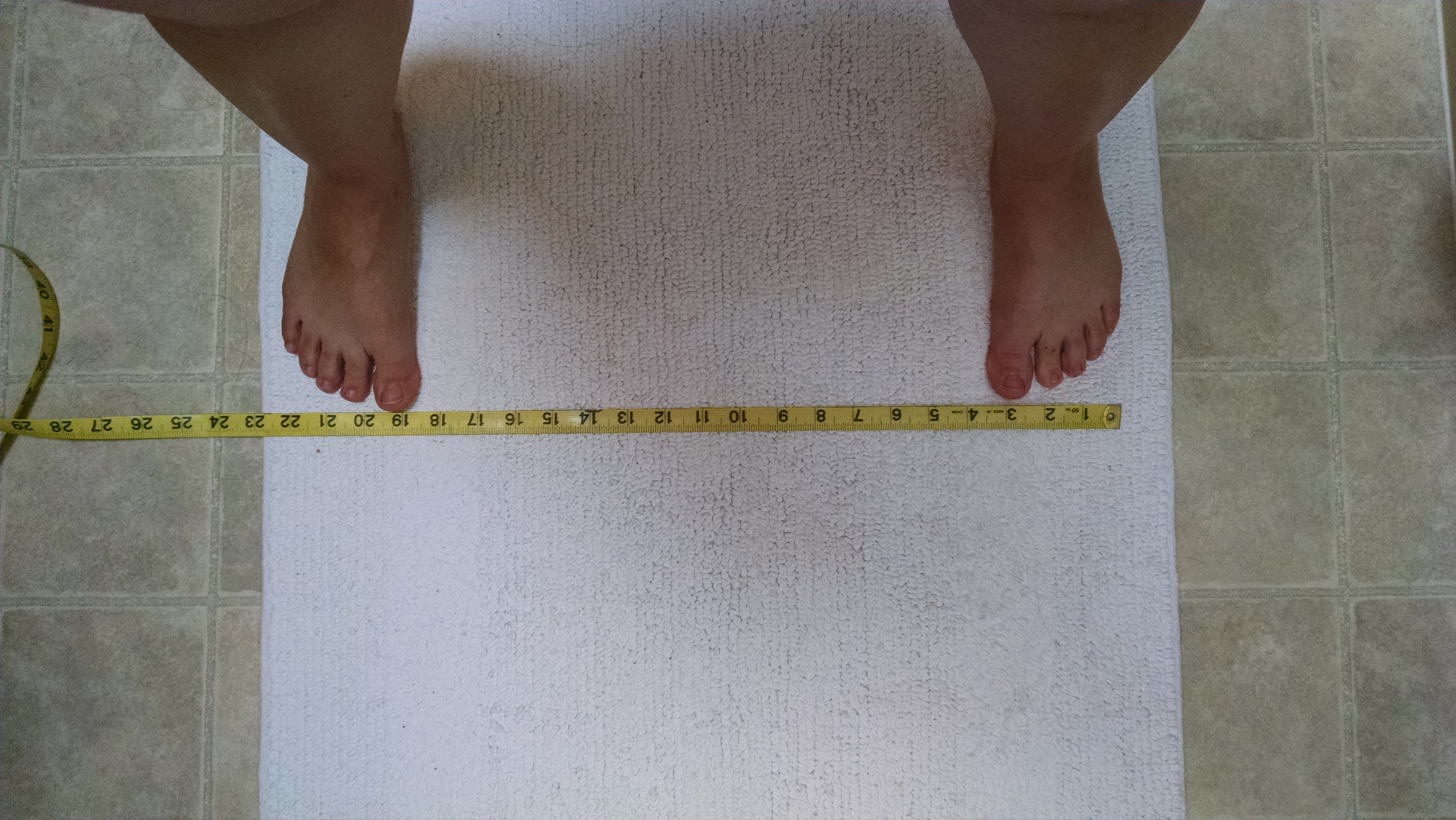
22 inches.

That’s how far I have to stand with my feet apart in order to have “thigh gap.”

IMG_20140912_155310274

23 pounds.

That’s how much weight I’d still have to lose in order to be in the center of the “Healthy” range of my Body Mass Index (as I currently stand, I am considered overweight).

I wanted to open this latest installment of “The New Normal” with some ridiculous numbers to prove a point. I’m certain that you, my dear readers, can see from a mile away what this point is, but here goes anyway.

I will never be that woman. I will never be that thin. That sickly. That close to being physically erased.

I will never have (as my husband so colorfully calls it) “Factory Air.”

I will never be “toned” (a dangerous codeword, used almost exclusively to describe female bodies, which tries to use the language of health and fitness to cover up a reality of emaciation).

I will never try to reduce myself to nothing. To wish for empty space where my body currently resides.

And because of this, I will never be “beautiful.”

But, damn, I’m sexy as hell.

IMG_20140912_155332721

Instead of focusing on the space that I or anyone else wishes to see appear around me—the space we hope opens up where I used to be—let’s look at the space I inhabit.

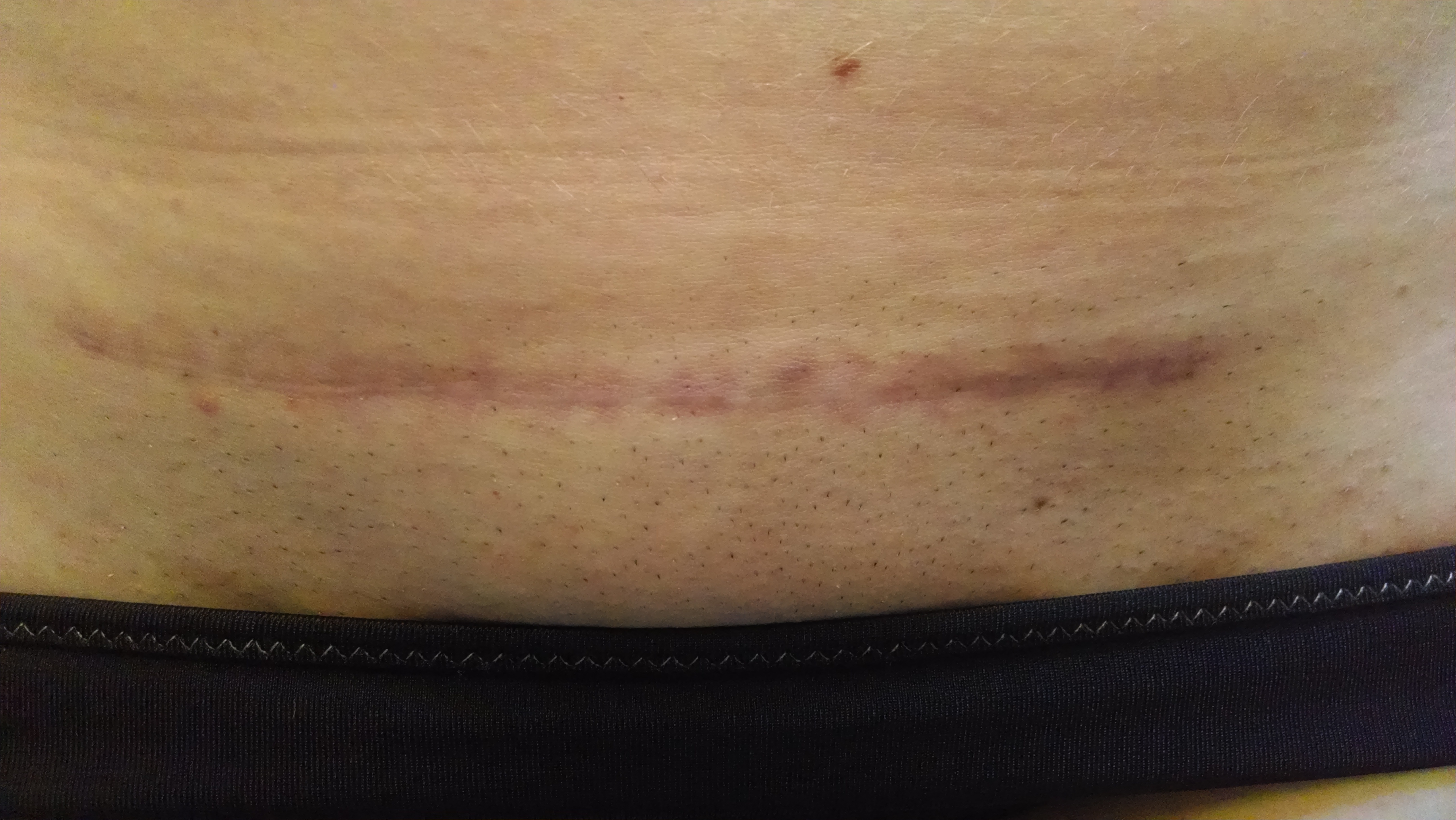
First, my scar. 6 months ago, it was purple and lopsided.

IMG_20140307_155956340

Now, there are whole days when I forget that it’s there. It’s still healing, but it really has improved.

IMG_20140912_155553523_HDR

Second, the befores and afters (though I hate using those words. They imply that my body is some kind of term paper and not a constantly-changing, organic creature. The only true “After” will be when I’m dead).

2010_Rachel

May, 2010. Vegas. The pool. This is the day before my wedding. I weigh 124 pounds. 4’ 11”. I’m wearing contact lenses.

IMG_20140307_160246042_HDR

March, 2014. Indiana. My bathroom. My daughter is lying on her play mat at my feet. I weigh 132 pounds. I have bifocals.

IMG_20140912_155358528_HDR

September, 2014. Indiana. My bathroom. My daughter is napping in her crib on the other side of the wall. I weigh 128 pounds. I still have bifocals.

IMG_20140912_155510539_HDR

I remember taking that picture in 2010 by the pool in Las Vegas. That has always been one of my favorite pictures of myself and my body, because I remember thinking, “Hey! I didn’t suck in!” I didn’t even think about my body, my stomach, my thighs. I stood with my siblings, and took a picture, giving not one thought for what my body looked like. It was liberating.

And I’m starting to feel as though I could get back there.

Because I’m liking the space I’m taking up these days.

It’s my space.

And I’m going to use it all.

Spoiler Alert! If you haven’t seen Frozen, and you don’t want to know anything about it, stop here. For real. Stop. I warned you.


The premise of Disney’s juggernaut, Frozen, is beautiful and simple (as most beautiful things are): true love overcomes fear. A young woman, Queen Elsa, is born with the power to create winter. At an early age, she accidentally strikes her younger sister, Anna, in the head with her powers, and when her family takes Anna to be healed, Elsa is warned that “Fear will be your enemy.” The family misinterprets the prophecy, thinking that the fear that needs to be contained is that of other people. They subsequently lock Elsa away, keeping her hidden from other people, and try to teach her to successfully “pass” as a non-magical person. (To be fair, the prophecy shows Elsa being attacked by a mob, so it makes sense that her parents would think that the prophecy is warning against other people judging her unfairly and thinking that she’s a “wicked sorceress.” This is why I don’t blame Elsa’s parents for secluding her, which I know has been a big issue of complaint from the Frozen fan base.) This, of course, creates enormous fear in Elsa, and she lives in constant worry that others will discover her powers. Elsa’s fear, though, is what makes her powers dangerous and uncontrollable. It is not until her little sister, Anna, demonstrates that she truly loves her sister, flaws and all, that Elsa’s fears are shattered, and she is able to thaw the endless winter she has created and control her powers. Finally, she is able to use them for good.

And there’s a talking snowman.

Who rocks.

As a mother of two daughters (two sisters who bicker, fight, hold hands, hug, and love), I have seen this movie approximately 812 times. And I still cry at the end. And at the beginning (“Do you want to build a snowman?” Oh, god. I can’t.). I think that it’s Disney’s biggest triumph to date.

But I also know that its singular premise is deeply, deeply flawed.

Because I have true love in my life.

And because of that, I know what true fear feels like.

True fear is knowing that my very being is wrapped up in two tiny girls with blue and hazel eyes.

True fear is making sure that I whisper “I love you” to them every single night, just in case one of us doesn’t wake up in the morning.

True fear is fervently praying that it will be them who will wake up to the sun. Always.

True fear is recognizing that I mean nothing compared to them. That I would give everything that I am—my body, my mind, my very soul—for them. And I would do it without hesitation. Without question.

True fear is going into labor too early, and giving birth to a girl who can’t breathe on her own.

True fear is a well-lit NICU.

True fear is the way that time seems to suspend itself indefinitely in the half a second it takes for my two-year-old to run down our driveway and into the street.

True fear is being able to run faster than I’ve ever moved before, just to throw my own body in front of hers when I see our neighbor’s car turn the corner.

True fear is realizing that nothing—nothing—is worthwhile without them.

True fear is a part of true love.

But my heart isn’t frozen.

Because I don’t live in those moments of fear.

They’re always there. And they’re normal. Even, dare I say, healthy.  It’s good every now and then to sob, to cry, to hold my babies tight-tight and smell the sunshine that clings to their hair. But it’s even better to let them go.

Because when I see them run.  When I hear them laugh.  When I watch them pick blades of grass and smell the greenness.  Or press their cheeks and bellies against our French door, to feel the cool glass. Or kiss each others’ faces and hair. That’s when I can forget to be afraid.

When I marvel at my toddler’s love of books and stories.

When I watch my one-year-old furrow her brow and work all day, just to figure out how to climb up onto a chair and get back down again.

When I see them crawl into a single bed together and speak to each other in a language all their own.

A language that is full of smiles and clapping.

Even when I see them push each other, and fight and cry over who gets to play with their Olaf doll.

I forget the fear.

Because the love is stronger.

True love doesn’t overcome fear. They walk hand-in-hand together, sometimes one leads, sometimes the other. Sometimes one needs to carry the other. I haven’t figured out how to break the connection between these two. It seems one can’t quite exist without the other. They have a bond I can’t explain.

They are sisters.

As much a part of my life as a mother as my own children.


I have no grand take-away for this. My true fear was born at the same time as my true love. I have no tips for you. I don’t know how to get rid of it. I don’t know if I can. I don’t even think I want to.

Perhaps that’s how I am able to live within the loving fear. Perhaps that’s how I’m able to stay warm, to keep the summer sunshine filtering down through my heart.

Because I accept the true fear.

Maybe, in a way, I love it.

Because the terrifying truth of motherhood is that it is terrifying.

I’d die for them.

I’d burn.

I’d melt.

It’s that simple.

And beautiful.

Team Olaf all the way!

Team Olaf all the way!

Okay, everybody. It’s time to calm the fuck down.

I’m talking about cell phones.

And Facebook.

And Twitter.

And Instagram.

And “technology” in general.

It’s not evil. None of it. Not even close.

And it’s not ruining communication. Or writing. Or dinner.

It’s just not.

So chill out.

In the past couple of weeks, I’ve seen several articles talking about a sweeter, simpler time. A time when people actually knew how to have face-to-face conversations, delved deeply into each others’ thoughts, desires, minds, and found a reflection of themselves staring back, trembling in the sudden light of their shared experiences and waiting, hoping, breathlessly anticipating an embrace from the sister soul of their companion.

This time of sweet connectivity and genuine friendship? I’m talking 2004.

Martha Stewart went to prison for insider trading.

George W. Bush was “reelected” as President.

And what else happened?

Facebook launched.

And apparently everything went to shit (and, no, I’m not talking about GW, okay? Not today).

First, I noticed the viral Craigslist “Upscale New York Restaurant” hoax. Yes, it’s a hoax. Anybody who has ever worked in a restaurant immediately knew that it was a hoax. Also, anybody who has recently eaten in a restaurant. Or walked inside one. Or driven slowly past one and glanced casually through the windows. Hoax. Hoaxy hoaxy Hoax McHoaxerson.

For those of you who were spared the constant “Wow, it really makes you think!” reposting and citing of this article, allow me to explain. A post appeared on Craigslist New York’s “Rants & Raves” section, claiming to have been written by an owner of a “popular” New York restaurant. The ranter claimed that they had received several negative online reviews, citing slow service. Even though “the number of customers we serve on a daily basis is almost the same today as it was 10 years ago, the service just seems super slow even though we added more staff and cut back on the menu items.” The ranter, in an effort to understand how such reviews could possibly exist, compared surveillance tapes from 2004 to today.

What he “found” was that people spend so much time on their cell phones that the average length of dinner had skyrocketed, from 60 minutes to 115 minutes.  Not only that, but the amount of meals having to be sent back to the kitchen for being “cold” quadrupled, because people were spending an average of “5 minutes” showing waiters “something on their phone” and an “average of 3 minutes taking photos of the food.” Over half of the people at the restaurant in 2014 also asked the waiter to take group pictures of them, then asked the waiter to take multiple pictures while “chit chatting” and taking up another 5 minutes of the waiter’s time.

Bullshit. And here’s why.

  1. If patrons in your restaurant are taking twice as long to eat their meals than they were ten years ago, then it is actually, physically impossible for you to serve “almost the same” number of customers per day as you did ten years ago. Unless you have doubled the size of your dining area. If that’s the case, then perhaps the longer wait times have something to do with an overworked kitchen staff as opposed to those evil cell phones.
  2. Speaking as a former waitress, I have to say that VERY rarely did customers send food back for being “cold.” Usually, it was because something was on the plate that shouldn’t have been (like, say, the time I told the kitchen that my customer had a severe peanut allergy, so they decided to place the spicy peanut sauce “on the side” instead of directly on the salad. What part of “anaphylaxic shock” don’t you understand?). Also, if you’re just looking at dining room surveillance footage, how on earth do you know that the food is being sent back because it’s cold? Do you also have footage of your kitchen? Complete with high quality microphones that will be able to pick up on the single waitress talking to an assistant chef over the noise and confusion of a busy kitchen during lunch rush?
  3. Does your restaurant only cater to 13 year old girls? Who shows their waiter something on their phone? Ever? Do you really expect me to believe that 27 out of 45 customers (over HALF) asked to get a photo taken? Have you been to a restaurant recently? You know who asks to get photos taken? Bachelorette parties and kids going to prom. What the hell kind of restaurant is this?
  4. Think about how long 3 minutes is. 3 whole minutes to photograph food? Here, try this. Sing “Happy Birthday.” Just sit still, and sing the whole thing. That was ten seconds. Now, do that EIGHTEEN more times. You don’t think anybody on the planet would be able to snap a picture of a double stuffed potato in that time? It’s an eternity!
  5. Why the anonymity? If this was a real “popular New York restaurant,” the owners and staff would be arranging interviews on Good Morning America and calling every online review place in the universe to get their story heard. It would be incredible, positive publicity for the restaurant. People would show up in droves (and maybe a few covered wagons) just to show off how efficiently they can eat in a restaurant without technology. If it was my restaurant, I’d hire a PR firm to make sure that my “rant,” name, address, picture, and GPS coordinates were on the front of the Huffington Post homepage for at least a week. But nobody did that.

Because it was made up.

So, please, stop reposting it.

Then, just today, I read an op ed piece from the New Yorker entitled “A Memoir is not a Status Update.” In this piece, memoirist and novelist Dani Shapiro worries:

[W]e’re confusing the small, sorry details—the ones that we post and read every day—for the work of memoir itself. I can’t tell you how many times people have thanked me for “sharing my story,” as if the books I’ve written are not chiseled and honed out of the hard and unforgiving material of a life but, rather, have been dashed off, as if a status update, a response to the question at the top of every Facebook feed: “What’s on your mind?”

Bitch, please.

Do you think that online capabilities and mindless scrolling through pictures of friends’ (or acquaintances’, or even strangers’) cute babies and puppies has somehow stripped all of us of our collective humanity? Shapiro bemoans the emergence of emoticons—symbols that serve to clarify tone, or emphasize a particular emotion without linguistic words—and while, as a writer, I tend to shy away from them (I stubbornly insist that my tone must always already be understood by my audience. I am a writer! I can never be misread or misunderstood!), I understand their broader appeal. The problem with online communication is that, without the human voice, or the human face, knowing when something is being said in jest, or satirically is sometimes hard to distinguish (my friends have often laughed that Facebook needs a “sarcasm font.” I would agree, but I do so love the drama that such tonal misunderstandings create). Most people aren’t writers. Most people are uncomfortable with communicating solely via the written word. Most people have come to believe at some point that they “just can’t ‘do’ English” (at least, that’s what I heard, over and over, from my students).  But nobody is mistaking a “heart” for a “phone call,” as Shapiro fears. Nobody is confusing the change in status from “Married” to “Single” as telling the “story” of a divorce. Even people who love social media (and I am one of them. Oh yes, I am) recognize that it is a representation of the self, another filter through which we strain out the unsavory and leave the humorous, the kind, the talented, the fashionable.  And a true reader will be able to see through the vapid “stories” that others post. We’ll be able to see that our friend whose status shifted, without additional comment, from “Married” to “Single” is making a statement with his silence. Perhaps a statement of denial. Perhaps one of self-preservation.  Perhaps one of masculinity and vulnerability. Perhaps one of unspeakable sadness. Perhaps one of embarrassment. Perhaps one of bravado.

It may be hidden.

It may feel digitized and manufactured.

But it’s still there.

Our humanity.

Our stories.

Yes, even our dinner.

It’s not going anywhere.

It can’t. A cell phone cannot take it away. Nothing in the hundred thousand or so years of human evolution has yet.


And, seriously, put the phone away during dinner. At least for date night.

My Nana’s eyes were filling with tears, but she was still smiling.

“He agreed to fix all of the shoes for the women in the shop, and in exchange, they gave him silk stockings for all of his girls.  All three of us and my mother. Even though we didn’t have much money, I always had silk stockings. It felt so good. You can’t even find silk stockings anymore.”

Her eyes let me know that she was no longer sitting in the kitchen with me, in 2012. She was walking past seemingly endless rows of tract houses on Chicago’s south side, in a close knit, poor immigrant community. She was helping her mother butcher whole pigs and bake kolackys, but not in the traditional, wrapped way that her mother had learned growing up in Czechoslovakia. No. “We are in America now. We do things the American way. The easy way.” Instead of wrapping the sweet apricots or sesame seeds up in the flaky cream cheese dough until they looked like snug babushkas, my Nana watched her mother roll the dough out flat, and cut it into circles using one of her husband’s whiskey glasses. She pressed three fingers into the middle of the circle, making “puppy dog feet” in the center, and filled the indentation with apricots, baking the cookies flat.

“I never knew very much Czechoslovakian, because my mother refused to speak it once she got to America. ‘We are American now!’ Steve was the one who was fluent. He taught me so much.” She ran her hands along her dented and scratched kitchen table. “He used to say that he would have to work forever just to keep me in silk stockings! He and my father would laugh about it. My father would tell him, ‘Keep her in silk stockings,’” finally, she smiled up at me. A small jolt ran through her as she looked at me, saw me, her grown granddaughter, breastfeeding a newborn great-granddaughter to sleep. She paused.

“I can’t believe it’s been ten years.”

I nodded. “I miss Dedo.”

A familiar look crossed her face. I never knew if it was sadness, or worry, or some combination of both, but we all recognized it when we saw it. Her brows wrinkled together, and she placed her fingertips up against her lips, lightly patting them, almost trembling. Soon, she’ll start picking her nails. She’s always so anxious. Dedo was the only one who knew how to calm her down.

“Is there anything you wish you could still say to him? Or do for him?”

The second I asked the question, I was sorry for it. Why am I trying to make this 87-year-old woman remember her loss?  Her loneliness? Am I trying to make her feel the guilt of her regrets? I wanted to get closer to my memory of Dedo, but did I have to do it by torturing her? I looked down, and forced a chuckle, “I mean, Dedo was the first adult to swear at me. He called me a little shit. Do you remember that? He was such a hard ass . . .”

“Eggs.”

“Huh?”

“I never made him over easy eggs.” The worried look was gone. There was a calmness, a solidity to her expression that I rarely saw. “After his heart attack—you know, that was back in 1968—all of the doctors told you to stay away from eggs. He loved breakfast. He’d eat it for every meal if he could. Every morning, I’d wake up, pour us some juice, get the paper, and we’d have our breakfast together. Drink coffee. Read the paper. And he loved runny eggs. He would beg me, ‘Helen, please. Just one egg.’ He loved to dip his toast in it.” Rye toast. Another nod to the old country. Nana has only ever had rye bread in her house. White bread just doesn’t have enough flavor for her. “But I never made him an egg. I made him eat these awful, powdered eggs. You had to add water to them, and then cook them. They only came scrambled.  They were like rubber.” She stared down at the well-worn kitchen table, running her fingertips along the deep scratches and roughness. She whispered, “I could have made him an egg. Just one egg.” She looked up at me. Solid once again. “It would have made him so happy. And I could have done it. But I never did. I never did. Just that little thing. It would have made him happy all day. And what would it have mattered? Just one egg. You know, now they say that you can have eggs, even with a bad heart. I kept arguing with him and arguing with him. ‘Steve,’ I’d say, ‘You have to follow doctor’s orders!’”

She smiled a little. My grandparents were almost always engaged in loud, lengthy power struggles. Both were too stubborn to admit defeat.  Too proud to apologize.  Dedo was an adventurous spirit. A tinkerer who never read the directions. Nana was a dutiful daughter, close to her family. Dedo made sure she left the house every now and then, and Nana made sure he didn’t electrocute himself. They both were determined to do it on their own, and they both could never admit that they were lost without each other.

“Just one egg. It would have made him so happy. I could have made him so happy. And I didn’t.”

My mind flickered back to a conversation I once had with an Iraq veteran. We were splitting a six pack while crashing at a friend’s house, and I once again couldn’t stop myself from asking the wrong question, “So, what was it like over there?”

His beer stopped halfway to his mouth. Our friend’s orange kitten jumped on the couch next to him, and he scratched her small head for awhile before answering.

“You couldn’t get good eggs over there.”

“Huh?”

“None of the eggs are pasteurized over there, so you have to cook them all the way through. The scrambled eggs would be brown on one side. They’d just cook the shit outta the eggs. You couldn’t get good eggs.”

Then, we watched Jeopardy.

That was all he would say.


Love, and family, and home. Those all sound like really big things. Things that need big gestures, or big structures, or big people, or big moments.  As I spoke with my grandmother, holding my new daughter, I kept waiting for, looking for, anticipating, something big.

But maybe all of those things are actually very small.

Maybe home is that scratch on the counter where your husband sliced the rye bread without a cutting board.

Maybe family is baking kolackys the “easy” way.

Maybe love is pair of silk stockings.

Maybe love is bickering for hours, then splitting a glass of orange juice over the morning paper.

Maybe love is watching every single Cubs game together for fifty years.

Maybe love is a single, runny egg.