Archives for category: Uncategorized

I never knew that such a huge portion of my life would be defined by milk.

There’s something about milk. It gives life.  It sustains life. We are all born in and composed of rivers and streams of water, but milk is what helps us grow.  What gives us the potential to thrive.

I have been breastfeeding for two and a half years now, and in that time, I’ve donated literally thousands of ounces of breastmilk. Now, before you start clapping and calling me a hero, please know the truth: I’ve hated 90% of it. Breastfeeding itself is wonderful (Until those teeth come in. Sonnuvabitch! I’ve had a blister on my left nip for two months now. It can’t heal because, well, the kid still needs to eat, right?), but donating is a major pain in the ass.  If you decide to donate through official channels, you need to go through interviews (which are all basically designed to figure out whether or not you are using illegal substances or are secretly a prostitute. Seriously. I was asked the “Have you accepted money in exchange for sexual favors within the last year?” question about four different times. And what does that have to do with breastmilk? Hookers lactate too!), blood tests (I have had 3 HIV tests in the last three years. One for my first pregnancy—it was standard for new patients in that OB’s office—one for the milk bank, and one for my second pregnancy—again, I was a new patient at a new office.  They were all negative, in case anyone was wondering.), and you have to follow very strict pumping, sanitizing, and storing rules.  They send you the containers they want you to store your milk in. Which, of course, are the least convenient containers known to man. They end up taking up about 87% of your freezer space. Because you can’t just drop off the milk as you are collecting it. No. You have to wait until you have at least 200 ounces saved, then you can load it all up in a giant cooler designed for Fraternity-level tailgating, lug it to whatever major urban center happens to be closest to you, and then haul it over to the milk bank’s offices so that they can, once again, check every container, and casually ask you if you’re a prostitute.  Just to be sure.

And you can’t have any medicine. Or caffeine.  Or alcohol. Or fun, apparently.

I got a UTI while donating breastmilk, and I had to actually make the choice between antibiotics or pumping milk for donations.

I chose the drugs.

Because it hurt when I made peepee.

How’s that for a hero?

This time around, I’ve decided to donate to a good friend. Her baby was born 10 days after mine, and she never made enough breastmilk. She lives in my neighborhood, so when my freezer starts to look a little full, I just fill an old grocery bag with those flat baggies of milk, and walk it over. I still mostly abstain from alcohol and caffeine (and I haven’t had to be put on any antibiotics), but I don’t sit around and worry about whether the milk has been sitting in my fridge for over 24 hours, or have to stop and calculate how long ago I took that Motrin for my screaming headache. I can shrug, and say to myself, “Would I give this to my baby?”  If the answer is still yes, then I feel just fine handing it over to her. Once, I even joked that I was giving her a special “Whiskey and coke” baggie that I pumped after a dinner party.  I said it was going to be her baby’s “sleeping bottle.” I see her baby regularly, and I know that he has incurred no ill effects from my having an occasional glass of wine, or an extra cup of coffee, so I feel fine making jokes like this (and, again, I breastfed my daughter while drinking that whiskey, so I had no hesitations giving her the milk).

I’ve never officially calculated how many ounces I’ve given to her over the last nine months (as opposed to the official donation. 240 ounces.). I figure that I’ve averaged about 7 extra ounces of milk a day, which works out to just around 2,000 ounces of breastmilk. Or about 15 gallons.

(Woah.  Okay.  Now that I actually did that calculation, that looks like a lot—like, a lot—of milk. And I’m being pretty conservative with the amounts here. Woah.)

Being so much more relaxed about donating has relieved quite a bit of the pressure of donation, but that doesn’t mean that I haven’t bitched about it at great lengths as well. I have. Because I still thought of it as an inconvenience.  As a pain. As a time suck.

I have actually complained about it to my neighbor.  While she fed her son my milk.

Again, how’s that for a hero?


Last week, I was approached by one of the instructors at my daughters’ daycare.  “You donate breast milk, right?”

A little surprised by her question, I answered that, yes, I donate to my neighbor. Under the table. Black market donation.

Her eyes grew wide with excitement.  “Would you ever consider donating for this little girl?” She gestured to the infant in her arms.  “She’s four months old, and she’s been prescribed breastmilk, but we can’t always get enough of a supply built up for her. She can’t digest formula.”

I balked. This was a major request.  And I had already been toying with the idea of starting some weaning, some pulling back and cutting down of my milk supply. “Well, my neighbor’s boy really needs it. . . .”

“I know that it would be appreciated.”

Is she speaking for the mother? “Would her mother be okay with this?”

“There’s—“ she hesitated. “Her mother isn’t really in the picture.”

I sighed. “Well, maybe I can give a little. You know, the stuff that my neighbor doesn’t need.”

“Anything! Anything.”

I went home and looked at my milk sitting in my refrigerator. I started the mental math: Honest Baby needs about 18 ounces for her bottles for daycare. But she’s only really drinking about 12 now that she takes three meals a day. And my neighbor just took about 100 ounces, so she’s set for about a week or ten days if she only uses one baggie a day. Just a supplement to the formula. But we’re going to a wedding this weekend, so I need about 8 ounces for bottles for grandma while she watches Baby. Then, of course, we need some “just in case.” So, let’s see . . .

I figured out that I could easily spare about 50 ounces. Easily. Really, I could have given her about 80, but I was worried about setting a precedent.  I didn’t want this woman to start relying on me. I didn’t want to be yoked with this responsibility. I just didn’t want to do it. I figured I could toss her a few ounces of frozen milk, tell her that it was all I could manage, and be done.

This morning, I brought in the milk.

You would have thought I was handing her a bag full of gold.

I was hugged.

There were tears brimming in her eyes.

Someone actually clapped for joy.

It turns out, that the instructor (we’ll call her K) who asked me to donate had just adopted that four-month-old girl. She was the daughter of one of the instructor’s relatives, a woman who has a serious heroin addiction.  K’s relative decided to voluntarily sign away her maternal rights, recognizing that her daughter would be better off with someone else providing her care. K took her in. Against the advice of almost everyone around her, K first fostered, then adopted the little girl (the director of the center told me that she had argued with K for months, telling her to not get involved.  To not get emotionally attached. That there were just too many unknowns in this situation. K ignored them all.  She had fallen in love.).  The little girl has lingering health problems as a result of her mother’s addiction. Mostly, her digestive tract is “immature.”  She can’t digest formula.  One woman at the center described what happens when they have to feed her formula: “I’ve never seen anything like it. That little girl’s belly swells up. It looks like a basketball. Just perfectly round. And tight.  She screams for hours. It’s just the saddest thing you’ve ever seen. We hate to do it.”

And I only brought 50 ounces.

Annoyed at being asked.

Irritated that my oversupply was being “exploited.”

By a baby.

A little girl.

Who hasn’t been able to gain weight.

Who has been born with the cards stacked perilously against her.

Who already has had to fight just to be here.

To be present.

She’s been diagnosed as “failure to thrive.”

My milk could change that.

My milk.

It will make me part of the community that raises this child.  It has the power to insert me into her life, to help guide it.  To help save it.

It won’t necessarily improve her odds.

It won’t really make her a better person.

But it can give her the option of reaching her potential.

It can help give her a chance.  When she was born without any.


And I didn’t want to give it.


Lord, forgive me.

Forgive me.

And thank you, over and over, for the “curse” of this inconvenience.  For the pain of engorgement. For the sleeplessness that accompanies being needed.  For the tug and rush of the letdown.  For the daily heaviness.  The nightly aches.

For the burden of milk.
In high school, my father had his Drama class read Waiting for Godot. I found it beautiful.  Strange. Completely unforgettable. I memorized and performed Lucky’s monologue of philosophical gibberish as part of my final exam in the class (I still remember quite a big chunk of it, about a God with a white beard, living in time and through existence), and wrote a paper about the play. I argued that it was about love.

Fifteen years later, I’m still convinced that I was right.

Waiting for Godot is the quintessential absurdist play. Literally, nothing happens.  Two men, Vladimir and Estragon, stand around, talking and not talking, for two whole days. They are waiting for the arrival of “Godot.” Spoiler alert: he never shows.  But the play ends as it began:  with the two of them promising to stay where they are, together, waiting. Basically, Waiting for Godot is a how-to on extreme queuing.

And it’s about love. The ridiculous beauty of coupling.  The strange, sometimes sad hopefulness of monogamy in modernity.

Five times throughout the play, Vladimir and Estragon ask for, and receive, “embraces” from each other. Not hugs. Not high fives or fist-bumps. Embraces.  Now, often, they find themselves embracing because they really have nothing better to do, but that shouldn’t render their choice to waste time in a moment of affection for each other any less poignant.  Though it’s “absurd,” they want to kill some time by being as close to each other as they possibly can.  They vacillate between wanting to leave, wanting to stay, hating each other, loving each other, needing each other, and, ultimately, end standing face to face, equally aware that they will—that they can—never, ever leave each other.

Surely, you see where I’m going with this?

Being a dedicated couple is absurd. It’s truly a ridiculous thing to look at a person—who you have conveniently found, usually pretty geographically close to you, amongst your 6 billion or so options—and say, “You. I choose you.  Your face. I want to only see your face. Every day. And at night. For all my life. Until I can’t see your face anymore.” But we do it. We all need to do it.

Because if we don’t have each other to look at, what is there to see?

“A country road. A tree.”

(That’s the set description for the play. That’s it. In its entirety.)

Some people are content just looking at a country road, a tree. But I’m not one of them. Because, it’s true.  It is insane to look at another person and say, every day, “Let’s stand together.  And talk.  And not talk.  And look at our shoes.  And look at each other.  And every now and then pull each other as close as we possibly can without actually physically bonding into a single entity.  Let’s do nothing. Together. And tomorrow, let’s do it all again.”

It’s absurd.

But I’d rather stand in an eternal line with you, my love, than stand by myself.

And I haven’t met all of my 6 billion alternatives, but I trust that you’d still hedge out the rest. I believe it.  It’s a truth. It’s my truth.

It’s silly to say that.

It’s illogical.

But it’s absolutely true.

And Godot? Who or what are we all standing around waiting for?  Certainly, there have been rivers of ink spilled on the speculation. But here’s my theory. Godot is a condition of modernity. Godot is the constant when that everybody seems to be waiting for.

When the kids are bigger.

When we save up some money.

When we take that vacation.

When your feet stop hurting.

When the world finally hears us, and slows down just a little bit.

When things become less complicated.

Godot is the wonderful, irrational, immature whenness of being a modern couple.  He is the dreaming that we can’t seem to stop when we’re together. He is the hope we have of uncomplicated togetherness amidst all the messiness. He is our joint, childlike possibility.

Sure, he never comes.

But we still wait.

We still stand around, every day, and hope and think and dream and desire and will him into being.  And at the end of it all, we still decide to come back the next day.  Because we realize that it really wasn’t so bad, all that waiting. Because we got to do it together.  Dreaming the impossible doesn’t make the dream any less pleasant, or exciting, or scary, or thrilling, or addictive, or lovely.

Sometimes, dreaming the impossible is just exactly everything I’ve ever wanted.

And, when I dream it with you, I believe that it is all possible.  That’s true. That’s my truth.

I have chosen you.

Your face.

I want to see it.

Every day.

And all night.

For all my life.

Until I can’t see it anymore.

Now, shut up and embrace me.


Happy anniversary, babe.

maternity

Already this year, I’ve had three friends lose their mothers.  I’ve been a terrible friend at this time.  And a pretty piss-poor writer. Struck dumb by the extent of their grief, by the depth of the pain, by the chasm of their loss, I haven’t offered condolences (they’d be weak and generic anyhow), and haven’t known how to respond in any way other than awkward, unnatural embraces and sad-faced frowns and nods. I couldn’t even stop long enough to consider what their loss meant, because the prospect frightened me so much. So I changed topics, told inappropriate jokes, worked to distract rather than comfort.

I’m trying to fix that now.

The loss of a mother.

It is the loss of a core.  The axis around which your world spins. The central structure without which no part of you can stand.  She is the one who made you. And everything that you have become and could yet be.  She is the one who made possible happen.

And now?

How does one cope with the sudden non-existence of all of your reasons for existence?

How can the day begin with no sun in the sky?

As we approach Mother’s Day, the loss of a mother becomes palpable.  The warmer air carrying the scent of lilacs, reminding us all of soft, lightly powdered skin, smushy bellies against which we could lie, feeling the gentle rise and fall of her breaths.  Those soft, soft mother bellies. The skin, never quite recovering from having held us for nine months. Stretched, lined, thin to the touch, yet thicker, stronger, tougher than we’d ever be able to guess. Perhaps tougher than she ever knew.  Bellies that hung like deflated empty sacks, yet somehow signifying her incredible fullness. Signifying that, by splitting apart to make you, she discovered a way to be whole.

Remember, dear friends, your mother’s heartbeat was the first sound you heard. Her rhythms are part of you, the most recognizable part.  The part that you have carried since life before life. You haven’t lost that.  You never could. It is the beat that played while you grew your mind, your heart. It made the small spark of your young soul dance. It made you dance. Your earliest, truest movements happened in response to her heart. A memory before memory.

The rhythms of her heartbeat are a song that you can still hum, to which you still move in graceful steps. You have not lost that. You never could.

It is the song of love.

The purest love.

The cleanest love.

The most primal and ferocious.

The most innocent.

And unending.


Grieve for her, dear friends. Don’t let anyone rush you through this time of real, deep grief.

But then, when you feel ready, try to remember that first song she sang to you. The soundtrack to your becoming.

And dance.


This is dedicated to you, Kim. I love you.

This weekend, my husband started practicing some songs for an audition that he has coming up. One of the songs, “Small Town” by John Mellencamp, actually stopped me in my tracks. For the first time ever, I listened to the lyrics and thought about them on a deeper, more analytical level.

No offense, Mr. Mellencamp, but that song is bullshit.

Please, allow me to clarify. I grew up in a consummate “small town.” I lived just outside of the county seat (my parent’s driveway is exactly 3 miles to the single stoplight in the center of town). I would ride my bike in to town during the summers, and park it either at my aunt’s house, or bring it inside the single-screen movie theatre my parents and aunt and uncle owned. Every day, I would clean the theatre, using the huge space as my personal Broadway, singing Janis Joplin and Les Miserables at the top of my lungs, practicing my grand jetes and pirouettes on the creaky, green flannel stage (Seriously. The stage was covered with bright green flannel. Don’t ask me why), and reenacting entire movie scripts while sweeping the enormous, 300+ seat space. When I was done, I’d pour myself a Cherry Coke, and wander outside again, looking for one of my cousins to pass the time with before I had to start my second job, bussing and waiting tables at a restaurant owned by longtime family friends. Or, if I was lucky and didn’t have to work that night, I might have ridden down to the harbor, and gone for long, solitary walks along the shoreline of Lake Huron, exploring the woods and streams, the Old Depot, and the ravines that were just as large a part of my childhood as my mother’s open-faced apple pies or my Uncle John’s perennially burned barbeque chicken. I had a great, wonderful, surprisingly innocent childhood in a small town. I graduated in a class of 61 students, most of whom had been in my class since preschool at the old church along US 23. My father taught my English, Speech, and Drama classes all four years of high school. My mother and aunt worked in side-by-side offices in a clinic 500 yards from my school. At one point freshman year, I was in theatre class with my big sister, and traveled to Knowledge Bowl tournaments with my big brother. My cousin and I graduated in the same year. My aunt handed me my diploma (pushing the Superintendent of the school out of the way). I was, eternally, surrounded by people who loved me.

But it was also very lonely.

I never quite felt as though “I can be myself here in this small town, and people let me be just what I want to be.” I loved books. I preferred reading to fishing. I hated hunting, abhorred guns, and I knew, even at a young age, that I was politically left of center, believing in social programs and help for the underprivileged as well as women’s rights. I didn’t like drinking, or drugs. Even pot held no appeal to me. I knew the entire score to Les Mis, Cats, The Phantom of the Opera, Rent, and Miss Saigon by heart. I was a soprano, and loved singing the high, operatic parts. I corrected people’s grammar (I don’t anymore). I loved school. Since the age of seven, I wanted to get my PhD. I felt more comfortable talking to my teachers than to my classmates. My sister, just a few years ago, pointed out that while we were growing up I never spoke when I was around a group of people. Which is why everyone was so taken aback when I got onstage. I was electric. A natural. I was (and still am) a terrible liar, but a good actress. I used my characters as a way to forget about being me for awhile. Because I had no idea who me was. My characters might have been drug addicts, suicidal teenagers, homeless drunks, or happy-go-lucky optimists who have to deal with disappointment, but that was their confusion, not mine. In my mind, I didn’t belong anywhere. Even though I knew that there were more people who loved and cared about me in the three-mile radius in and around Harrisville Michigan than anywhere else on the planet, I still felt like an outcast. (I’m sitting here, thinking about all of the houses in town. If I was in trouble, being chased, needed to call someone, needed a drink of water, I honestly don’t think that there was a single house in the whole city where I couldn’t have knocked and gotten my needs addressed. Really. I can’t think of a single one.)

In order to find anyone else my age who believed, behaved, and acted the way I did, I had to drive 40 miles north, to the next county, where the nearest community theatre was. I was a different person there. Closer to being me. But still not entirely free. Starting in junior high, I became a regular feature at the local theatres. My father would drive up with me, every night, to rehearsals. He’d accept some small part in whatever play I was in, then sit in the audience and grade papers while I rehearsed and socialized with my new theatre friends. I cherish those memories with my father. We talked, gossiped like a quilting bee, sang along to the radio, ran lines together. I was closer to him than anyone else. But I still couldn’t tell him all of the things I feared, thought, and hoped.

I was a freak.

I never looked like the other girls. I always had very short hair, wore my brother's jeans, and preferred had a special love for purple lipstick (I still do).

I never looked like the other girls. I always had very short hair, wore my brother’s jeans, and had a special love for purple lipstick (I still do).

Around my friends and people I was comfortable with, I was funny, witty, talkative, and curious about sex. Though I was the last of my friends to lose my virginity, I was the first to admit that I masturbated, that I fantasized, that I lusted and desired. I didn’t know how to actually perform any of the acts that I saw on screen at the movie theatre, or read about in my novels, but I knew that I wanted to know more about them, which sent my girlfriends into waves of giggles. I laughed along, but inside, it hurt that I couldn’t talk about these things without being “outrageous.” I grew up dancing (I was terrible, while my big sister was the star—she deserved to be—but it was another place where I didn’t have to be Rachel for awhile), so I wasn’t ashamed of my body, or of being naked. When the girls had to start changing their clothes for gym class, I was the only one who didn’t try to duck behind a towel, or sneak into a dark corner of the locker room. And I was curious about their bodies. I wanted to see the other girls. I wanted to look at other breasts, thighs, shoulders, musculature. I wanted to tell the other girls that they didn’t need to be ashamed. They were beautiful.

I thought they were beautiful.

So beautiful.

And they all knew, just as I did, how wrong that made me in my small town.

For a while, I actually thought that my “wrongness” had to be explained physically. For the better part of a year, I truly thought I was a hermaphrodite. Both man and woman. How else could I explain wanting to touch, to hold bodies, regardless of gender? How else could I explain the thrill I got when my friend Melissa taught me how to dance to hip hop (The one form of music that was forbidden at my parent’s house. My father thought it was disrespectful to women.)—her knee and thigh pushed between my legs, her hand lightly guiding my hips to snap and cut to the pounding, intoxicating rhythm? It had to be a mistake of nature. Something internal. Invisible, but still present.

It wasn’t until I was in college that I felt comfortable with the concept of “bisexuality,” that I didn’t just shrug, “Oh, I just don’t think that love can be tied down to any one gender. If it happens, it happens.” In college, I found a group of friends who didn’t know my father, or my siblings. In college, I could be a “theatre kid” without being the only one. Also in college, I found that it wasn’t the acting I loved, but the stories. The words. The people. The communication. After just a year as a Theatre major, I switched over to Literature, where I really found my voice. Writing, studying theory, finding a home and a voice through the stories that spoke to me and through me. I found Rachel. I took lovers. Male and female. I wrote my father a handwritten letter, letting him know that I was bisexual. His nonresponse was all the response I needed. Unsurprised and unchanging. The women and men I loved, we were all okay with that. They let me be just what I want to be.

And then I fell in love.

With a man.

And then I moved in with a man.

And then I got married to a man.

And then I had two children with a man.

And moved to a small town.

On paper, I look like the opposite of transgressive. Faithfully and lovingly married. A stay at home mother. A graduate student. A frequent peruser of Pinterest and Houzz. I’m excited about a major kitchen renovation that we’ve just started in our two-storey house in an excellent school district. I’m hosting a cooking class in my home later this week, giving tips for how to set up a great pizza night for the kids. I drive a minivan. And I love it.

I look like I really belong in a small town.

Like I can breathe in a small town.

And, really, I can. Now. Because I know who I am. I’m comfortable with who I am. But it took a long time to get to this place. To get back to this small town.

Mr. Mellencamp, the problem with your song is simple: You found your home at a young age, because you never had anything to feel uncomfortable about in the first place. Straight, white, male, able bodied (even, dare I say, sexy?), talented, born in the American Midwest. People were destined to listen to you. You were able to “see it all” and “have a ball” in your small town, because who was going bar you access? It may have taken a little bit of time (and I know that you work hard. I’ve seen you in concert. Twice. It’s a good show, and I know from experience that bringing that kind of energy every single night for years on end is not easy), but your story IS the story of America, because “America” is a narrative created by people who look and act and think an awful lot like you.

But I’ve noticed, as I’ve gotten older, that a whole lot of people look like me, too. And don’t look like me. And, even in this small town, I can finally see a bunch of people who look and don’t look like me. All around. And THAT’S something to sing about.

Being a teenager who feels lonely and misunderstood is not a new narrative. I am exceptionally privileged. I can still come home. I can still return to that three-mile radius and find a lot of doors that will open, willingly and freely, when I walk up to them. I know a lot of people who had to take a much longer road. Who are still traveling that road. And who may never find their way back (or whose way back has been irrevocably blocked). Perhaps the story that we need to start spreading, Mr. Mellencamp, is not that we can all find acceptance within the confines and limitations of a small town, but rather that within these small towns are people and ideas and beliefs and dreams and desires that go beyond the typical “boring romantics” of what is accepted and expected. My small town created me, and hundreds of people who are just as strange, confused, unique, abnormal, curious, and different as I was and still am. People who are afraid and scared and ashamed of the things they keep to themselves. The song we need to start singing is one of recognition and support for our collective weirdness. The beautiful right in all of our strange little wrongs. Together, we can create what Virginia Woolf called a Society of Outsiders.

Now that’s a good song title!

So, okay, your song isn’t bullshit.

It’s just another part of the story. But not the most important part . . .

I promised myself that I would do this. I’m not going to back out now. But I really, really want to.

A few months ago, while I was still pregnant with Honest Baby, I wrote a post called “The New Normal,” where I wondered about what my body would look like after two back-to-back pregnancies, and after my first C-section. I promised myself that I would post a follow up about my “new normal” body when Honest Baby turned 6 months.  Well, that deadline has now arrived.

So here goes.

First of all, I want to start off by saying that my caesarean went perfectly.  I had no complications (except a violent nausea in reaction to the anesthetic. I threw up probably about a dozen times the first ten hours after my section. It’s a known problem that I have with anesthetic, so I was expecting this).  I had almost no pain. I never took any of my pain killers.  I never even filled the prescription.  I was up and walking around the entire ward the morning after, and was only in the hospital 36 hours total (one of the shortest hospital stays the nurses there had ever seen for a C-section). The procedure was fast and efficient.  My OB was capable and confident. Up until two minutes after Baby’s birth (when she stopped breathing), my vote was for C-section all the way. The recovery was easier than my vaginal delivery. For days after giving birth to Honest Girl, my legs were weak, shaky. I could barely keep myself upright. I also had completely lost bladder control, and my self esteem was shattered every time I looked down at the battlefield below my belly button.  Seriously.  My vagina looked like Droopy Dog. And it was about as happy. After my C-section, I was sore, it’s true.  It took me a few days to convince my legs to swing from my hip joints in any way that felt natural.  And I was scared to cough for the first two days after surgery. But other than that?  Easy as pie. I’d do it again in a heartbeat.

That is, if I’ll ever do it again.

Since there seems to be so little out there in Internet-land about positive C-section experiences, I wanted to tell mine.  For anyone out there who is nervous about the possibility of having a C-section, don’t be. Really. They’re not all that scary.

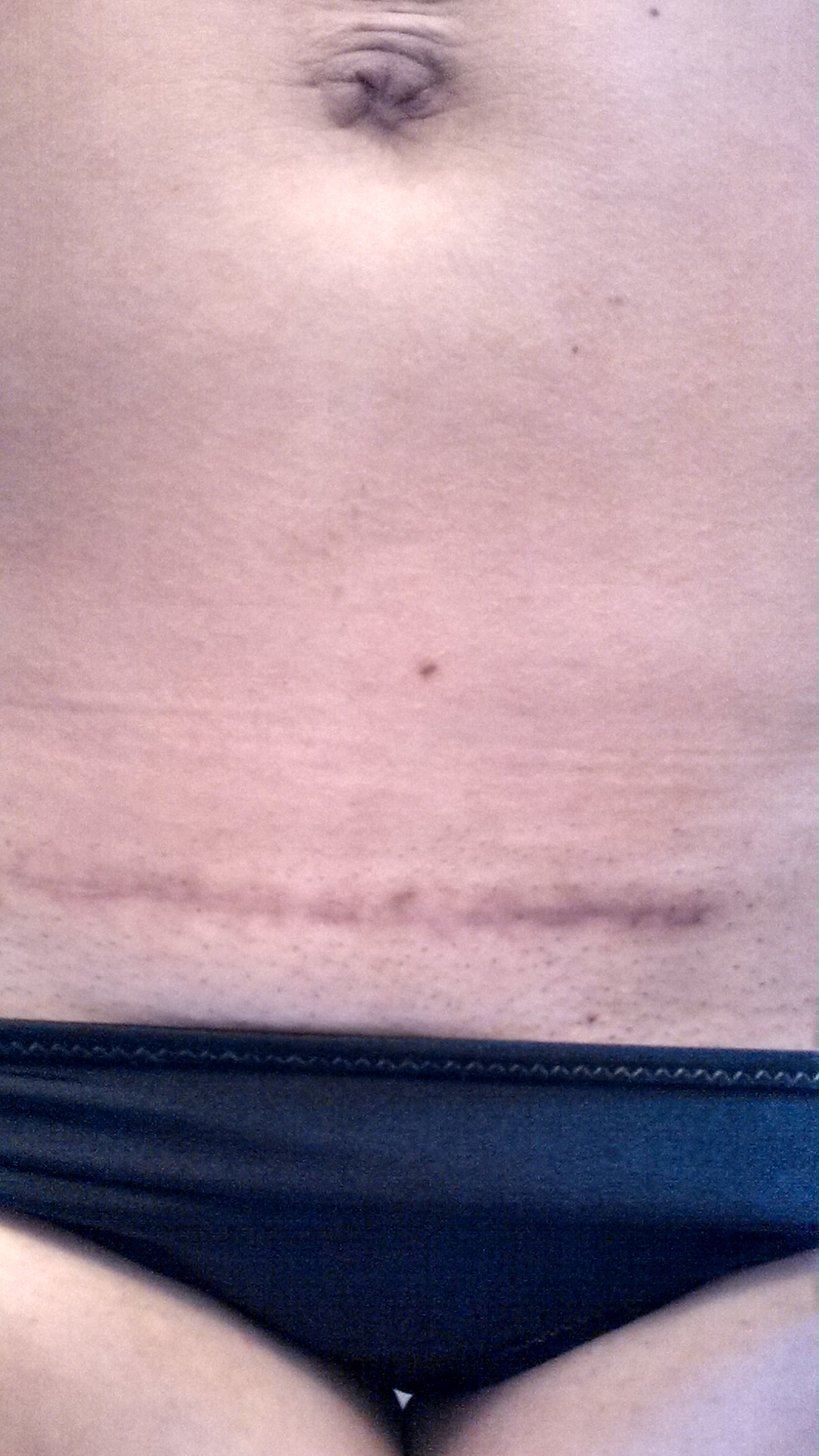
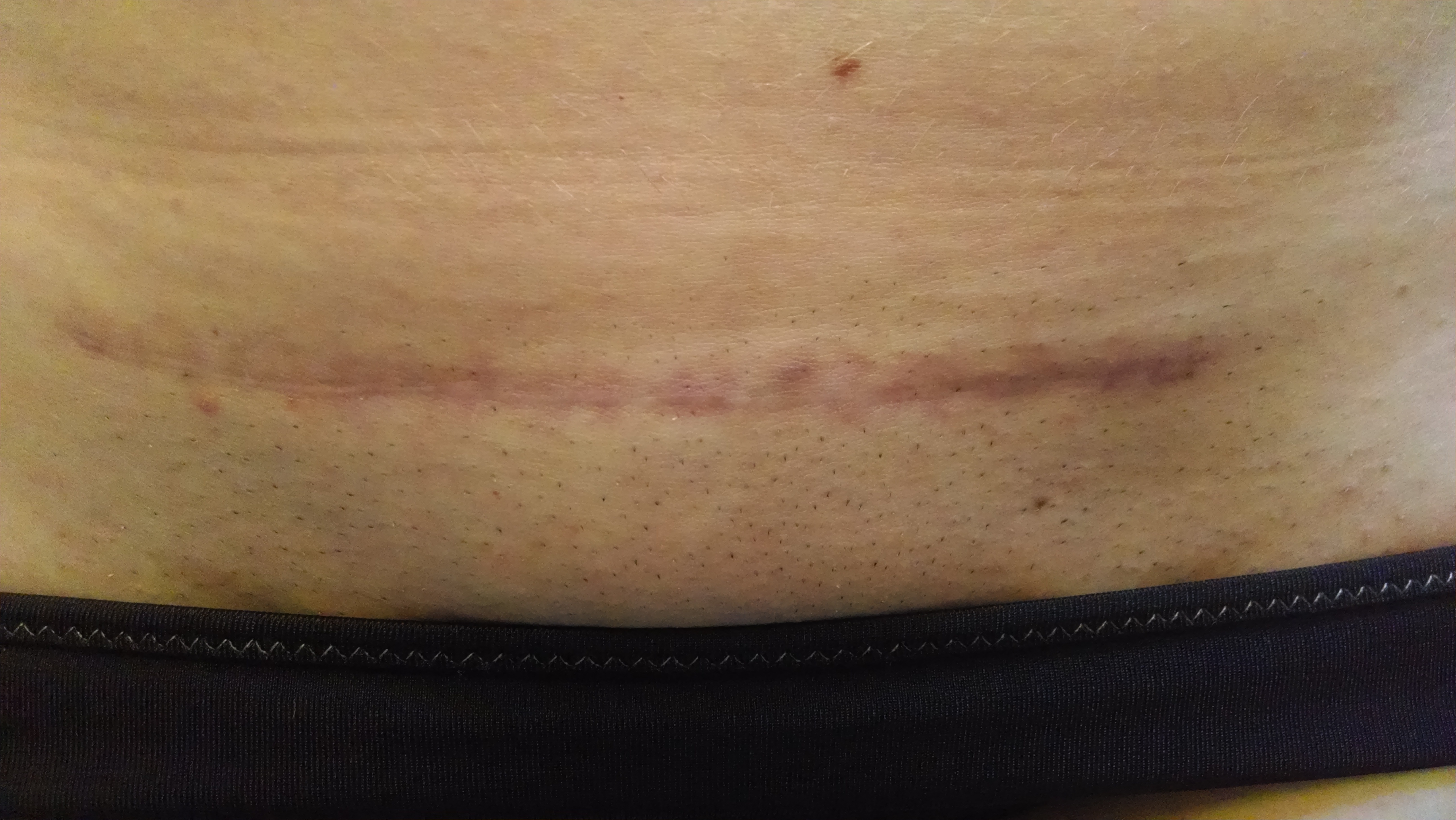
Okay, so first picture. Here’s my C-section scar, 6 months post-partum.

IMG_20140307_160027128_HDR

IMG_20140307_155956340

This is perhaps the aspect of my new body that I’m the most self-conscious about. My scar looks purple in person (also, do you see how dark my belly button is?  Why does that happen? Anybody know?).  It hasn’t faded much, and because it’s a little bit off-center, I feel as though it’s really noticeable.  One of my best girlfriends has a scar that seriously faded to nothing. Nothing. It looks like a wrinkle.  A fold in the skin. And I had convinced myself that mine would look the same way. But it doesn’t.  And I have no idea what I can do about that.

Now, the body before:

2010_Rachel

May, 2010. Vegas. The pool. This is the day before my wedding. I weigh 124 pounds. 4’ 11”. I’m wearing contact lenses.

And, (deep breath, Rachel) after:

IMG_20140307_160246042_HDR

March, 2014. Indiana. My bathroom. My daughter is lying on her play mat at my feet. I weigh 132 pounds. I have bifocals.

As you can see, I actually put on the same bikini for these pictures. It helps to highlight where the differences are. And there are differences. I must be a bikini sadist, because I was torturing that thing. I’ve never had to tie a bikini so tightly around my neck. It was a desperate attempt to hoist my breasts up. I’ve started calling them “National Geographic Boobies.” In a few more months I’ll be able to toss one of them over my shoulder to feed my daughter without having to take her out of the Baby Bjorn.

But it’s unfair to only show a picture of me in a bikini that no longer fits. Here’s what I usually look like these days.

IMG_20140307_161841034_HDR

Well, okay. HERE’S what I usually look like:

IMG_20140307_161908054_HDR

Nursing tank. Comfy jeans. Minimal makeup. Baby.

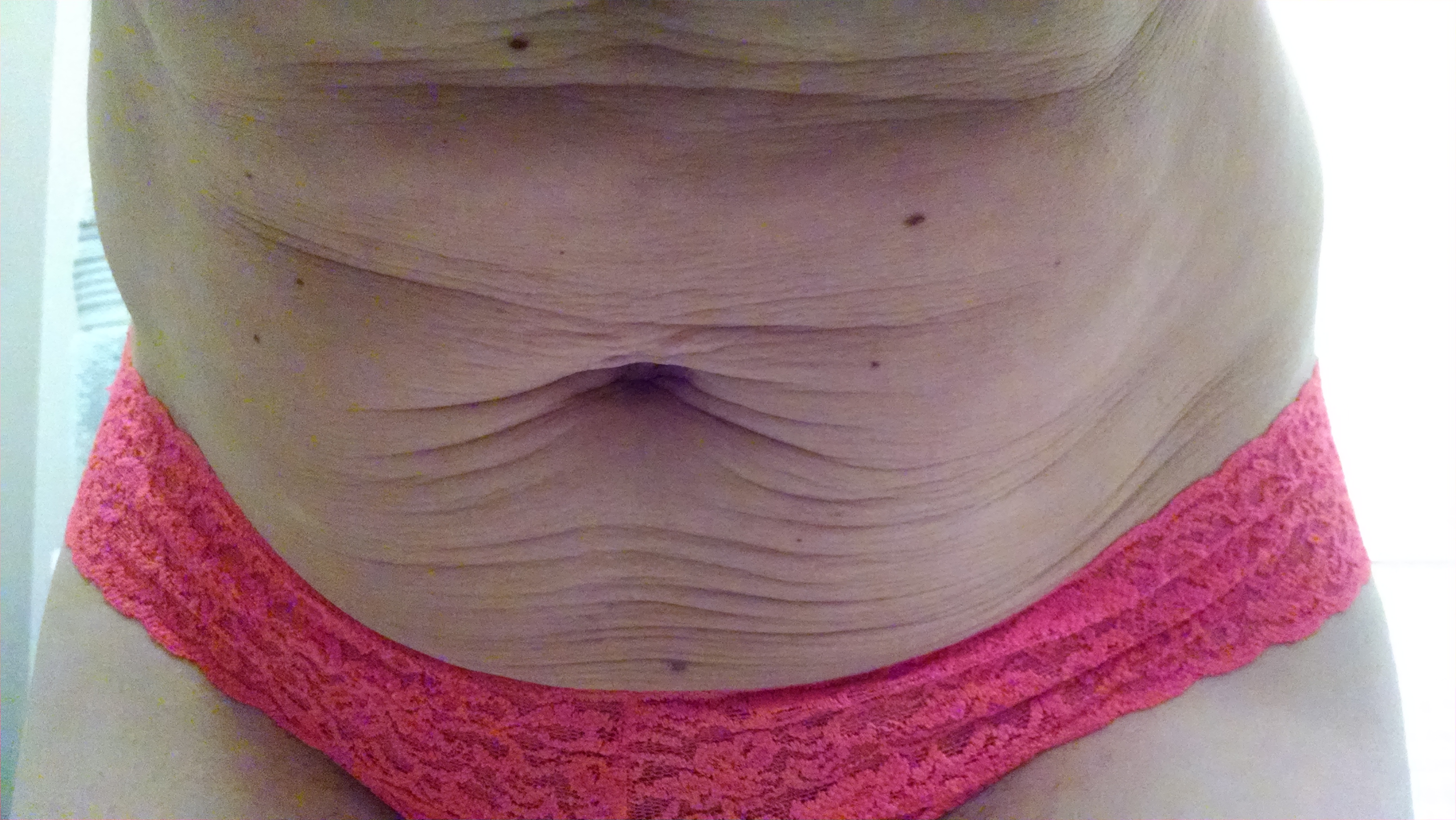
It really isn’t horrible. But it doesn’t feel “normal” to me yet. Or sexy. Or very comfortable. Especially since, though my stomach isn’t very big, the extra skin I now have just distracts me. When I bend over to blow dry my hair, this is what I see.

IMG_20140220_072531789

Yeesh. For some reason, I think I look like the Governator at the beach. Too much skin. Too square. (True story. I just put this picture into this post, and when Honest Girl saw it, she hollered, “Woooooah! That’s Mommy! Right there!” My toddler is able to recognize my mushy parts. Awesome.)

A few months ago, the internet exploded in rage over fitness trainer and mother Maria Kang, who posted this picture:

Maria_Kang

People said she was fat-shaming. They said she was setting unrealistic expectations. They said that she was placing undue pressure on mothers who are already asked for far too much. And I nodded in agreement. Yes. Bad Maria Kang. Bad.

But, honestly? I also want to be her.

I wish that I looked like that.

I started counting my excuses.

Baby. Toddler. Dissertation. New house. Endless winter. Workaholic husband.

But are those excuses? Or are they reasons? Is there a difference? And does that matter?

I’m actually embarrassed posting these pictures to show that, 6 months out, I’m not any closer to looking like that.  I really thought that I’d be closer. Because I want to be. I just don’t know how to right now.

The last few weeks, I’ve been experiencing some problems with Honest Girl and Honest Baby’s daycare, specifically, with the woman who assists in Honest Baby’s infant section. <Sidebar> The nature of the problem isn’t important.  I’ve had long discussions with the director about the issue, and, as far as I’m concerned, it has been cleared up. I’m not one to hold grudges.  Mistakes happen.  People sometimes use poor judgment.  Forgive, but never forget.</Sidebar> Though we held a meeting and talked the issue through, I was still nervous about sending the girls to daycare this morning.  Would the person I had complained about treat them differently?  Would she be bitter?  Would she resent me, and therefore my children, by proxy?  Would I be forced to pull my kids out of there?  Was my complaint going to be responsible for a hostile environment for my girls?

I brought them in to the center, left Honest Girl to her breakfast and her “boyfriend” (she currently has two. One is the boy next door, and the other is a boy at daycare who apparently likes to hug her. A lot.), then took a breath and brought Honest Baby to the infant area.  The woman I had complained about smiled, sheepish.  “Can I talk to you?”  I smiled back.  I suddenly felt like a small child.

She apologized, repeatedly, for her actions with Honest Baby, and begged me to not remove the girls from the center: “We all just love them.  They’re the sweetest little things.  They love each other so much.  It’s just wonderful to see every day.”  I smiled, knowing that, for all of the other things that might be chaotic in my household, my girls really do love each other. Honest Baby smiles with her entire body whenever Honest Girl comes over to her, and Honest Girl loves to bring Baby her toys, her blanket, loves to hold her hand and kiss her, and help burp her.  At least once a day at the center, Honest Girl walks over to the infant area and spends some time with Honest Baby.  She calms little sister down, makes her smile, and it melts their caretakers’ hearts.  I nodded, “I know.  They’re crazy about each other.”

“And about you.  You know, you’re a perfect mother.”

I was taken aback.  Perfect mother? I started to shake my head.

She reached out and put a hand on my arm.  “No, no.  I’m not just saying this.  God’s honest.  I see you drop them off every morning.  I see you ask for kisses, and hugs, and tell them that you love them.  I see how their hair is always combed, and how you put them in nice, clean clothes every day. You are a really, just perfect mother.  I’ve always thought so.”

I had started crying without realizing it.

She continued, her eyes filling. “And the way those babies love each other?  They don’t just know how to do that.  Babies have to be shown how to love like that.  They have to see it somewhere.  They get it from you.”

I looked away. Perfect mother. Perfect mother? I thought about the time-outs I had to give Honest Girl this week, the night I let her eat a hot dog and bar-be-que chips for dinner, the time I let Honest Baby cry in her crib because I couldn’t bring myself to get out of bed for the fourth time, even though I knew that she had a little head cold and just wanted to snuggle.  I though about my dirty bathrooms, and grease-covered range. Perfect mother?

I think I said thank you.  I hope I did.  But it couldn’t have come out as anything other than a whisper as tears rolled down my face.  Regardless, she pulled me to her and hugged me, tight.

Every day, at some point, I feel overwhelmed.  Every day, I feel anxiety.  Every day, I convince myself that I am permanently damaging these incredible, young souls that are under my care.  But her words made me realize something.  When was the last time, parents, that we thought about how we’re perfect for our children?  When was the last time somebody told you, without instigation, that you are doing a good job?  When was the last time you admitted that, yes, the dirty dishes have taken over, but I just made my toddler laugh, and felt, honestly and truly, that that was enough??

So let’s start right now.  Right here.  How do you feel perfect as a parent?  What things make you feel overwhelmed?  I’ll bet, once you write it out, you’ll find that the bad stuff is easy to let go of, and the ways that we are perfect will be things that we can hold on to, all day long.  You don’t have to share your name.  At the end of today, I’ll collect all of your responses, and copy them to the end of this post, so that the whole world can bask in our collective awesomeness.  This can be completely anonymous. I just want you to think, really hard, about how great you are. Because you are.  You all are.  I promise. Just perfect.

image

Because they always think you’re perfect. No matter what.


I’ll start:

Name: Rachel

I am a Perfect Parent When I . . . I am great at story time. I do the funny voices, I yell, I emote, I wave my arms. I can make my girls laugh, and even my infant, who doesn’t understand language yet, is mesmerized by mommy at story time. I know that I’m helping instill in my girls a lifelong love of books. I’m also a really good cook. When I make dinner, I *make* dinner! And, often, we will all sit at the kitchen table and eat dinner as a family. Together. That’s important to me, and I think I rock it.

I Feel Overwhelmed as a Parent When . . . When I think about actually organizing, cleaning, and maintaining my house, I have a small aneurism. It’s too big, there’s too many places for dust to collect, or cobwebs to form. And don’t even get me started on the sad shape of my toilets! I have finally made peace with my vacuum cleaner, only to trade clean floors for dirty bathrooms.

← Back

Thank you for your response. ✨

I’m taking a break from my “Perpetual Twilight” series to talk about something happy and awesome: Christmas crafts!  I don’t know if it was the Downgrade that was squeezing my budget, my new friendships with local moms who are always doing the cutest, most wonderful family crafts, or just my own incredible need to do something creative (yet feel productive at the same time. Blogging?  Super creative.  Not exactly recognizable as a productive activity, however), but I went a little nuts with the homemade this year.  Here are some of the Christmas Crafts we have undertaken in the Honest House.

This is going to be a picture-heavy post, and, sadly, the quality won’t be all that great because most of these shots were taken with my phone. I’m not one of those great DIY bloggers who take professional-grade pictures of their work.  But who cares? ‘Tis the season to turn the brown spot on the tree into the corner, and admire the green foliage before us!

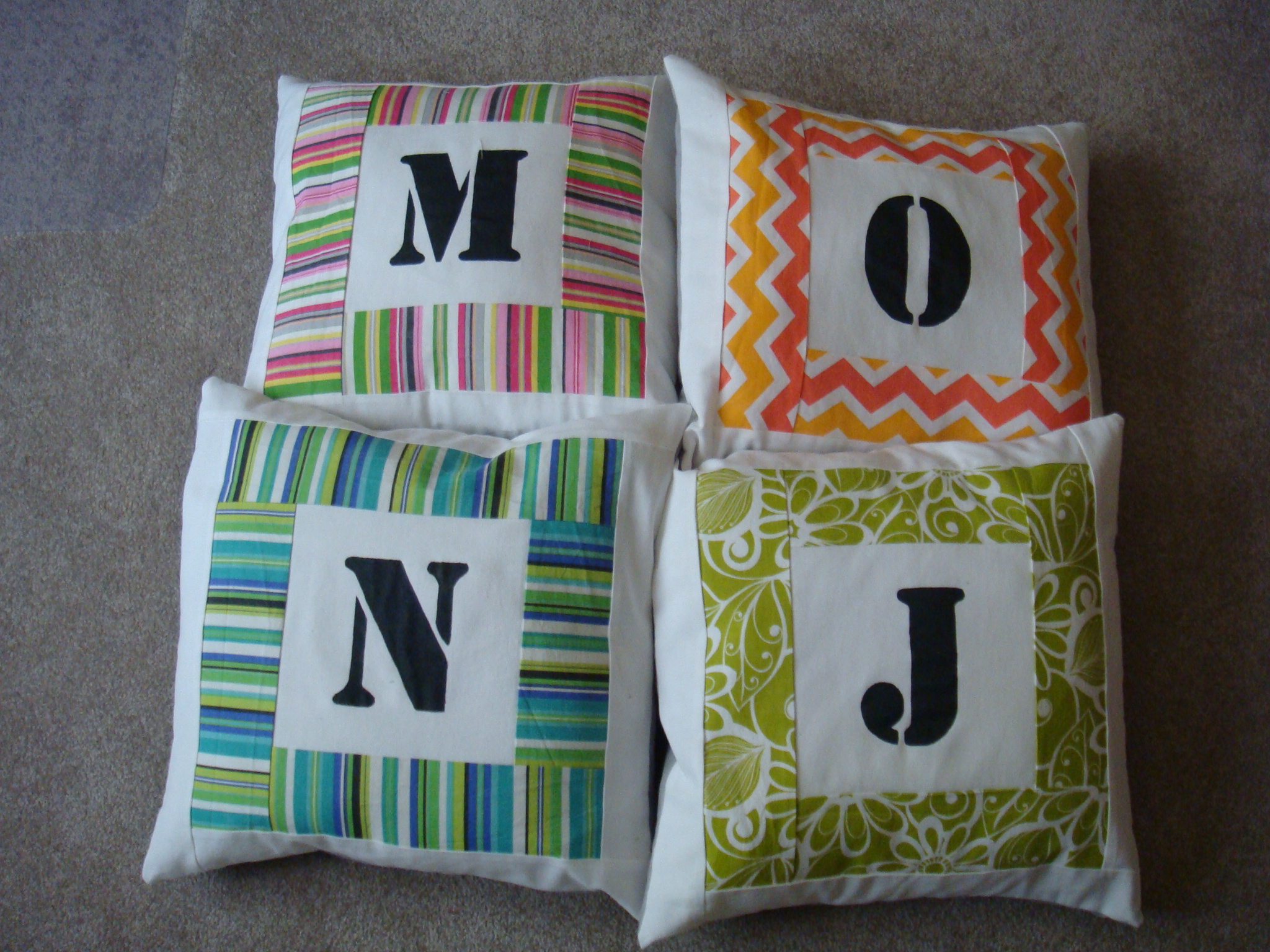
Christmas monogrammed pillows.

NOEL!

NOEL!

Honest Girl and Honest Baby have 10 “cousins” (most of whom are only the relatives of our choosing), and every Christmas, I usually get them all a little something. I am not the fun gift-giving Aunt. I usually get everybody a book and an article of clothing—pjs or a tee.  Snore. Yawn.  I mean, those were the gifts that I loved getting as a child, but I had a rock collection and read Crime and Punishment in the sixth grade, so what the hell do I know.

K & O are sister and brother. L & E are sisters. J & G are brothers.

K & O are sister and brother. L & E are sisters. J & G are brothers. I tried to coordinate patterns and colors according to family.

M & N are sister and brother. O & J are only children.

M & N are sister and brother. O & J are only children.

But this year, I decided to try and make something for all of the kids.  Again, nothing super exciting, but something that they could call all their own.  I know that Honest Girl is at that age where she likes to identify every item in the house according to who “owns” it (“Mommy’s pants.”  “Daddy’s nose.”  “Baby’s blanket.” “Girl’s shirt.” “Girl’s light.” “Girl’s cookie.” “Girl’s tree.” “Girl’s remote?”—She really tries hard to convince us that everything in the house is hers).  How cool would it be if I could manage to make something that could be displayed in a family room or sitting room (a “grown-up” space), but that was identifiable as belonging solely to the kids?  I decided to try two new things for these pillows: making quilt blocks, and fabric painting.  I used a stencil with a sponge brush, some matte charcoal grey fabric paint, and created 20×20” pillows with a simple log cabin quilted top.  I used some heavy cotton fabric so that they would be completely washable and super-durable.  Because kids.  The results aren’t perfect by any means, but I’m pretty proud of them!  Inspiration and basic pattern instructions found here: http://thehappyhousie.com/?p=2027.  Like her, I used Ikea pillow forms. Unlike her, I found the Ikea forms not exactly true to size. They were closer to 18×18″.  Still a sizable pillow, but it caused me a headache for the first couple of tries! Apparently Ikea is great for storage solutions for a 600 square foot apartment. Not so great with measuring. Who knew?

I wound up spending about $10 per pillow on these. Not a huge savings (I usually try to spend only about $15 per child for Christmas presents), but I like these better. I really tried to personalize every one.

I spent a long time selecting fabrics that I thought reflected the personality of the children. K is a classic beauty. J loves superheroes. O is girly, and a little anal retentive. She'd respond to the precision of a nice, geometric chevron.

I spent a long time selecting fabrics that I thought reflected the personality of the children. K is a classic beauty. J loves superheroes. O is girly, and a little anal retentive. She’d respond to the precision of a nice, geometric chevron.

<Sidebar>Honest Dad is a crafting Fascist.  He’s a Craftscist.  He thinks that my stenciling is messy and unimpressive. I’d say it’s a “two-foot” job.  From two feet away, they look really good.  If I had used quilting cotton (finer and thinner woven cotton) they would have probably looked better, been smoother, etc. But I wanted to use a nicer, thicker fabric than that, because of this, you can see the way that the fabric paint really shows the texture of the fabric’s weave. But they’re for the under-ten crowd, so I’m not too worried about judgment and anal retentive nit-picking.  I say that the Craftscist is just too much of a stressed out perfectionist to see the beauty in my work. Relax, baby. It’s just fabric.</Sidebar>

See? About a two-foot job.

See? About a two-foot job.

Christmas dough ornaments. Oh, I had such plans for these. I remember my parents’ salt dough ornaments that they pulled out every year.  They made them in the winter of 1970, during their first Christmas as a married couple.  They were too poor to buy ornaments, so they made all of them instead.  Only a few remain from that first batch, but my mother puts them on the tree every year.  And here I was, with my own daughters, starting our family traditions. We would bake them, Honest Girl would decorate them.  Honest Baby’s chubby hand print would adorn them. I’d sign them “Christmas, 2013” on the back, and years from now, I’d pull them out and show them to my gorgeous, grown daughters.

I found the recipe online, and followed a commenter who suggested adding a half teaspoon of cinnamon to the batch to give it a nice smell (which is really noticeable after it sits packed away in boxes with the other ornaments for a whole year).  I mixed the dough, got Honest Girl to help me knead and work it.  She played with the flour while I rolled it out to a lovely, smooth consistency. Smiles all around.  Fun family times.

It was only after getting the dough all prepared that I realized I didn’t have any cookie cutters.  Any.  At all.  Not a star, not a heart, not a Santa, or a snowman, or even a circle.  And my neighbor—the baker.  That’s right.  She’s a baker.  Like, for reals.—didn’t have any either. Had no idea where they were.  Must’ve gotten lost in the move. Oh! Wait.  Here are some.  They’re a set of cookie cutters for a baby shower.  Here’s a baby carriage, and a onesie, and a teddy bear, and a rocking horse.  Can you use those? I looked down at my dough, rapidly drying out on the board before me.

I guess I have to.

So, we have a bunch of baby shower cookie ornaments.  Undecorated.  Why undecorated?  Because the dough made Honest Girl’s hands feel weird, and she didn’t like how cold the finger paints were, and Mommy kept telling her she couldn’t put the markers in her mouth, and she was exhausted, because the ornaments took about three times as long to bake and solidify as the recipe said they would, and they’re just cookie lies because they look like cookies but you can’t eat them!

Just cookie lies...

Just cookie lies…

She begrudgingly half-colored three cookies, threw another one on the ground and cracked it, then went down for a nap. I didn’t even try to put Honest Baby’s handprint on one.  Besides, it wouldn’t fit on any of them.  I’m going to buy some cookie cutters for next year, and make this happen, dammit.  But for now, those three are sure pretty on my tree.

I love this teddy bear Honest Girl decorated. It almost looks like he's holding a rose!

I love this teddy bear Honest Girl decorated. It almost looks like he’s holding a rose!

“Cannolirolls.”  I adore cannolis.  How could you not?  They’re so decadent, and rich, and heart-cloggingly bad for you.  But they’re a pain in the ass to make.  So I don’t make them.  Instead, a few times a year, Honest Dad and I will buy a couple from the bakery section at the grocery store.  Often, these won’t even make it home, and we usually walk through the door with our guts spilling over our belts, powdered sugar creased into the corners of our smiles.

But they’re expensive that way, and I wanted to make some cannolis this year as a little Christmas treat for Honest Dad (and for Honest Girl.  And for me.  Okay, mostly for me).  I started looking up easy cannoli recipes online, and came across this: http://www.braumeisterswife.com/2013/03/quick-phyllo-dough-cannoli-with-whipped.html.It was genius.  She took tin foil, rolled it into a long tube, coated it with non-stick baking spray (or just butter, y’all), and wrapped her dough around it to make the cannoli tubes.  She baked them as usual, then, while they were still hot, she just slid them off the tin foil and—voila!—cannoli shells!

Only I didn’t have any phyllo dough.  Or ricotta cheese (the traditional cannoli filling).  But I had Pillsbury rolls.  And cream cheese.  And chocolate chips.  Those three ingredients alone have to make something good, right?  I did the exact same procedure, but with the Pillsbury rolls, and made a cream cheese frosting (I tried to make it more cannoli-esque with the addition of nutmeg, as she recommends, though I didn’t use any milk in order to keep my filling as stiff as possible).  I put the frosting into a piping bag, and squirting it into the Pillsbury rolls.  Then, I made a chocolate ganache and drizzled it over the top.  My favorite recipe is from Martha Stewart.  It requires corn syrup, which, for all its faults, is great for a ganache because it ensures that it doesn’t harden.  The chocolate stays a little soft and pliable, so I think it sticks to the top better and doesn’t flake off while you eat it.

They’re not cannolis.  They’re cannoli facsimile.  But, shut the front door, they were good.  Next time, I may sprinkle a little sugar on either side of the Pillsbury roll before wrapping them around the tin foil, just to cut the buttery taste a little more.  Sorry I don’t even have a crappy picture of these.  They were gone too fast!

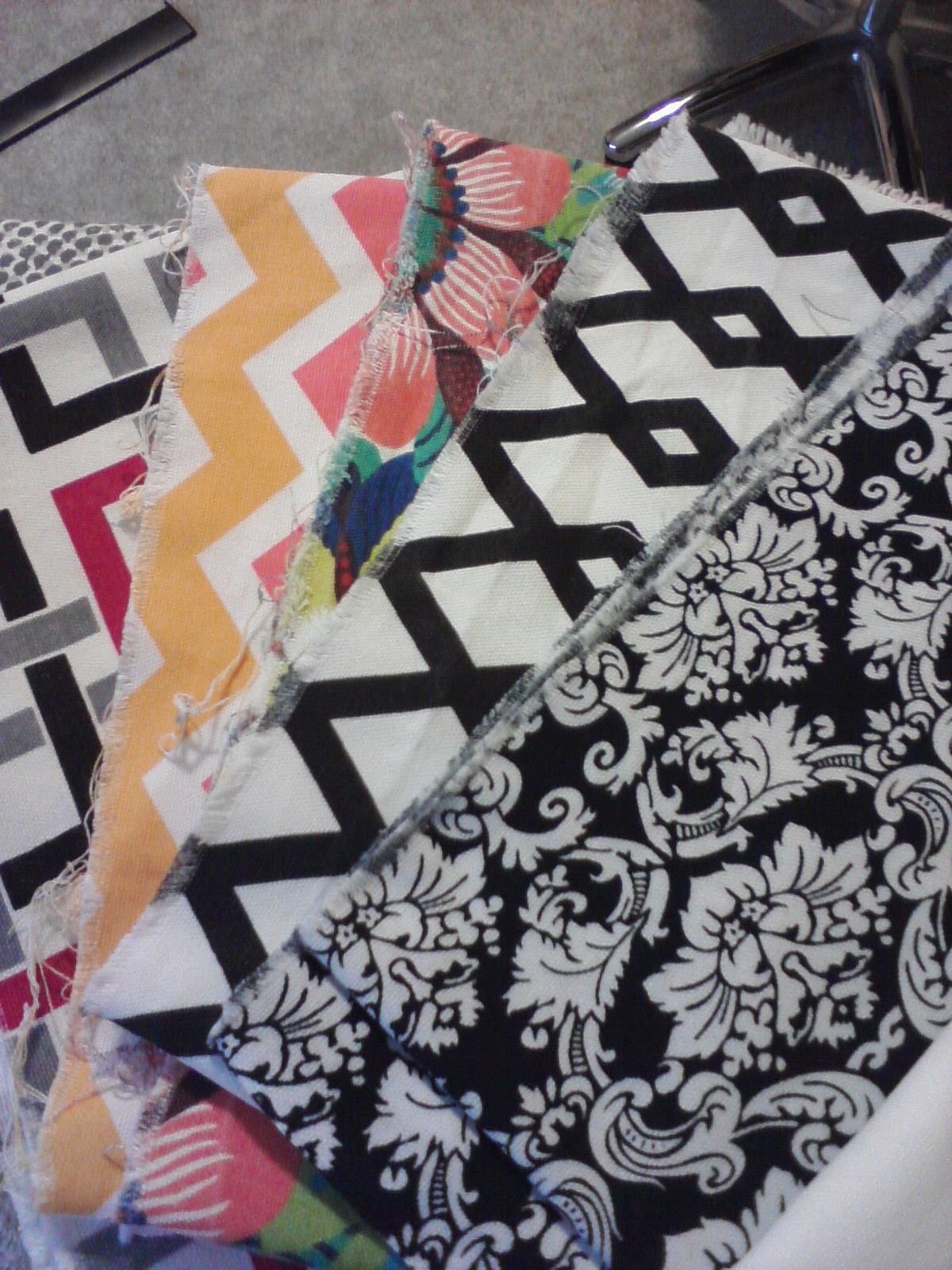
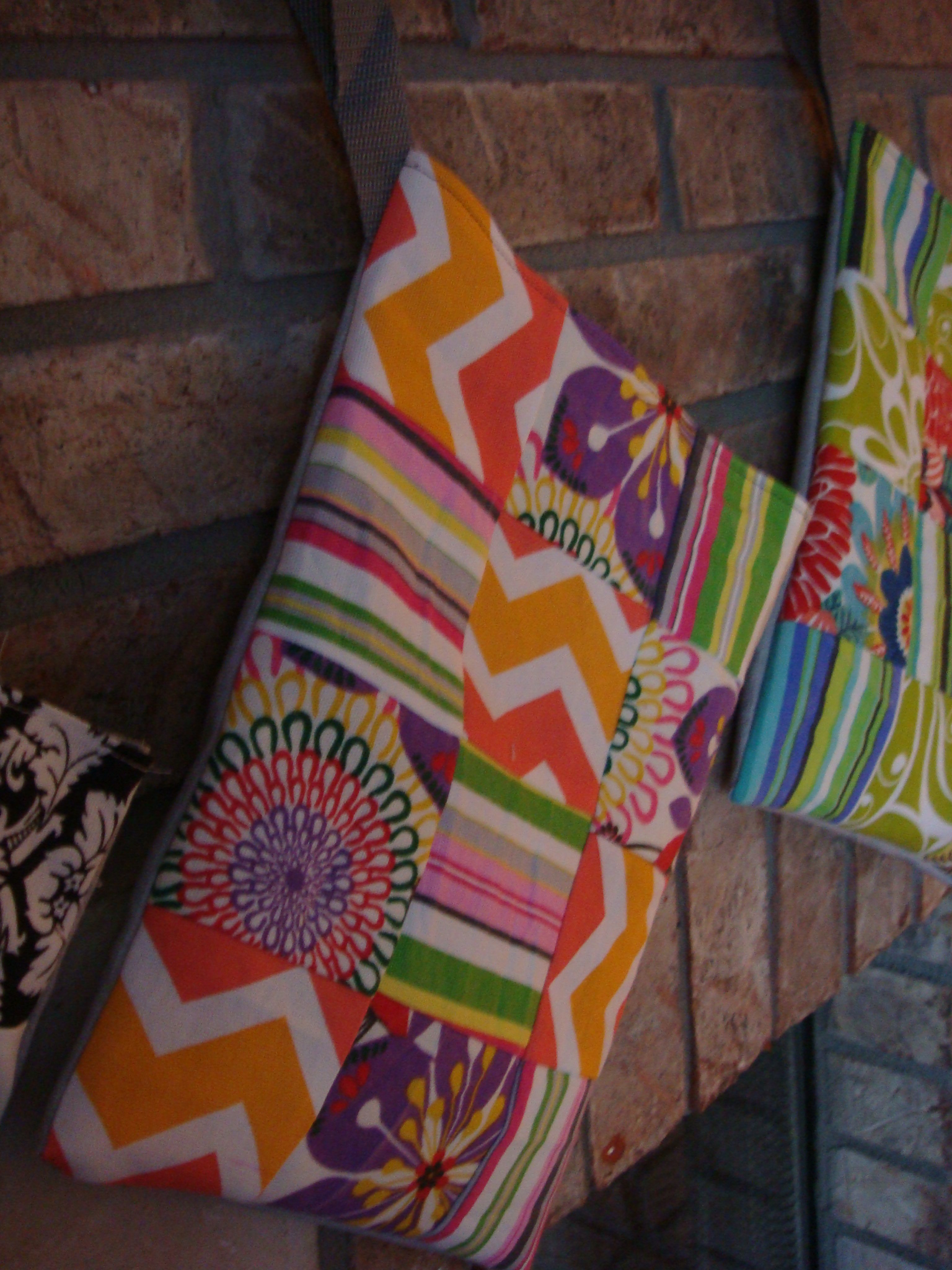
Stocking bags. The dilemma: no Christmas stockings.  The solution: Make Christmas stockings out of fabric scraps. Further dilemma: I have no idea how to make stockings.

But I know how to make bags.

Honest Dad, Honest Mama, Honest Girl, and Honest Baby's Christmas bags, respectively.

Honest Dad, Honest Mama, Honest Girl, and Honest Baby’s Christmas bags, respectively.

This was a quick solution I concocted while trying to decide how I was going to make sure we all had a least a little Christmas stocking, without spending a bunch of money on nice store-bought ones or devoting a lot of time to their construction. I made these between 1 and 2am last night. Because something was going to get hung by the chimney with care, dammit! And if there’s one thing toddlers love, it’s putting stuff into and taking stuff out of something. Over and over again. Bring on the Christmas bags!

Boom.

A temporary solution, but not an unpleasant one, if I do say so myself.

A temporary solution, but not an unpleasant one, if I do say so myself.

A close-up of Honest Girl's bag. You can see that I used scraps from my pillow project.

A close-up of Honest Girl’s bag. You can see that I used scraps from my pillow project.

Hooray for Crafty Christmas Goodness! I’m a crafty novice, so please bear with me if these are horrible, but they’re way more involved and awesome than anything else I’ve ever attempted before.  So I’m just rolling with it.

Merry Christmas, everyone.  And the happiest of New Years.  I have two healthy, beautiful, stubborn, willful girls, and a doting Craftscist by my side. It’s going to be a good year.

Today, I want to veer off of my usual discussions about family, sex, and poop to talk about the latest trend in female-specific marketing: Multi-Level Marketing “schemes” (MLMs). You’ve probably never heard of “MLM,” but you know what they are. 31, Avon, Mary Kay, Origami Owl, Scentsy, Shakeology, Premier Jewelry, Pure Romance, Pampered Chef (I am literally only looking at my own Facebook feed right now to compile this list). All of those companies that your Facebook friends gush over, post pictures from and about, and fill your “Event” box with invites to “parties” to. These are the companies that have morphed your former high school friends into “consultants,” “guides,” and (my personal favorite) “stylists.”

<Sidebar>Seriously, ladies, can’t we all just have parties? Whatever happened to “Hey! I ordered pizza, have the complete box set of ‘The L Word,’ and three unopened bottles of cabernet! Let’s have a party!” parties? We can do better than this! Do we really need to sling crappy merchandise to friends and family who felt obligated to show up because of their love and respect for you, just to have an excuse to get together? How about these instead? 

  • I just got my husband a new grill for Father’s Day. Let’s let the kids destroy the backyard and eat cheeseburgers! 
  • Hey! We made it through an entire summer with the kids, and nobody’s dead or insane! Back to school party!
  • I put on an old pair of jeans and found a $20 bill! Party time!
  • Or what about, “I miss your face. I miss all your faces. I miss our talks. Come over and let’s hang out again.”

See? No buying or selling required. Just call up your friends and ask if they want to come over. It’s that easy. 

And serve booze, for Christ’s sake! This isn’t Utah!</Sidebar>

Here’s the way MLMs work: an individual (usually a woman. These things are targeted specifically to stay-at-home mothers and women in what have been called “transitional” stages—just married, just had children, just graduated college, just divorced, etc.) joins a company under the auspices of becoming a salesperson for that company. Of course, simultaneously, this individual/salesperson is required then to recruit other salespeople as a way of gaining a portion of their commission on top of the commission they can already generate from the sales of their own products. Here’s a great quote and visual from Stephanie Peterson of Fairground Media:

The neverending loop of recruiters-recruiting-recruiters is incentivized by the fact that salespeople earn commissions on any sales made by people “beneath” them (people they helped sign up with the company).

In case that explanation wasn’t completely clear, here’s a great visual to drive it home:

I’m not saying that this is a “pyramid scheme” per say, but the whole set up does have this three-dimensional triangle kind of feel to it. But maybe I’m just being a hater who wants people to stop telling me that I need a new vibrator in order to feel empowered as a woman. Who knows? (And my vibrator is doing just fine, thanks for asking. I’m a big girl. I can walk into the Lion’s Den all by myself.)

Here’s the thing: MLMs sound like gooey, chocolate-covered awesome, especially for those “transitional” women I mentioned earlier. I get it. I’m one of those transitional women. You set your own hours! You get to be involved in a community of business women! You feel empowered! (“Empowered” is a word that is used repeatedly in MLM propaganda literature. That and “Christian.” Did you know that 31 really pushes a “Christian” propaganda message? Like ordering one of their Chinese-manufactured, monogrammed storage boxes is sanctified by Jesus or something.) You get to decide how much money you want to make! You have your own business! You can sell products that you believe in while getting deep discounts on the products you want for yourself! You can take care of your family, while making supplemental income for them!

Wow, that last one really gets me. As a stay-at-home mother, I want nothing more than to feel I can “do it all.” That I can bring home at least a little bacon, while still devoting my time to my children. That I am a useful member of the household, responsible for contributing financially instead of just spending. It’s tempting. And I get why so many women I know fall for it. I really do. I empathize. Seriously.

But, ladies, it’s bullshit.

The Federal Trade Commission (FTC) released a report in 2008 calling MLMs “extremely viral and predatory.” Judging from tax information, the report concluded that 99% of “salespeople” in MLMs end up losing money:

Failure and loss rates for MLMs are not comparable with legitimate small businesses, which have been found to be profitable for 39% over the lifetime of the business; whereas less than 1% of MLM participants profit. MLM makes even gambling look like a safe bet in comparison.

I swear I did not make this up, ladies. The FTC just said that MLMs were not comparable to “legitimate” small businesses and that gambling was a safer investment. So, beyond just being an incredible annoyance for all of your friends, doesn’t that raise a whole lot of red flags?

And I know that I’m going to get a barrage of comments about this post. “I love what I do!” “I am not taking advantage of anyone, and NO one is taking advantage of me!” “I AM profitable in my ventures!” “This venture has been the best decision of my life. Hands down.” And, “Why the hell do you care how I choose to spend my time and my resources?”

Okay, okay. Settle. Maybe you are profitable. Maybe you have found a company that answers all of your needs, and you are successful and pleased, and (dare I say) empowered by your relationship with your MLM. But I have a few questions for you:

  1. Is it sustainable? After that first flurry of orders. After that initial “You go, girl!” from your dedicated friends and family members. After the first season has been rendered obsolete and you discover that you have to order all new catalogs or product, will you still be able to convince your neighbor to host another party? Buy another monogrammed bag? Desire another lemon zester? Once your close friends have all bought a necklace from you, or have joined you in “businesses” of their own, who can you turn to? Do you have another plan? Cold calling? Advertising? Or (and this actually happened to me and a girlfriend of mine while we were walking around Target) approaching strange women at random and “surprising” them with a selling party by luring them in under the false pretense of “You have such beautiful coloring! Can I give you my card and call to see if you’d like to be one of our models for a make-up application seminar?” (This did actually happen, but luckily I got over the initial flattery, Googled her line, and found out that it was a selling tactic for a cosmetic MLM.)
  2. Have you really crunched all the numbers? I’m not trying to be condescending. Think about how much time you put into “your business.” How many hours? What are you getting paid for those hours? Are you paying yourself? Don’t you think you deserve to get paid? Are you giving away more and more product, just to make room for the new lines coming out soon that will render your current stock obsolete? What about the gas money? The cost of advertising? The cost of samples or catalogs or business cards? The time, expense, and energy it takes to make 35 canapés for your fifth selling party this month? I have been flirting with the idea of starting my own business from my textiles and weaving, and when I sat down and calculated, really and truly, what I would have to pay myself in order to make my time worth the work, I realized that I couldn’t compete in a real way with the Chinese companies who have flooded Etsy and cheapened the price of handmade, high quality goods.
  3. Why is this the way that you seek out community? This is a genuine question I have. Like I suggested in my <Sidebar> above, I just don’t know why so many women feel as though they’d never throw parties or have friends over if it weren’t for these sales pitches. I sympathize. I also almost don’t feel as though I’m “important” enough to warrant asking people to take time out of their days and lives to, you  know, be a part of mine. But why selling? Doesn’t that go against everything we ever learned about social etiquette? I mean, you would just insult your Mother-in-law if you offered to pay her for the Thanksgiving dinner she just made, right? Because that was done as a gesture of love, not finances. Being a stay-at-home mom is isolating and lonely, but there are ways of expanding your community that don’t involve taking advantage of your friends (and don’t you feel like you’re taking advantage of them? I mean, seriously?).
  4. What about opening your own small business? And I mean, all on your own? No Big Brother watching over you. No frets about commission. No pressure to recruit. You probably won’t make very much money right off the bat (again, those initial, heady first sales seem to really draw people in with unsustainable promises of more to come), but you can pursue products that you GENUINELY believe in, or even that you made yourself. Now that would be empowering!

And there it is. Why I have just lost about 15 friends. Maybe 20. Easily. Because being recruited for one of these companies, or invited to one of these parties, or coerced into purchasing these products has become as common for women in America as a daily stop at Starbucks or McDonalds.

But, finally, why do I care? If you decide that this the best decision for you, then who the hell am I to judge? Well, there are several reasons why I give such a big fuck. Firstly, and most importantly, because I see these companies as being particularly predatory towards women. They are preying on our collective sense of failure, on our culturally-devalued chosen paths (mothers, homemakers, wives, unemployed college graduates, single adults, or underpaid employees in menial service industries). Men are traditionally lauded as the “businessmen” of the world. The leaders. The Don Drapers. Women are the secretaries. Mostly noticed for our big boobs. These companies play into those uncertainties and tensions with promises of self-sufficiency and guilt-free social productivity (which in America we translate into dollars). Again, they want us to feel as though we can “have it all.” Business, family, success, profits. And all in a woman-centered, woman-friendly environment. They’re not fixing any problems, though. Because when those 99% of women fail at their new “businesses,” when they lose an average of $900 to $1000 annually (FTC) at this venture that was meant to make them feel like the smart, capable, and savvy women they didn’t realize they already were, these companies send women into spirals of guilt, depression, and bitterness. I know. They report it themselves on Pink Truth, a website cautioning women against joining MLMs with true stories that the companies don’t want you to hear: the stories of the 99%. Read the forums, if you dare. These women are mad as hell, and they’re not going to take it anymore.

What a bitter path to empowerment.

Secondly, I care about these decisions, because I can’t compete with them. As I mentioned above, I’ve been wanting to open my own small business, selling hand-woven textiles (bags, blankets, rugs) and beadwork (not jewelry on a string, but purses, cuffs, and tapestries also woven on a loom). I also looked into making diaper bags, looking at solutions that I didn’t see currently on any market. I did my research. I opened a spreadsheet. I calculated how much it would cost for supplies. For the time to manufacture these goods. How much inventory I would need to set up a respectable “shop” (read: booth at a local art fair). How much a website or online domain would set me back. How much I would have to sell to make up for that initial investment. Finally, I had to ask how much I would have to sell to make it worthwhile. To actually turn a profit. I flirted with the idea of the “purse party.” But then yet another invite for a 31 Gifts party came through my inbox. And I balked. No matter how overpriced the goods are from these companies (and make no doubt, they are overpriced) I couldn’t compete. Not if I wanted to pay myself something, instead of just covering my initial investment. These companies have the power of large manufacturers, mass-producing their goods, often overseas. I can find a “beaded purse” online for sale for $25. It takes me about 30 hours of work to make just the outer beaded portion of one of my clutch bags. Then I have to make a lining, a handle, decide if I want to install a zipper, or a snap, or a flap closure. Then I have to actually assemble and make the damn thing. I can’t pay myself less than $1 an hour, no matter how desperate I am for recognition and a sense of personal value. I’d value myself less if I let my wares go for that low. And I didn’t want to take advantage of my family or friends by forcing them into buying my goods using these high-pressure “party” techniques. I couldn’t do that ethically. And that’s why I can’t compete. And that’s why I care. Because I know I’m not the only one. I have good friends who are also struggling artisans, trying to genuinely create something unique and high-quality, who are being shut out by people who have been brainwashed into believing that they are “stylists” and “designers” for these large conglomerates.

So that’s why I care. And maybe I shouldn’t. Maybe you’re all right and it’s just none of my business and this whole post is just me venting my personal frustrations and failures.

Either way, stop inviting me to your “parties.” I’m not going. But I’d love to just hang out sometime. For no reason at all.

And that’s a promise you can take to the bank.

I didn’t sleep well last night. Twice I woke up with intense, sharp pains in my stomach and abdomen.  I told myself that if it happened a third time I’d be waking up Honest Dad and telling him to meet me at Labor and Delivery (I didn’t think that they were contractions, but in a sleepy haze, it’s hard to make these distinctions, and at almost 32 weeks pregnant, it’s better to be on the overly-cautious side).  I was uncomfortable all night.  I knew I was keeping him up.  I tossed.  Lay on my side.  Lay on my back.  Try the other side.  Stack up pillows to prop my head up.  Cross my legs.  Uncross my legs. Kick one foot out of the covers.  Tug on the covers that Honest Dad had stolen (again).  Put my hand under my head.  Fold my hands across my belly.  Pull everything, even my tee shirt, away from my belly and just think about breathing.  Breathe.  Just breathe.  There.  Like that.  Just like that . . .

Alarm.

Instead of waking up Honest Girl to send her to daycare for her usual 7:30 start time, I decided to let her sleep in.  (Poor girl’s working on three molars right now, and those things just look painful.  They’ve reduced my usually easy-going, completely non-picky eater to a pile of tears who can only handle applesauce and mashed potatoes, and who now has to eat her favorite food [cold watermelon] with her front teeth only)  While waiting for my husband’s alarm (set for just a half-hour later than mine), I read a blog post that one of my girlfriends had linked to: The Three Things I Learned at the Purdue Conference for Pre-Tenure Women: On Being a Radical Scholar.  It was a beautiful post, about how to be an “academic” woman while still being a “whole” woman.  The author argued in favor of openly wearing our femininity, and not feeling ashamed for feeling overwhelmed, underappreciated, and, most-importantly, of not feeling guilty or somehow less-than for wanting just a day where we can put our work away—physically and (the nearly impossible task) mentally—and just snuggle and play with our children.  How can a woman be a “radical scholar” while at the same time being a wife and a mother who knows that those things will always rank higher on our priority list than the tenure-track?

One part of the post in particular stopped me cold.  While at a session, the author, Dr. Kate Clancy, was asked, “It is 5 years from today. If you were wildly successful in your work and personal life, what will you have achieved?”  She described the answers that the other women in the room gave:

It was powerful to hear women’s answers all around the room. They gave bold answers: to become a leader in their field, to embody social justice values, to raise a family, to be on the path to becoming a provost, to have several federally funded grants. Like many women, I have been chastised in the past for daring to say that I want to lead a big life. But here was only encouragement and excitement.

I stared at the screen.  With the exception of raising a family, nothing in their answers meshed with my own.  Nothing.  Grants?  Provost?  Leader?  In my head, I started to list all of the things that I wanted to have in five years.  What would it take for me to consider myself “wildly successful”?  I made a quick mental list:

  • Have my girls be intelligent, kind, loving to each other, but still maintain that fierce independence that Honest Girl especially is starting to exhibit (Watching her develop a preference for what hair clip to put in her strawberry blonde hair, or what color socks she should wear, I just think about the final scene of Bull Durham, where Kevin Costner tells Susan Sarandon, “I got a lotta time to hear your theories and I wanta hear every damn one of ’em.” <Sidebar>Best sports movie EVER.</Sidebar>)
  • See my husband advance in his new career.  Not necessarily monetarily, but in terms of his abilities, his passions, his responsibilities, the respect he commands.  And, okay.  Monetarily would be really nice too.
  • Have an article or short story published in the New Yorker, or some other literary magazine, and have regular freelance work for smaller, local publications.
  • Have my novel and memoir completed and at least being looked at by literary agents and publishers.
  • Finally run a half-marathon in a slow but respectable ten-minute-mile pace.
  • Slowly work on our new house and make changes to make it feel more like “us.”  Maybe by the end of those five years, we’ll have enough time and money put away to start tackling the downstairs kitchen and bathroom remodel we keep fantasizing about.
  • Maybe have a third child. A boy.  <Sidebar>Is it wrong that after two girls, I would prefer to have a little boy?  Am I not feminist enough for admitting that?</Sidebar>

And that was it.  Are those “bold answers”?  Do my dreams constitute a “big life”?  Was that “radical” enough?  It certainly doesn’t sound like it.  And where was my PhD in all of this?  How did all of this scholarship and research fit into it all?  The truth is, I never even thought about it.  It didn’t factor in.  In five years, if all goes well, I’ll be able to sport the title of “Dr.” (hopefully, I’ll have that title before the year runs out), but I’m sweating and working and stressing on that title now so that I can finally throw it aside and get to work on what I really love—my kids, my husband, my writing, my fitness goals, “Team Family.”

Why am I doing this?  Why do I want this?  Do I want this?

Do I want enough?  Am I enough?  Am I—good God—typical??

Maybe I just need some sleep.  Maybe I just need the catharsis of non-academic writing (which is what I’m trying out right now).  Maybe I just want to spend some time, thinking about my new baby girl, focusing on her and on my body, and how we’re going to spend the next eight weeks in increasingly tight quarters together.  Maybe I need to figure out why it bothers me so much that I seem to be neither “radical” nor a “scholar.”  Why do I feel so uncomfortable “just” being wife, mother, writer, caretaker?  And can I ever actually do and be all of these things, if I feel as though I’m “just” those things?  Why am I feeling guilty for not wanting a “big life”?  Or is my definition of “big life” too small?

Either way, I’m going to sit down and work on my dissertation today.  I have a few short sections that need some serious attention, and I have not gotten the amount of work done these last few weeks that I needed to (family visiting, a teething toddler, the general malaise that comes with entering the third trimester during a heat wave—the reasons and excuses for this slacking are prodigious).  So I’m going to do my work.  I’m going to be a scholar.  Not a radical one.  Not really a willing one.  Not today.  Not right now.  But I’m going to be a scholar today, notwithstanding.

It’s been a rough morning.  And I’m frankly afraid of posting this blog.  I’m afraid that someone from my department, one of my committee members, could stumble across it.  Be angered by it.  Or disappointed.  Or frustrated.  But I’ll post this in spite of those fears, because maybe the only part of being “radical” that I can manage right now is to be my “whole self.”  Frankly, I just don’t have the energy to be anything else.

He was being sexy.  He was being complimentary.  He was being kind.  And what’s more, I’m pretty sure he was being honest.

The pictures flashed across the screen in a regular progression.

“Look, baby.  You look so good.  You are so sexy.  You still look like that.  You can’t tell me you don’t look hot.”

One file was from the summer of 2006.  I was 24.  Wearing a bikini.  Smiling seductively at my then-boyfriend behind the camera.  My hair was tousled and looked like it had been pulled back in a ponytail all day.  I wasn’t wearing makeup.  I had on a red hooded sweatshirt, half zipped. The top of the hoodie had fallen down.  It lay, rumpled in the crook of my elbows, exposing my shoulders. I had the distinct glow of a sunburn across my freckled chest.

He clicked the mouse again.  The next file appeared on the screen.  It was from the summer of 2012.  My daughter was only four or five months old at the time.  I was again wearing a bikini, my hair again showing signs of having been pulled back in a ponytail all day.  I wasn’t wearing makeup.  I remember the day he took those pictures.  I was arguing that I needed to buy a new bathing suit before we left for our upcoming trip to Las Vegas.  Some good friends were getting married, and my husband and I were taking advantage of their elopement to spend some much-needed alone time over a long weekend away.  My husband told me that I didn’t need to buy the body-camouflaging one-piece I wanted.  He took several pictures of me, modeling my old bikinis, hoping that when I saw myself as he saw me, that I wouldn’t feel so self-conscious. I was doing my best to look confident and sexy, but I could see the strain on my face.  I was holding in my stomach, standing with my thighs slightly apart, hoping to make them look thinner, less prone to cellulite.  My hip was cocked, trying to look firm enough so that the small bikini bottom didn’t cut into the soft, ample flesh.  I was trying to stand the same way in every picture, the images all looking stiff and uniform as my husband clicked through them.

I wound up packing the bikinis, but we never made it to the pool that weekend.

“That was only four months out.  Look how sexy you are after just four months.  And this one’s different.  You haven’t even put on much weight.  You’re going to bounce right back.  Just you wait. You already look so good.”

He was staring hungrily at the screen, his hand on my thigh.  He was speaking quietly, earnestly. He was being sincere.  He loved the images of me on our computer.

He smiled as he turned to look at me, but it quickly crumpled away.  He immediately dropped the mouse and folded me into his arms when he saw the silent tears streaming down my face.


I didn’t recognize the girl in either picture.


In less than two months, I will give birth to my second daughter.  My oldest child will be eighteen months old when her little sister gets here.  Since Saturday, June 5th, 2011 (the date of our intrauterine insemination), I have been either pregnant or breastfeeding.  I will be breastfeeding my second child as well, for at least 8 months.  When it’s all over, I will have nearly 4 solid years of rigid physical reproductive focus, and that’s not counting the year we spent in infertility.

I want my body back.

I’m not saying that I want my body to look like it did before I had children.  I don’t need to be that 24 year old in the red hoodie again.  I don’t need that tan, smooth skin.  Those muscular thighs.  Those firm, small breasts.  I’m adult enough to know that those days are gone.  I know that the body I’m occupying right now is going to be my “new normal.”  Softer, hairier, greater fluctuations from dark to light. This is going to be me now.  But I want some time to myself, time to acquaint myself with this new body.  I’ve been living in this body for two years now, but we’ve never been formally introduced.  I don’t know what it’s capable of, what it can do.  I haven’t pushed it to its limits (not counting childbirth, of course).  I don’t know how it feels when it’s just mine.  When its primary function hasn’t involved the creation and sustentation of my children.   I got pregnant with my second daughter only six weeks after weaning Honest Girl.  I barely had enough time to start looking at (much less appreciating and familiarizing myself with) the new, soft, empty breasts that had replaced the full, firm, milk-filled boobs that Honest Dad used to joke looked like leaky implants (the result of my over-production of milk).  I never made it back to the gym before this second pregnancy, and because of the bladder damage caused by Honest Girl, I haven’t even gone for a jog since early fall, 2011.  I don’t know how this new body breathes, how it moves, how it bends, how it flexes, how it dances.

<Sidebar>God, I miss dancing.</Sidebar>

Honestly?  I’m afraid.  Afraid that I’ll never feel normal in this new normal again.  Afraid that I’ll never feel confident, sexy.  Afraid that I’ll never be able to see my husband behind the camera and flash him that seductive, you-know-you-want-me look again.  Afraid that I’ll never recognize the girl looking back in the mirror.

There are so many unknowns with this pregnancy.  I have to have a C-section.  I have to be in the hospital three, maybe four days.  I have to wear stiff, strong stomach binders, and be on pain killers.  I have to have a spinal instead of an epidural, my torso and legs completely numb, perhaps unresponsive.  My stomach will be sliced and stitched back together, through skin, tendons, muscles, and organs.  I have no idea how my body will react to any of these things.  I have no idea how long it will take for the new normal to take hold, to establish itself.  I have no idea how my new scar will look, will feel, or where it will be.  I have no idea what the normal will look like on the other side.

I’m hoping to join a gym.  And, because I will be breastfeeding, I will be eating as healthy as possible.  For the sake of my new daughter.  Because for at least a little while longer, my body will be hers.  It needs to be.  It should be.  And for now, all I can do is hope.  Hope that the new normal will become a normal that I can feel comfortable about, confident in.  Hope that one day I’ll be able to look at pictures of myself and see what my husband sees, what he’s always seen.  Hope that, after my body is hers, it will be all mine.  Because only after it’s all mine, can I ever think about giving it to him again.