This weekend, my husband started practicing some songs for an audition that he has coming up. One of the songs, “Small Town” by John Mellencamp, actually stopped me in my tracks. For the first time ever, I listened to the lyrics and thought about them on a deeper, more analytical level.

No offense, Mr. Mellencamp, but that song is bullshit.

Please, allow me to clarify. I grew up in a consummate “small town.” I lived just outside of the county seat (my parent’s driveway is exactly 3 miles to the single stoplight in the center of town). I would ride my bike in to town during the summers, and park it either at my aunt’s house, or bring it inside the single-screen movie theatre my parents and aunt and uncle owned. Every day, I would clean the theatre, using the huge space as my personal Broadway, singing Janis Joplin and Les Miserables at the top of my lungs, practicing my grand jetes and pirouettes on the creaky, green flannel stage (Seriously. The stage was covered with bright green flannel. Don’t ask me why), and reenacting entire movie scripts while sweeping the enormous, 300+ seat space. When I was done, I’d pour myself a Cherry Coke, and wander outside again, looking for one of my cousins to pass the time with before I had to start my second job, bussing and waiting tables at a restaurant owned by longtime family friends. Or, if I was lucky and didn’t have to work that night, I might have ridden down to the harbor, and gone for long, solitary walks along the shoreline of Lake Huron, exploring the woods and streams, the Old Depot, and the ravines that were just as large a part of my childhood as my mother’s open-faced apple pies or my Uncle John’s perennially burned barbeque chicken. I had a great, wonderful, surprisingly innocent childhood in a small town. I graduated in a class of 61 students, most of whom had been in my class since preschool at the old church along US 23. My father taught my English, Speech, and Drama classes all four years of high school. My mother and aunt worked in side-by-side offices in a clinic 500 yards from my school. At one point freshman year, I was in theatre class with my big sister, and traveled to Knowledge Bowl tournaments with my big brother. My cousin and I graduated in the same year. My aunt handed me my diploma (pushing the Superintendent of the school out of the way). I was, eternally, surrounded by people who loved me.

But it was also very lonely.

I never quite felt as though “I can be myself here in this small town, and people let me be just what I want to be.” I loved books. I preferred reading to fishing. I hated hunting, abhorred guns, and I knew, even at a young age, that I was politically left of center, believing in social programs and help for the underprivileged as well as women’s rights. I didn’t like drinking, or drugs. Even pot held no appeal to me. I knew the entire score to Les Mis, Cats, The Phantom of the Opera, Rent, and Miss Saigon by heart. I was a soprano, and loved singing the high, operatic parts. I corrected people’s grammar (I don’t anymore). I loved school. Since the age of seven, I wanted to get my PhD. I felt more comfortable talking to my teachers than to my classmates. My sister, just a few years ago, pointed out that while we were growing up I never spoke when I was around a group of people. Which is why everyone was so taken aback when I got onstage. I was electric. A natural. I was (and still am) a terrible liar, but a good actress. I used my characters as a way to forget about being me for awhile. Because I had no idea who me was. My characters might have been drug addicts, suicidal teenagers, homeless drunks, or happy-go-lucky optimists who have to deal with disappointment, but that was their confusion, not mine. In my mind, I didn’t belong anywhere. Even though I knew that there were more people who loved and cared about me in the three-mile radius in and around Harrisville Michigan than anywhere else on the planet, I still felt like an outcast. (I’m sitting here, thinking about all of the houses in town. If I was in trouble, being chased, needed to call someone, needed a drink of water, I honestly don’t think that there was a single house in the whole city where I couldn’t have knocked and gotten my needs addressed. Really. I can’t think of a single one.)

In order to find anyone else my age who believed, behaved, and acted the way I did, I had to drive 40 miles north, to the next county, where the nearest community theatre was. I was a different person there. Closer to being me. But still not entirely free. Starting in junior high, I became a regular feature at the local theatres. My father would drive up with me, every night, to rehearsals. He’d accept some small part in whatever play I was in, then sit in the audience and grade papers while I rehearsed and socialized with my new theatre friends. I cherish those memories with my father. We talked, gossiped like a quilting bee, sang along to the radio, ran lines together. I was closer to him than anyone else. But I still couldn’t tell him all of the things I feared, thought, and hoped.

I was a freak.

I never looked like the other girls. I always had very short hair, wore my brother's jeans, and preferred had a special love for purple lipstick (I still do).

I never looked like the other girls. I always had very short hair, wore my brother’s jeans, and had a special love for purple lipstick (I still do).

Around my friends and people I was comfortable with, I was funny, witty, talkative, and curious about sex. Though I was the last of my friends to lose my virginity, I was the first to admit that I masturbated, that I fantasized, that I lusted and desired. I didn’t know how to actually perform any of the acts that I saw on screen at the movie theatre, or read about in my novels, but I knew that I wanted to know more about them, which sent my girlfriends into waves of giggles. I laughed along, but inside, it hurt that I couldn’t talk about these things without being “outrageous.” I grew up dancing (I was terrible, while my big sister was the star—she deserved to be—but it was another place where I didn’t have to be Rachel for awhile), so I wasn’t ashamed of my body, or of being naked. When the girls had to start changing their clothes for gym class, I was the only one who didn’t try to duck behind a towel, or sneak into a dark corner of the locker room. And I was curious about their bodies. I wanted to see the other girls. I wanted to look at other breasts, thighs, shoulders, musculature. I wanted to tell the other girls that they didn’t need to be ashamed. They were beautiful.

I thought they were beautiful.

So beautiful.

And they all knew, just as I did, how wrong that made me in my small town.

For a while, I actually thought that my “wrongness” had to be explained physically. For the better part of a year, I truly thought I was a hermaphrodite. Both man and woman. How else could I explain wanting to touch, to hold bodies, regardless of gender? How else could I explain the thrill I got when my friend Melissa taught me how to dance to hip hop (The one form of music that was forbidden at my parent’s house. My father thought it was disrespectful to women.)—her knee and thigh pushed between my legs, her hand lightly guiding my hips to snap and cut to the pounding, intoxicating rhythm? It had to be a mistake of nature. Something internal. Invisible, but still present.

It wasn’t until I was in college that I felt comfortable with the concept of “bisexuality,” that I didn’t just shrug, “Oh, I just don’t think that love can be tied down to any one gender. If it happens, it happens.” In college, I found a group of friends who didn’t know my father, or my siblings. In college, I could be a “theatre kid” without being the only one. Also in college, I found that it wasn’t the acting I loved, but the stories. The words. The people. The communication. After just a year as a Theatre major, I switched over to Literature, where I really found my voice. Writing, studying theory, finding a home and a voice through the stories that spoke to me and through me. I found Rachel. I took lovers. Male and female. I wrote my father a handwritten letter, letting him know that I was bisexual. His nonresponse was all the response I needed. Unsurprised and unchanging. The women and men I loved, we were all okay with that. They let me be just what I want to be.

And then I fell in love.

With a man.

And then I moved in with a man.

And then I got married to a man.

And then I had two children with a man.

And moved to a small town.

On paper, I look like the opposite of transgressive. Faithfully and lovingly married. A stay at home mother. A graduate student. A frequent peruser of Pinterest and Houzz. I’m excited about a major kitchen renovation that we’ve just started in our two-storey house in an excellent school district. I’m hosting a cooking class in my home later this week, giving tips for how to set up a great pizza night for the kids. I drive a minivan. And I love it.

I look like I really belong in a small town.

Like I can breathe in a small town.

And, really, I can. Now. Because I know who I am. I’m comfortable with who I am. But it took a long time to get to this place. To get back to this small town.

Mr. Mellencamp, the problem with your song is simple: You found your home at a young age, because you never had anything to feel uncomfortable about in the first place. Straight, white, male, able bodied (even, dare I say, sexy?), talented, born in the American Midwest. People were destined to listen to you. You were able to “see it all” and “have a ball” in your small town, because who was going bar you access? It may have taken a little bit of time (and I know that you work hard. I’ve seen you in concert. Twice. It’s a good show, and I know from experience that bringing that kind of energy every single night for years on end is not easy), but your story IS the story of America, because “America” is a narrative created by people who look and act and think an awful lot like you.

But I’ve noticed, as I’ve gotten older, that a whole lot of people look like me, too. And don’t look like me. And, even in this small town, I can finally see a bunch of people who look and don’t look like me. All around. And THAT’S something to sing about.

Being a teenager who feels lonely and misunderstood is not a new narrative. I am exceptionally privileged. I can still come home. I can still return to that three-mile radius and find a lot of doors that will open, willingly and freely, when I walk up to them. I know a lot of people who had to take a much longer road. Who are still traveling that road. And who may never find their way back (or whose way back has been irrevocably blocked). Perhaps the story that we need to start spreading, Mr. Mellencamp, is not that we can all find acceptance within the confines and limitations of a small town, but rather that within these small towns are people and ideas and beliefs and dreams and desires that go beyond the typical “boring romantics” of what is accepted and expected. My small town created me, and hundreds of people who are just as strange, confused, unique, abnormal, curious, and different as I was and still am. People who are afraid and scared and ashamed of the things they keep to themselves. The song we need to start singing is one of recognition and support for our collective weirdness. The beautiful right in all of our strange little wrongs. Together, we can create what Virginia Woolf called a Society of Outsiders.

Now that’s a good song title!

So, okay, your song isn’t bullshit.

It’s just another part of the story. But not the most important part . . .

The Year of the Kitchen

Honest Dad and I moved into our home about a year ago. I love my new house. It’s spacious. It’s quiet.  It’s comfortable.  It’s not too big, nor too small.  Not too open, nor too closed.  And my father-in-law found it for us! True story. Honest Dad and I were starting to kick around the idea of moving back to his hometown, when out of the blue, my father-in-law called us. “I found your house!”

“Was it missing?”

He had been talking about the prospect of us moving back to town with a friend of his who is a realtor, and she told him about this property. He said that it sounded perfect. Skeptical (and still not entirely sure we were ready to make the big move across state lines), we came over for the weekend, “just to look.” It was the first home we had ever toured together (my husband had purchased our first home fresh out of college), and what can I say? The old man was right. It was our house.

Located in a premium school district, along a cul-de-sac, the house is a South-facing brick front home built with a nod towards a classic “four square” design. It has four bedrooms on the top floor, one on each of the four corners. Each bedroom is separated from the other by either a closet or bathroom, so even with two small children, all of the bedrooms are quiet and peaceful.  But, because it also has an attached garage, it has a large bonus room above the garage and a large family room behind it, open to the kitchen.  It had a fenced-in backyard with room for a swingset, and a deck that stayed cool and shaded in the summer.  It was perfect.

The classic Four Square home.

The classic Four Square home.

After that first tour, my husband asked me to rate it on a scale of 1-10.

“8.5.”

“Where does it lose points?”

“The kitchen. But not because of function. It’s aesthetics. I’d say that, compared to the kitchen we have now, this kitchen is a lateral move. Everything else is a move up.”

It really was. The kitchen in our current house is very functional.  It has a small island, a great work triangle, good prep space, and plenty of cabinets (at least for my purposes. We do have a large buffet in our dining room that houses all of the bigger serving platters that usually only make an appearance around Thanksgiving and Christmas. But even that isn’t packed full. If push came to shove, I could certainly store all of my kitchen accoutrement in the actual, physical kitchen).  But it was clearly getting a little dated.  Built in 1992, it is a shrine to the dark, heavy oak and brass fixtures that were considered the height of sophistication at that time.  Honest Dad and I have an aesthetics of mid-century modern with a splash of old-school.  He loves large, shiny, clean black surfaces, and I love to dress them up with bright, patterned fabrics. We prefer grey and white to beige.  I think that certain shades of purple and blue can be considered “neutral.” Ikea has had a hand in the furnishing of every single room in our house. Dark oak, cathedral style cabinets with beige laminate countertops just ain’t our thing.

But it worked. It had a breakfast nook, and opened up into a sunken family room with a large, brick fireplace and 16-foot ceilings. The girls could play in that room while I cooked, enjoying the brand new, state-of-the-art stainless steel appliances, while Honest Dad and I saved up for the eventual inevitability of a fix-up/remodel.  And when we moved in, that was our plan. Live with the dark kitchen for now, and in a decade or so, as the girls grow, look into remodeling.

But we weren’t in the house very long before some very real concerns arose in the kitchen. The first thing that I noticed was that the countertops felt sticky.  All the time. No matter what I did.  No matter what cleaners I used. Sticky. Or at least, tacky. All over. I told Honest Dad about it. We scrubbed.  He brought back industrial strength cleaners from work (he works in aviation, so these cleaners are designed for some serious grime!).  I coughed and wheezed from the fumes, and worried about Honest Baby, swimming around in my womb and absorbing all of these horrific chemicals. Nothing worked. Tacky. Sticky.

And stained. For some reason, these countertops would stain within seconds. Red wine.  Fruit juice. Indian takeout. If any sauce or fluid dripped on the counter and sat for longer than 30 seconds or so, I had a new stain to add to my growing collection. I once set a bag of tortillas down on my island while putting groceries away, and when I picked the bag back up, there was a perfect mirror-image of the label. Emblazoned across my kitchen island.

Desperate, we started scraping and polishing. We scraped the entire top layer of laminate off.  The top layer of laminate was destroyed.  Melted, for all we could tell, probably by some kind of harsh cleaning product not intended to be used with laminates. Suddenly, my functional-yet-dated kitchen was depressing. As a stay-at-home mother, I spend about 80% of my time in my kitchen, and these countertops were making my time much more difficult and distracting than it needed to be. And potentially dangerous. Without the protective coating on the top of what is essentially pressed paper, I can only imagine the bacteria and diseases that are now setting up shop on my countertops. How could I keep Honest Girl safe while we baked brownies?  What about when Honest Baby starts eating solids? Every time I slice chicken or crack an egg, I just think about the horrors that are slowly seeping into my family’s space.

Then, there was the microwave. The old owners, in an attempt to make the house more appealing in a difficult housing market, had purchased an entire suite of beautiful stainless steel appliances. Including an over-the-range microwave with a built-in vent. But, in order to save money, the owners didn’t replace the upper cabinet on top of the microwave. So it was low. Very low. I only have about 11 inches of clearance between my stovetop and the bottom of my microwave. On one hand, that works great for me when I use the microwave. I’m only 5-foot tall, so if the microwave was six inches higher, I wouldn’t be able to even see inside it while trying to use it.  On the other hand, it means that cooking on the stove is a continuous challenge.  My tall stock pots fit, but not with a spoon and my hand.  Also, the bottom of the microwave gets splashed with grease and sauce no matter what I do. Finally, because it sits so low to the steam and heat of the cooking, the stainless steel has actually started peeling off the bottom of the microwave. Seriously.  There’s a little flap along the bottom of the buttons that has lost its ability to stay attached to the face of the microwave.  On a side note, I have to say that I have also always been less than impressed with the built-in ventilation capabilities of over-the-range microwaves. They’re just not powerful enough to actually move the smoke away fast enough.

Right off the bat, then, we realized that the countertops needed to be replaced. And the microwave. And a dedicated vent hood installed. Which would mean taking down some cabinets (that are not being used anyway). Just these two issues—countertops and the microwave/vent—made us realize that perhaps we didn’t have the luxury of the next 10 years to “just live with it.”

So, we started talking about what we could do to improve it. First, we said that we could just paint out the dark oak, replace the brass hardware, and replace the laminate.  These were all jobs we had done before in our kitchen at our old house.  But as we discussed our needs and wants for our kitchen in this new home, in this place that would see our children start and finish school, in this place that was no longer a “starter home,” but where we will be for the foreseeable future, things changed.  As we discussed budgets, time, DIY projects, and, of course, style, it became clear that just a refreshed kitchen wasn’t going to give us the kind of return on investment we were seeking.

Thus began the planning of our full, floor-to-ceiling kitchen remodel.

For months now, Honest Dad and I have discussed and researched cabinet boxes, cabinet doors, floor tile options, backsplash tiles, paint colors, layout, countertop options, drawer inserts, hardware, sinks. We went back and forth on every aspect at least three times. We discussed, agonized, scaled back, then charged forward again, only to creep backwards.  We created 3D models.  I placed sticky notes on my cabinets, trying to decide where the optimal locations would be for spices, plates, spoons.  Would the optimum set up be something highly functional and streamlined, or should I try to shove the maximum number of cabinets in?  What was the best balance?  For months now.  Just last week, Honest Dad and I sat down and ordered samples of high quality laminates (the biggest bang for our buck, in my opinion. Sturdy, durable, able to handle two young girls who love to “help,” and cheap enough that in 10 years, if we decide to rip them out and install a beautiful granite or quartz, we can).

How much have we been working on this?  The other day, I was going for a walk with my next door neighbor and good friend.  I was talking about the kitchen.

“We’ve made a command decision!”

She just looked at me. “You know you make a ‘command decision’ like every week, right?”

Oh. Right.

And now?

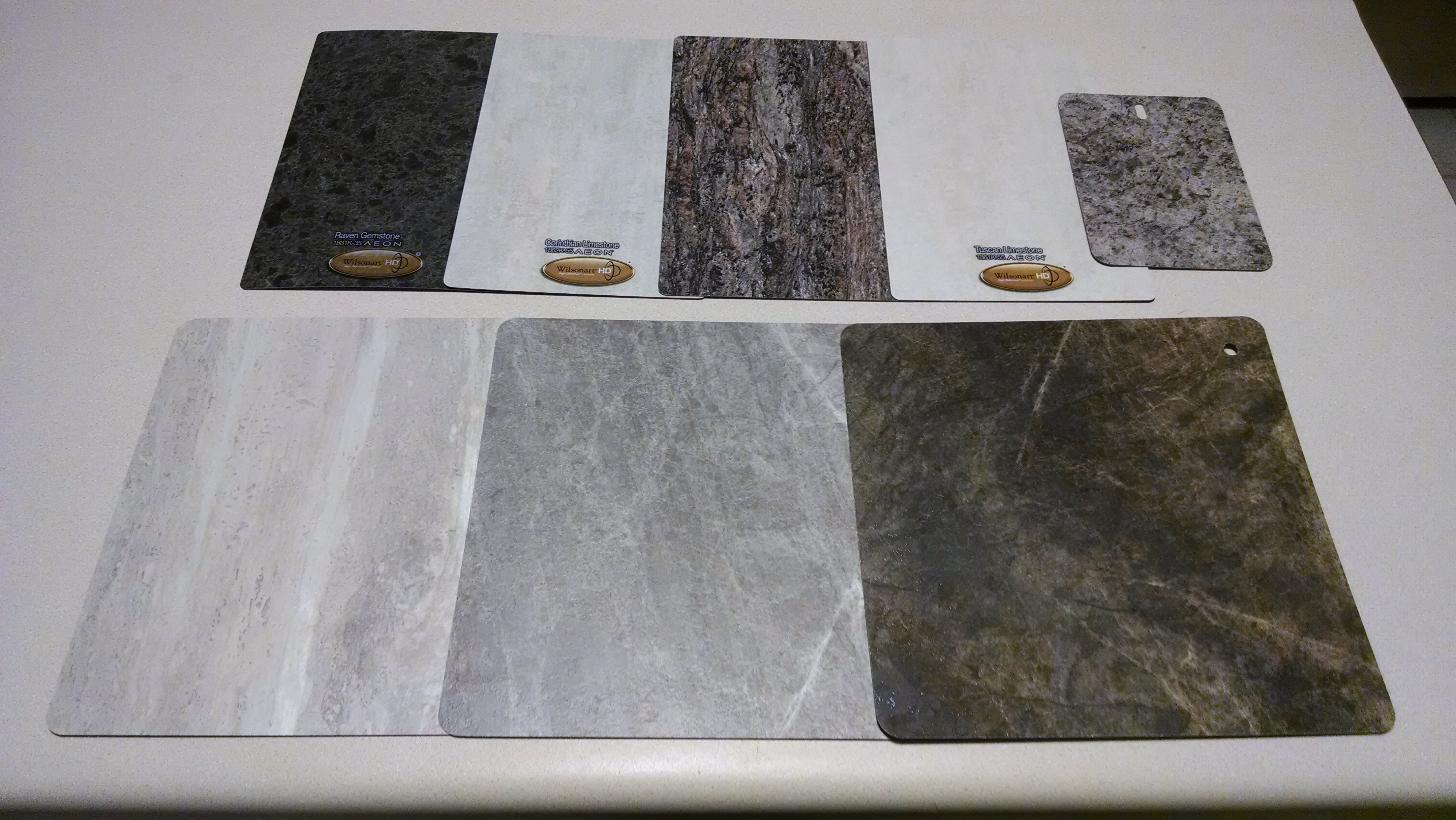
Our laminate samples! The official start to everything. The bottom center sample is the clear winner, in my mind.

Our laminate samples! The official start to everything. The bottom center sample is the clear winner, in my mind.

It. Has. Begun.

2014 will be the Year of the Kitchen. We are giving ourselves an entire year to complete this remodel (I think that’s reasonable for a complete DIY project of such magnitude). We have things organized into stages. First, we need to level the floor.  It has to happen before anything else can be done (There is a noticeable slope from the island to the dishwasher). Then, we will rip out the floor-to-ceiling pantry that’s currently blocking the gorgeous natural light from our 6-foot windows in the breakfast nook.  We’ll convert the closet in the adjacent laundry room into a walk-in pantry.

Then, the real construction begins.

The uppers will come down. Then the soffit. The ceilings will need to be repaired.  Plumbing, electrical, and ventilation all moved. Recessed lights installed throughout (right now, we only have one ceiling light for the entire kitchen).  Ikea cabinets purchased, arranged, and assembled.  Countertops built. Drywall repaired.  Cabinets installed. Backsplash. Paint. Electrical outlets. Grout. Sealers. Plumbing. Gas. Water. And a million other little things that I’m sure we’ll discover as we go along.

So don’t be surprised if this blog suddenly transforms into a mostly-DIY blog.  I will still be writing about kids, current events, pee and poop, to be sure.  But I’ll be doing it from a construction zone.  I’m sure that I’ll need to get on here and scream a few times throughout this process. Or cry. Or justify. Or explain. Or lament. And I’ll need some encouragement. And maybe even some advice. This won’t just be a terrifying adventure for me and my family, but for you as well, my online community. So, get ready.

The Year of the Kitchen is here.

A little inspiration. This kitchen is almost exactly our layout. They also used the Ikea Ramsjo (Shaker style) cabinets we selected.

I promised myself that I would do this. I’m not going to back out now. But I really, really want to.

A few months ago, while I was still pregnant with Honest Baby, I wrote a post called “The New Normal,” where I wondered about what my body would look like after two back-to-back pregnancies, and after my first C-section. I promised myself that I would post a follow up about my “new normal” body when Honest Baby turned 6 months.  Well, that deadline has now arrived.

So here goes.

First of all, I want to start off by saying that my caesarean went perfectly.  I had no complications (except a violent nausea in reaction to the anesthetic. I threw up probably about a dozen times the first ten hours after my section. It’s a known problem that I have with anesthetic, so I was expecting this).  I had almost no pain. I never took any of my pain killers.  I never even filled the prescription.  I was up and walking around the entire ward the morning after, and was only in the hospital 36 hours total (one of the shortest hospital stays the nurses there had ever seen for a C-section). The procedure was fast and efficient.  My OB was capable and confident. Up until two minutes after Baby’s birth (when she stopped breathing), my vote was for C-section all the way. The recovery was easier than my vaginal delivery. For days after giving birth to Honest Girl, my legs were weak, shaky. I could barely keep myself upright. I also had completely lost bladder control, and my self esteem was shattered every time I looked down at the battlefield below my belly button.  Seriously.  My vagina looked like Droopy Dog. And it was about as happy. After my C-section, I was sore, it’s true.  It took me a few days to convince my legs to swing from my hip joints in any way that felt natural.  And I was scared to cough for the first two days after surgery. But other than that?  Easy as pie. I’d do it again in a heartbeat.

That is, if I’ll ever do it again.

Since there seems to be so little out there in Internet-land about positive C-section experiences, I wanted to tell mine.  For anyone out there who is nervous about the possibility of having a C-section, don’t be. Really. They’re not all that scary.

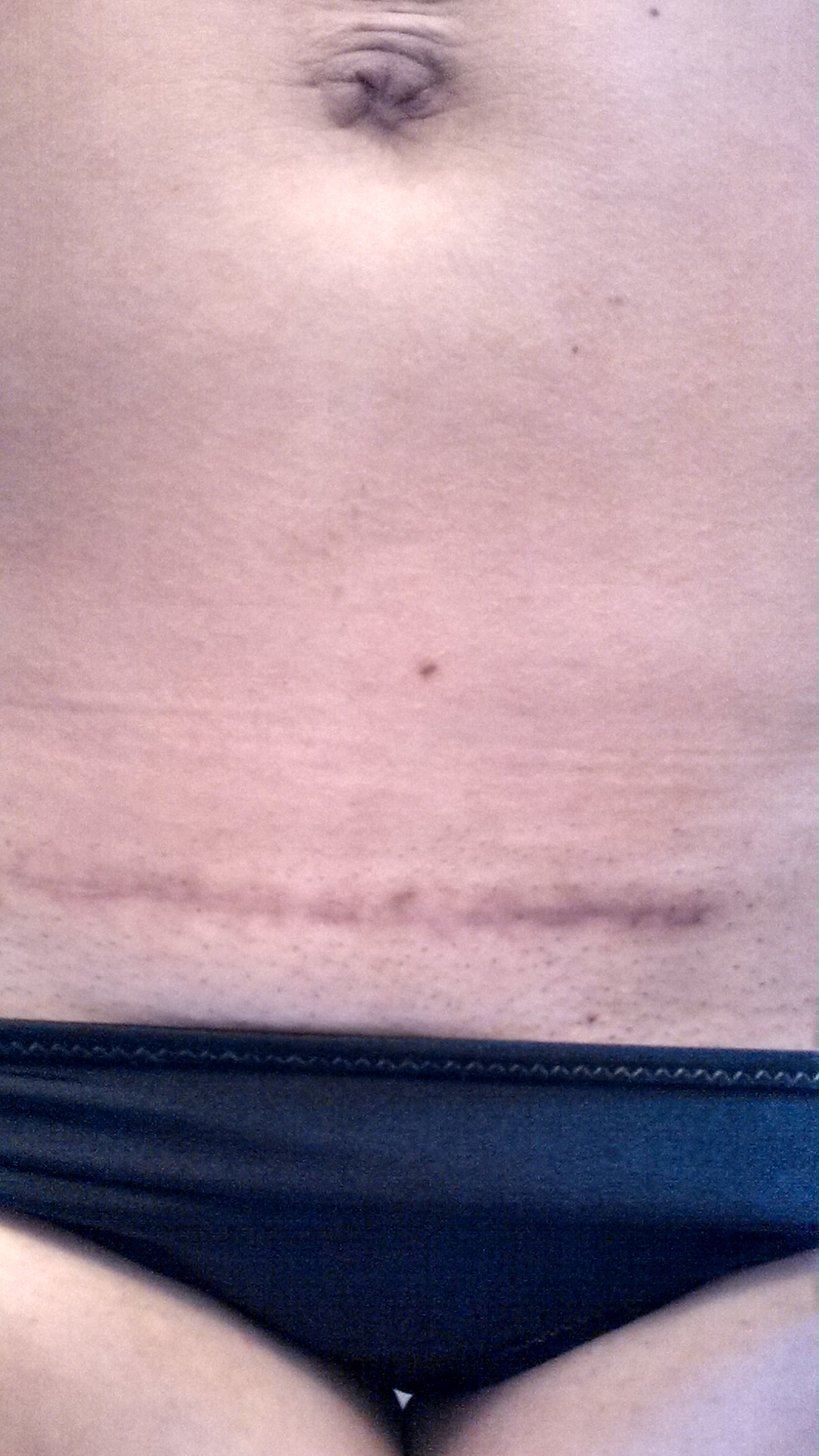
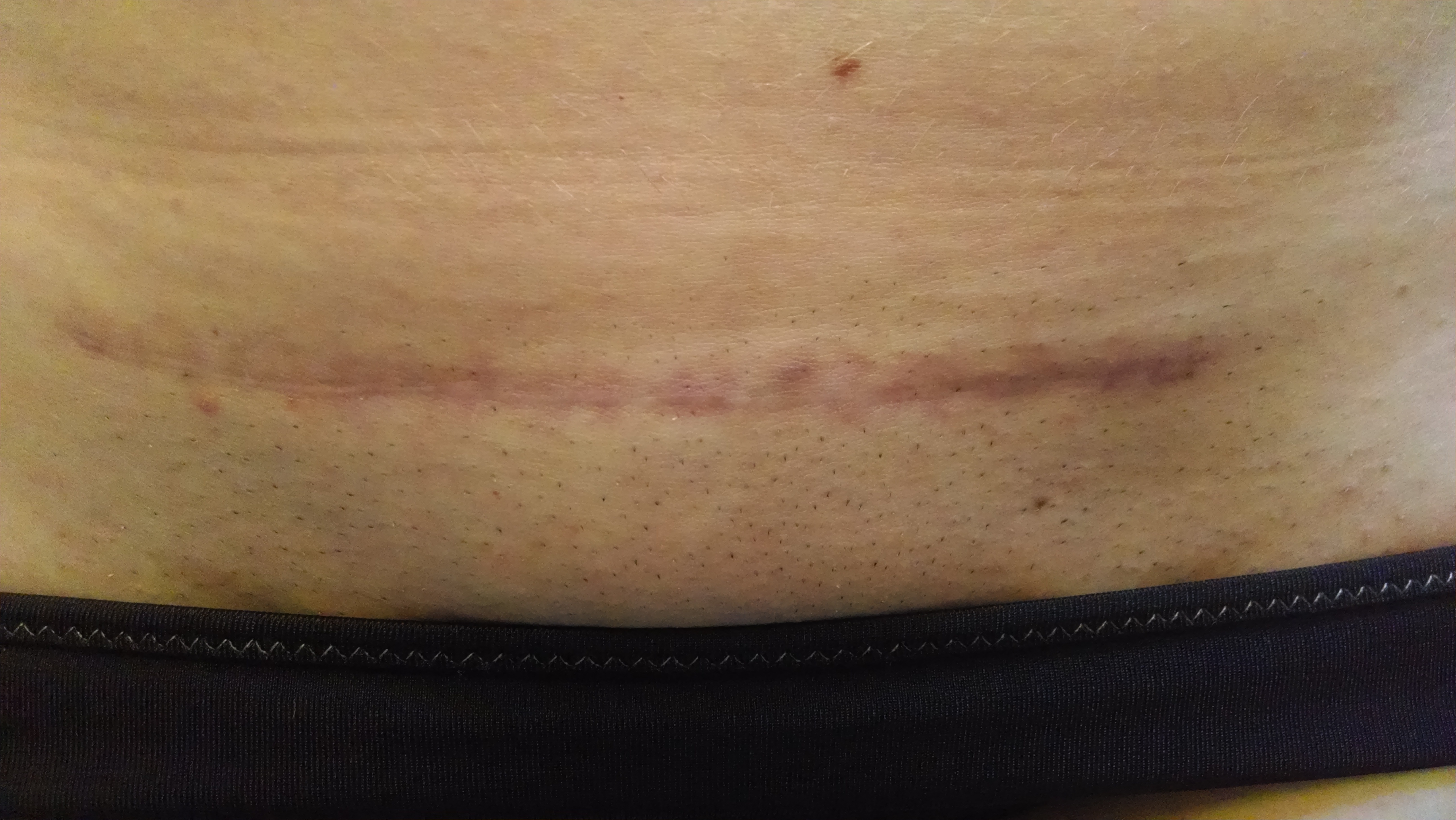
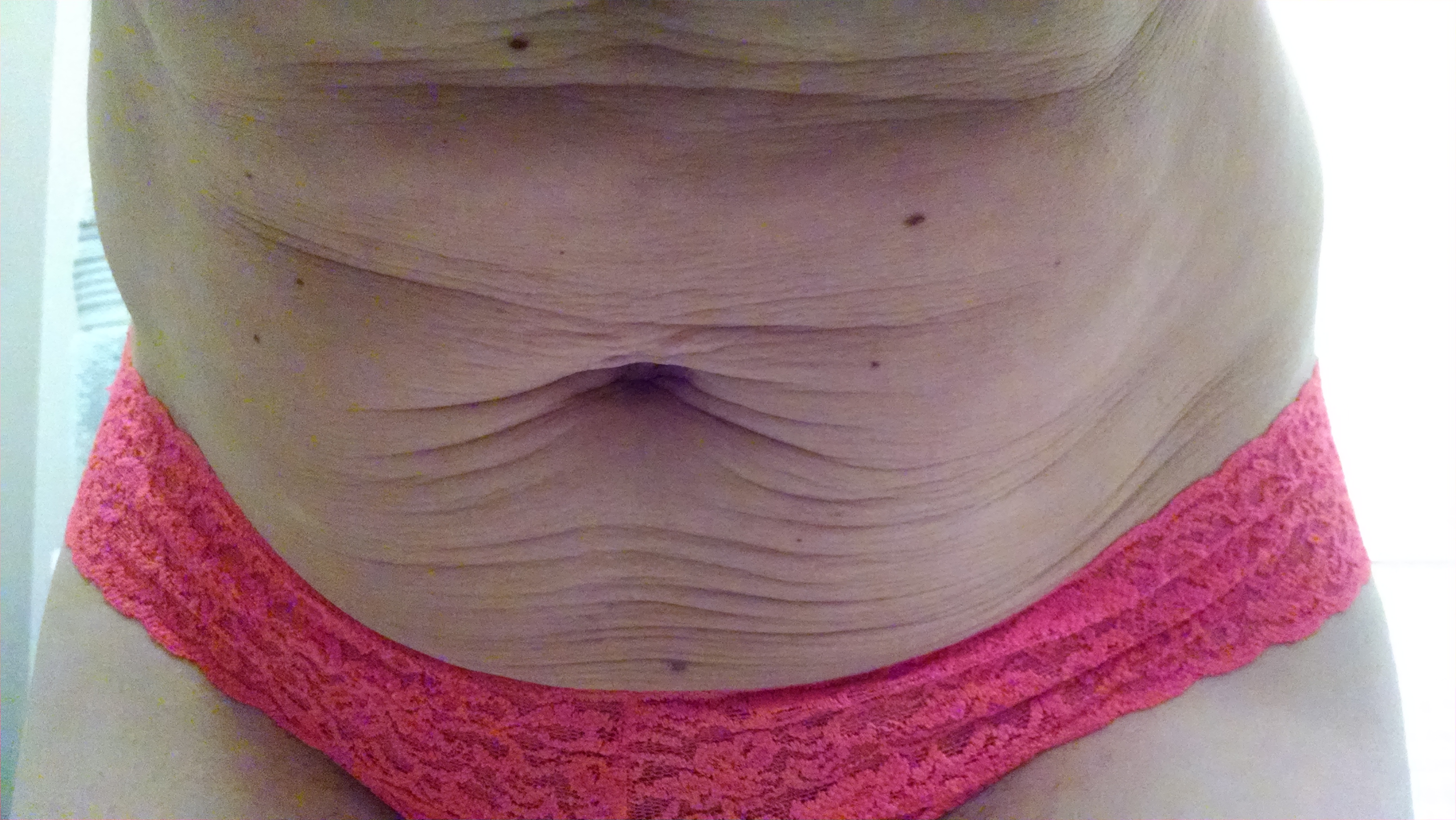
Okay, so first picture. Here’s my C-section scar, 6 months post-partum.

IMG_20140307_160027128_HDR

IMG_20140307_155956340

This is perhaps the aspect of my new body that I’m the most self-conscious about. My scar looks purple in person (also, do you see how dark my belly button is?  Why does that happen? Anybody know?).  It hasn’t faded much, and because it’s a little bit off-center, I feel as though it’s really noticeable.  One of my best girlfriends has a scar that seriously faded to nothing. Nothing. It looks like a wrinkle.  A fold in the skin. And I had convinced myself that mine would look the same way. But it doesn’t.  And I have no idea what I can do about that.

Now, the body before:

2010_Rachel

May, 2010. Vegas. The pool. This is the day before my wedding. I weigh 124 pounds. 4’ 11”. I’m wearing contact lenses.

And, (deep breath, Rachel) after:

IMG_20140307_160246042_HDR

March, 2014. Indiana. My bathroom. My daughter is lying on her play mat at my feet. I weigh 132 pounds. I have bifocals.

As you can see, I actually put on the same bikini for these pictures. It helps to highlight where the differences are. And there are differences. I must be a bikini sadist, because I was torturing that thing. I’ve never had to tie a bikini so tightly around my neck. It was a desperate attempt to hoist my breasts up. I’ve started calling them “National Geographic Boobies.” In a few more months I’ll be able to toss one of them over my shoulder to feed my daughter without having to take her out of the Baby Bjorn.

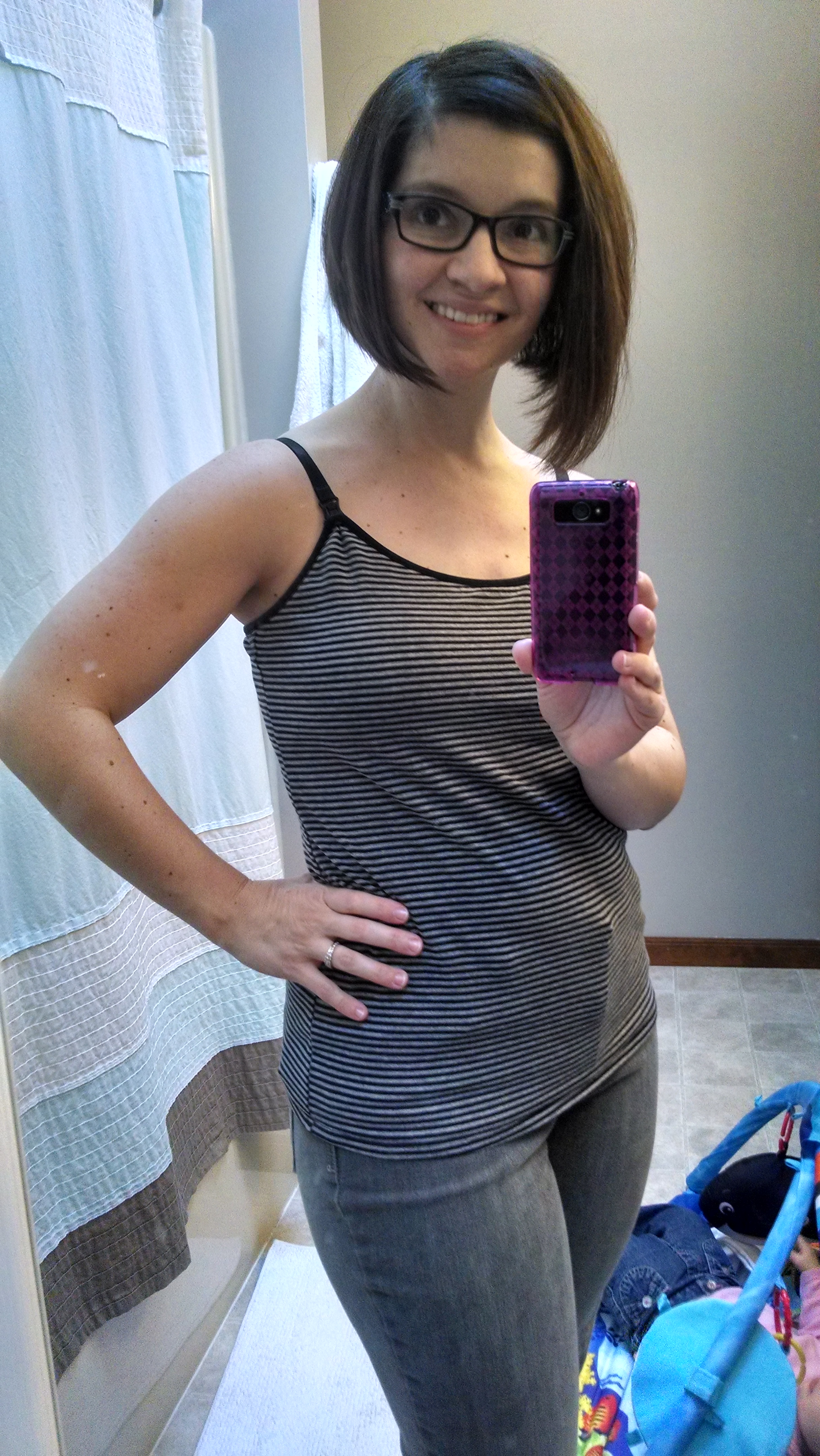
But it’s unfair to only show a picture of me in a bikini that no longer fits. Here’s what I usually look like these days.

IMG_20140307_161841034_HDR

Well, okay. HERE’S what I usually look like:

IMG_20140307_161908054_HDR

Nursing tank. Comfy jeans. Minimal makeup. Baby.

It really isn’t horrible. But it doesn’t feel “normal” to me yet. Or sexy. Or very comfortable. Especially since, though my stomach isn’t very big, the extra skin I now have just distracts me. When I bend over to blow dry my hair, this is what I see.

IMG_20140220_072531789

Yeesh. For some reason, I think I look like the Governator at the beach. Too much skin. Too square. (True story. I just put this picture into this post, and when Honest Girl saw it, she hollered, “Woooooah! That’s Mommy! Right there!” My toddler is able to recognize my mushy parts. Awesome.)

A few months ago, the internet exploded in rage over fitness trainer and mother Maria Kang, who posted this picture:

Maria_Kang

People said she was fat-shaming. They said she was setting unrealistic expectations. They said that she was placing undue pressure on mothers who are already asked for far too much. And I nodded in agreement. Yes. Bad Maria Kang. Bad.

But, honestly? I also want to be her.

I wish that I looked like that.

I started counting my excuses.

Baby. Toddler. Dissertation. New house. Endless winter. Workaholic husband.

But are those excuses? Or are they reasons? Is there a difference? And does that matter?

I’m actually embarrassed posting these pictures to show that, 6 months out, I’m not any closer to looking like that.  I really thought that I’d be closer. Because I want to be. I just don’t know how to right now.

The last few weeks, I’ve been experiencing some problems with Honest Girl and Honest Baby’s daycare, specifically, with the woman who assists in Honest Baby’s infant section. <Sidebar> The nature of the problem isn’t important.  I’ve had long discussions with the director about the issue, and, as far as I’m concerned, it has been cleared up. I’m not one to hold grudges.  Mistakes happen.  People sometimes use poor judgment.  Forgive, but never forget.</Sidebar> Though we held a meeting and talked the issue through, I was still nervous about sending the girls to daycare this morning.  Would the person I had complained about treat them differently?  Would she be bitter?  Would she resent me, and therefore my children, by proxy?  Would I be forced to pull my kids out of there?  Was my complaint going to be responsible for a hostile environment for my girls?

I brought them in to the center, left Honest Girl to her breakfast and her “boyfriend” (she currently has two. One is the boy next door, and the other is a boy at daycare who apparently likes to hug her. A lot.), then took a breath and brought Honest Baby to the infant area.  The woman I had complained about smiled, sheepish.  “Can I talk to you?”  I smiled back.  I suddenly felt like a small child.

She apologized, repeatedly, for her actions with Honest Baby, and begged me to not remove the girls from the center: “We all just love them.  They’re the sweetest little things.  They love each other so much.  It’s just wonderful to see every day.”  I smiled, knowing that, for all of the other things that might be chaotic in my household, my girls really do love each other. Honest Baby smiles with her entire body whenever Honest Girl comes over to her, and Honest Girl loves to bring Baby her toys, her blanket, loves to hold her hand and kiss her, and help burp her.  At least once a day at the center, Honest Girl walks over to the infant area and spends some time with Honest Baby.  She calms little sister down, makes her smile, and it melts their caretakers’ hearts.  I nodded, “I know.  They’re crazy about each other.”

“And about you.  You know, you’re a perfect mother.”

I was taken aback.  Perfect mother? I started to shake my head.

She reached out and put a hand on my arm.  “No, no.  I’m not just saying this.  God’s honest.  I see you drop them off every morning.  I see you ask for kisses, and hugs, and tell them that you love them.  I see how their hair is always combed, and how you put them in nice, clean clothes every day. You are a really, just perfect mother.  I’ve always thought so.”

I had started crying without realizing it.

She continued, her eyes filling. “And the way those babies love each other?  They don’t just know how to do that.  Babies have to be shown how to love like that.  They have to see it somewhere.  They get it from you.”

I looked away. Perfect mother. Perfect mother? I thought about the time-outs I had to give Honest Girl this week, the night I let her eat a hot dog and bar-be-que chips for dinner, the time I let Honest Baby cry in her crib because I couldn’t bring myself to get out of bed for the fourth time, even though I knew that she had a little head cold and just wanted to snuggle.  I though about my dirty bathrooms, and grease-covered range. Perfect mother?

I think I said thank you.  I hope I did.  But it couldn’t have come out as anything other than a whisper as tears rolled down my face.  Regardless, she pulled me to her and hugged me, tight.

Every day, at some point, I feel overwhelmed.  Every day, I feel anxiety.  Every day, I convince myself that I am permanently damaging these incredible, young souls that are under my care.  But her words made me realize something.  When was the last time, parents, that we thought about how we’re perfect for our children?  When was the last time somebody told you, without instigation, that you are doing a good job?  When was the last time you admitted that, yes, the dirty dishes have taken over, but I just made my toddler laugh, and felt, honestly and truly, that that was enough??

So let’s start right now.  Right here.  How do you feel perfect as a parent?  What things make you feel overwhelmed?  I’ll bet, once you write it out, you’ll find that the bad stuff is easy to let go of, and the ways that we are perfect will be things that we can hold on to, all day long.  You don’t have to share your name.  At the end of today, I’ll collect all of your responses, and copy them to the end of this post, so that the whole world can bask in our collective awesomeness.  This can be completely anonymous. I just want you to think, really hard, about how great you are. Because you are.  You all are.  I promise. Just perfect.

image

Because they always think you’re perfect. No matter what.


I’ll start:

Name: Rachel

I am a Perfect Parent When I . . . I am great at story time. I do the funny voices, I yell, I emote, I wave my arms. I can make my girls laugh, and even my infant, who doesn’t understand language yet, is mesmerized by mommy at story time. I know that I’m helping instill in my girls a lifelong love of books. I’m also a really good cook. When I make dinner, I *make* dinner! And, often, we will all sit at the kitchen table and eat dinner as a family. Together. That’s important to me, and I think I rock it.

I Feel Overwhelmed as a Parent When . . . When I think about actually organizing, cleaning, and maintaining my house, I have a small aneurism. It’s too big, there’s too many places for dust to collect, or cobwebs to form. And don’t even get me started on the sad shape of my toilets! I have finally made peace with my vacuum cleaner, only to trade clean floors for dirty bathrooms.

← Back

Thank you for your response. ✨

Home

Growing up in Northern Michigan, with Lake Huron visible through my bedroom window, I’ve watched the slow suddenness of dawn breaking over the lake.  At first, the dark appears impenetrable.  On nights without a moon, the dim starlight barely illuminates the outline of the roof, the house, the tall oak and maple trees that surround me.  I would sit and try to focus on the dark shapes, willing them into clarity.  Slowly, the trees become more familiar.  There’s the slope of the hill where we go sledding every winter.  And the gentle pitch of the roof under my window.  If I try very hard, I can direct my gaze out, looking between the trees, down to the lake, only recognizable as a black smudge—a large nothing that lets me know the forest has ended and the water begun.  For a long, long time, I focus on trying to distinguish shapes, one from the other.  Though I fight the urge, I still find myself looking frequently at the clock next to my bed.  Even as the minutes steadily tick by, I can’t believe that the dark remains this persistent.  Shouldn’t it be dawn by now?  I wait and watch.   Perhaps I hear the click of dry branches and leaves.  An animal is close by.  I try to decide if the sharp snap was just the magnified sound of a twig breaking underneath a possum, or the efficient cut of a deer’s hoof on a branch.  I look down at the backyard, thinking I should be able to see, amazed by my own blindness.  Awed with the potency of the night.  I am repeatedly surprised by the failure of my eyes to penetrate.

Then, without warning or anticipation, it is morning.

I look across to the black nothing, and clearly see the grey line of the lakeshore.  The shingles on the roof become distinguishable, visible.  I see a rabbit, nibbling on a fallen apple in the backyard.  The blue morning has come.  Night is over.  With a finality and a suddenness that I was never able to predict, it’s over.  The night held on with tenacity, but then quickly submitted to the light.

The day has begun.

It was our last test.

Maddie had already started gaining weight again (she took to breastfeeding immediately, and wanted to nurse constantly, making up for the first four days of her life when she subsisted on intravenous fluids and milk dripped into her stomach through a feeding tube).  She was growing.  Her nasal cannula had been removed.  Her oxygen levels were steady, never dropping below 98, even in the deepest sleep.  She wasn’t on any medications.  There was no sign of infection in her lungs.  She was still jaundiced, but there were signs that her bilirubin levels had already peaked.  She slept on a biliblanket, but that was something that we would be prescribed by our local pediatrician.  My husband and I had dutifully attended the newborn safety class that was required of all parents before leaving the NICU with their children.  Our bags were packed.  We were ready to go.

There was just one more test to pass before we could be discharged.

Maddie's biliblanket gave her a blue glow down her back.

Maddie’s biliblanket gave her a blue glow down her back.

Children in the NICU, especially children who had been admitted with respiratory distress, had to pass the “car seat test.”  Maddie would have to be strapped into her car seat for two hours, her vitals monitored regularly, to ensure that she could tolerate the pressure sitting up would place on her chest and lungs.

The night nurse decided to run the test from midnight to 2am.  My husband and I carefully lifted Maddie, with all of her wires and monitors, out of her warming table, and put her in the car seat that we had propped up on towels on the hospital floor.  I laughingly apologized for the blueberry stains on the cover.  The seat had just recently belonged to her big sister, who loves to eat blueberries on the drive home from daycare.  I was planning to wash it before Maddie came, but the unexpectedness of her delivery meant that the seat was still dirty.  Cheerios fell out of it as my husband lowered the straps down to the newborn setting.  The tiny messes from the car seat were reminders of home, of our older daughter, who was a big sister without realizing it.  My husband and I left a Cheerio on the floor, somehow liking the way the small, childlike mess looked in the sterile room.  We tightened the straps down, smiled and cooed at Maddie, and the nurse started the timer.  Two hours.  If her vitals remained stable, then we were cleared to be discharged the next morning. If not, we had the option of running the test again, but we had to wait several hours in between.  We were prepared to stay up all night.  We were prepared to do anything.

Home.  Home.  Home.

It ran through our heads, consumed our thoughts.  “C’mon, Maddie.  Just do this, and we get to go home!  Don’t you want to go home?”  We do.  We all want to go home.  You’ve never been home, but trust me, it’s wonderful.  Come on, Maddie.  You can do it, Maddie.

But, placed in the new and uncomfortable position, Maddie began to panic.  She screamed.  Her heart raced.  Her breathing rate leaped back up to the frightening numbers we saw on the first day.  100.   95.  98.  101.  89.

We weren’t allowed to stop the test once it had commenced.  Weren’t allowed to take her out of her seat, even for a minute, and the nurse told us that if her vitals remained elevated like this, she wouldn’t be able to pass us.  She wouldn’t be able to send us home.

I held Maddie’s hand.  I stroked her face.  My husband spoke low, calming words to her.  It was the same low, calm voice that carried me through the pain of preterm labor, and my first delivery.  Her legs kicked off her blankets.  We replaced them, tucking them around her so she felt snug, safe, being careful to not jostle her, to not disturb the monitors and send her vitals on even greater spikes.  The nurse saw our desperation.  Please, Maddie.  Please.  Just relax.  Just nap.  If you sleep for the next two hours, you get to go home forever.  Please.  She tried to time it so that she came and recorded Maddie’s vitals during moments when she was relatively calm.  Maddie’s tiny, sharp, papery nails gripped me, leaving small, crescent moon indentations in the flesh on my fingers.  She was red, staring at me, willing me to pick her up and cuddle her.  I started to bite my upper lip, focusing my sight on a spot somewhere underneath the rolling table full of newborn diapers.  My husband, always keeping an eye on me, saw me tense up.  “It’ll be okay, baby.  They’ll let us go.  There’s no reason to keep us any longer.”

I shook my head, still sucking on my lip.  If you just looked at Maddie’s numbers at this moment, they weren’t good.  Taken out of context, the numbers made it seems as though Maddie was still sick.  I was mad at the test.  How else could she respond?  She went from a tall, warm table from which she could see her parents’ faces and all of the activity of the hallway, to a stiff, low chair on the cool floor, able to look at nothing but the underside of medical equipment.  No soothing movement or rocking.  No music or conversation.  No cars or scenery whizzing by her window.  I was mad.  Mad that this was the silly, small thing that could keep us here, trapped.  I was mad that I couldn’t hold my baby.  Mad that I had to subject her to this.  Mad that she was strapped down, tight, with wires fished through her clothes and pressed against her soft, thin skin.  We’re going to have to stay.  We’ll never get out of here.  It’ll never happen.  We’ll have to stay here.  Forever.

“Somebody else is going to need this bed way more than we do.  They’re not going to make us stay because of this.  She’s a baby.  They understand that babies cry.”

I glanced occasionally at the clock, amazed by how quickly the two hours passed.  Maddie dozed for about 20 minutes the entire time, worn out by her own screams.  The nurse took the opportunity to quickly record her vitals repeatedly during that time, hoping, I assume, that the lower numbers would drive her overall averages down.  My husband and I never moved.  When the two hours were over, we stood up with creaking bones and numb feet.  I had been leaning on my left hand, and had to convince my fingers to stretch, to move out of the claw they had formed.  We unlatched Maddie quickly, and I nursed her to sleep.  It was 2:30 in the morning.

“She passed.”

The nursed smiled at my look of disbelief.  My husband squeezed my shoulder.  She passed.  The final test.  She passed.

It was over.

We were going home.

After Maddie and my husband were both asleep, I used the excuse of getting a glass of water to wander, once more, around the NICU floor.  It was the middle of the night.  The lights were dimmed in all of the rooms.  The few rooms that housed parents had curtains pulled across the fold-out beds in the back.  The incubators covered with bright, patterned blankets and the curtains thrown over the cots made for strange, mirror images in the rooms.  It’s a Mommy Bed and a Baby Bed!  One big.  One little.  For some reason, I found this thought hilarious.  A loud, inappropriate, bark of a laugh escaped my lips.  The nurses at the closest station looked up at me, and I sheepishly smiled as I hurriedly walked by.  I filled my water bottle in the lunch room, half hoping, half dreading the thought of running into Maria or one of the other parents.  But I saw no one.

It was 3 o’clock in the morning.

I smiled the entire way back to the room.

The next day, my husband, Maddie, and I walked through the front door just as our oldest daughter was finishing up her lunch.  A bouquet of flowers filled our kitchen table, and my parents stood, smiling, ready to greet us. My oldest daughter immediately kissed her little sister.  Though only 18 months old, it was clear that she knew, somehow, that this new, small, still very orange person was going to be someone she would love, protect, fight with and for forever.  I couldn’t stop touching my girls, my babies, my husband, my family.  I held everyone in the house, for as long as they’d let me.  There wasn’t a moment, a second, that day that I wasn’t touching one of them, feeling them, there, physical and present.  And all mine.

Image09062013123509

Once she was in the car, listening to the Black Crowes, Maddie calmed down and fell asleep.

It wasn’t until the next day, at Maddie’s follow-up appointment with our pediatrician that I finally broke down.  We were given a biliblanket for her jaundice and told to keep her on it for a few days.  But other than that?  “She’s perfect.  She doesn’t need anything else.  Take her home and enjoy her.”

“Really?”

“Really.”

“No medicine?  No more follow-ups?”

“Nope.  Her next appointment will be her regular two-week check up.  She’s just a normal newborn now.”

Normal. Normal.  Never before had I appreciated the gift, the joy of normal.

Normal.  It echoed inside of me, bounding off the walls of the strength I’d been trying desperately to show for the last week, and broke them down.  The avalanche started.

I cried.

I wept.

I sobbed.

I put my face in Maddie’s warm neck and cried until she was wet with my tears.

Normal.

It’s over.

Without even looking for it, it happened.

The day had begun.

Big Sister immediately kissed her sissy.

Big Sister immediately kissed her sissy.

Home
Home.

The stars in Northern Michigan aren’t like the stars anywhere else.  Growing up in a village, 100 miles away from the nearest mall, three miles from the only stoplight in the county, and 25 miles from the 45th parallel (halfway between the equator and the North Pole), the stars were some of my closest neighbors.  My family and I watched comets, meteor showers, lunar eclipses, found Mars and Jupiter, distinguished the pinkish cast of red giants and the sharp blue of white dwarfs, all from the vantage point of our front yard.  Every winter, at least once, we sat in awe, observing the beautiful dance of the Aurora Borealis.  My father would point out the sweeping band of the Milky Way, running East to West across our front yard.  We’d spread blankets on the hard, uneven ground, and gaze at the sky, every now and then flipping the blanket up to search for a rogue acorn that was digging into our backs.  While looking up at the stars, trying to not complain of the cold, even while my pinkie fingers turned numb, we would play with our flashlights, holding them above our heads and shining them up into the darkness, watching the beam for as long as we could until it vanished, out of our reach.

“That light will go on forever.”

My father was always fascinated with astronomy.  Physics combined with beauty, and a touch of the Almighty.  It was poetry for him.  He would tell us that the beams of our flashlights, the light from them, traveled out and away from us at incredible speeds.  The light was already above the Earth, past the Moon.  The light was out in dark, deep space even before we had picked up our blankets, given in to the cold, and trudged back to the warm, yellow lights of the house.  The light was traveling through the vast spaces, bringing at least a temporary something to the nothing that surrounded the stars.

He made me believe that, if I tried hard enough, focused clearly enough, and felt strongly enough, that my small flashlight could produce a beam of light that could travel for millions of years.  Through the cosmos, past galaxies and black holes and super novae.  I liked to think about my light, bringing an intangible something to the unimaginable nothing.  It wasn’t big or strong enough to erase the darkness, but it was enough to forever alter it.  My light could travel long after I was gone, and one day become as ancient as the stars themselves, stars that, already dead, were still shining brilliantly above me, marking this place, this spot on an old quilt on my front yard, as home.  Forever and always, somewhere, my small beam of light was reaching out, farther and farther, shining as a reminder of my having been here, on the almost-frozen ground, looking up.   Looking for a beam of light.

And maybe, just maybe, through the unlikely mathematics of nearly-impossible odds, my tiny beam of light could reach a far-distant stargazer, curled up on an old quilt in her front yard, her father and siblings by her side, also straining her eyes.  Also trying to fight against the dark of night.  Also waiting, impatiently, to see clearly again.

Also looking for the light.

Though it is small, I wanted this series to be a beam of light for others trapped in the dark.  Maria, this series is for you.  A good mother.  I hope, every day, that your dawn has broken.

A Good Day

I watch our nurse, Brenda, taking Maddie’s measurements.  She weighs her (still losing weight), checks her length (surprisingly long for her gestational age), and measures the circumference of her head (50th percentile.  Perfect).  It’s been long enough that I feel more comfortable asking questions.

“What does the head measurement tell you?  I don’t even actually know why you do that.  To make sure she’s normal?”

The nurse smiles, “No, not really.  There’s a big range of ‘normal’ when it comes to babies.  Measuring the head lets us know if her brain is growing.  We compare the size of her head from two days ago to today.  There’s an expected percentage of growth that we’re looking for.”

“And if it doesn’t grow?”

Brenda sighs, “It could mean a lot of things.  A birth defect.  A neurological problem.  Or that there’s just,” I was starting to get good at seeing when the nurses struggled for words, when they tried to soften what they were saying to the frazzled parents around them.  “Just, not as much brain activity as we want to see.  We want to see everything growing.  Especially in preemies.”

I nod.  I’m looking down at Maddie, squinting at me over the tube that’s covering the bottom half of her face.

Brenda sees my look.  She winks, “It’s growing.  Don’t worry.  She’s doing great.  She’s perfect.”

I chuckle, “Except for those lungs!”

“We’ll get those.  Don’t you worry.”

The NICU, Day 4.  Wednesday.

I woke up around 7am.  Woke up? Perhaps that’s too definite.  I shifted from one state of semi-consciousness to another. The niggling pain in my back told me that I had been on the armchair in Maddie’s room for far too long, giving me a sense that it was now morning, even though I couldn’t see any trace of daylight in the carefully-lit NICU.  While fumbling around in my suitcase (it was still the suitcase that I had packed for what I thought would be my four-day hospital stay after my C-section.  Mostly contained robes, yoga pants, empire-waist dresses, and a few soft nursing bras.  No real outfits. Nothing appropriate for meetings with doctors, or for camping out on an uncomfortable recliner in an aggressively air-conditioned ward) I stumbled across a rare gift.  A clean pair of socks. Still folded in a little ball.  I gave a small cry of delight when I saw them.  I actually hugged them close to my chest.  I had packed this bag expecting to wear hospital-issued compression socks in a maternity ward just an eight minute drive from my house.  I didn’t even remember throwing in a clean pair of socks.  After four days in the same pair of socks, the small, while ball of clean laundry looked like a gift from the Almighty.  I smiled at my husband, and waved the socks in his direction.

“Today’s going to be a good day.”

He stuck his lower lip out in a pout, “I’m so jealous.  I want clean socks.”

“Hey, at least you have clean underwear.”

“You’re still wearing those enormous maxi pads.  It doesn’t even matter for you.”

“And that thought is the only thing getting me through the day, trust me.”

He stretched.  He was sleeping on the small fold-out couch in Maddie’s room.  His feet hung over the edge of the bed all night, and I could tell by the way that he groaned as he got up that his back wasn’t doing any better than mine.  “Think I’m going to hit up the shower.”

I jumped, “No.  No, let me.  Let me go first.  I haven’t had a shower since I left the hospital.”

He smiled.  That smile.  His smile.  The smile that can make me lose track of how many toes I have, or whether or not I’ve eaten today.  The smile that derails me, unmans me, in the best possible way. “Sure, baby.  You go first.”

“If I miss rounds—“

“I’ll let you know what the doctors say.”

I took a forty-five minute long shower.  I stood in the small, tiled stall, and just let the water run over my body.  I played with the knobs.  First scalding hot.  Then goose-pimply cold.  Maddie’s nurse, Brenda, upon hearing that my husband and I had neglected to pack any toiletries, had managed to sneak in two small, travel-sized bottles of shampoo and conditioner.  Real conditioner.  Not the off-brand two-in-one that the NICU provided.  But a real, dedicated conditioner.  I used almost the whole bottle, combing through my hair with my fingers until it lay, perfectly smooth, plastered against my head and neck, and the water fell away from it in one sheet.  I ran my hands along its smoothness over and over again.  At one point, I heard a knock on the door.  I immediately thought that it must be Maria (there are so few other parents here, who else could possibly need the shower?).  I almost got out.  Almost yelled that I’d just be another minute.  But then I didn’t.  I pretended that I didn’t hear.  There’s only one shower in this wing, but I decided that it was all mine that morning.  All mine.

I took another half hour after my shower to dry my hair and style it.  I even put on a little makeup before I got dressed.  I didn’t have any clean pants or underwear, but I had that fresh, small ball of socks.  I pulled them on, being careful to avoid the damp puddles on the floor where I had stood.  When I slid my sneakers on, I sighed from the delight, the joy, of the soft, clean socks.

“Today is going to be a good day.”

I got back to Maddie’s room to find my husband.  He smiled, surveying me. “You look normal.”

We both knew, especially in this place, it was the ultimate compliment.

I had missed rounds, but my husband reported good news.  Maddie’s lungs were open enough, and her breathing was stable enough that they were going to take her off her ventotherm today.  Instead of a large tube taped over her mouth and across her cheeks, she was going to be placed on a small, nasal cannula.  We’d be able to hold her today.  For as long as we wanted.  And, even better than that, I would be able to try breastfeeding her for the first time.  I laughed and bounced up and down.  My husband smiled and left to take his shower.  I stood at Maddie’s warming table and chatted with her until he came back.

After the respiratory therapist (a small, pretty blonde who looked far too young to be as sure and competent as she was) had wheeled the ventotherm out of the room, Brenda came in and told me it was time to try breastfeeding.  I could see her choosing her words carefully, preparing me for failure.  Maddie’s never breastfed before.  She’s only been fed via IV and then feeding tube.  She’s never even swallowed before.  She’s never been held, skin-to-skin.  Never suckled.  She’s a newborn, and all of her energy has been focused on just breathing up to this point.  She might not have the energy, the musculature, the ability to latch.  It might take awhile.  It might never take at all.  I had to be prepared for all of that.

I nodded as I took off my shirt and put on my robe.  I tried to look serious and somber.  But I looked down at Maddie’s face, at her dark, dark blue eyes.  Almost purple.  Almost violet.  Almost grey eyes.  She looked back at me.  I saw the strength in her eyes, the determined little frown that crossed her forehead.  Both of her cheeks had been rubbed raw by the tape holding her ventotherm on, and her lips were swollen from having been pursed around it for four days.  She looked like she had gone through a fight.  And her eyes told me she was ready for more.  I nodded resolutely at Brenda, then smiled a smile just for Maddie. We’ve got this, little girl.

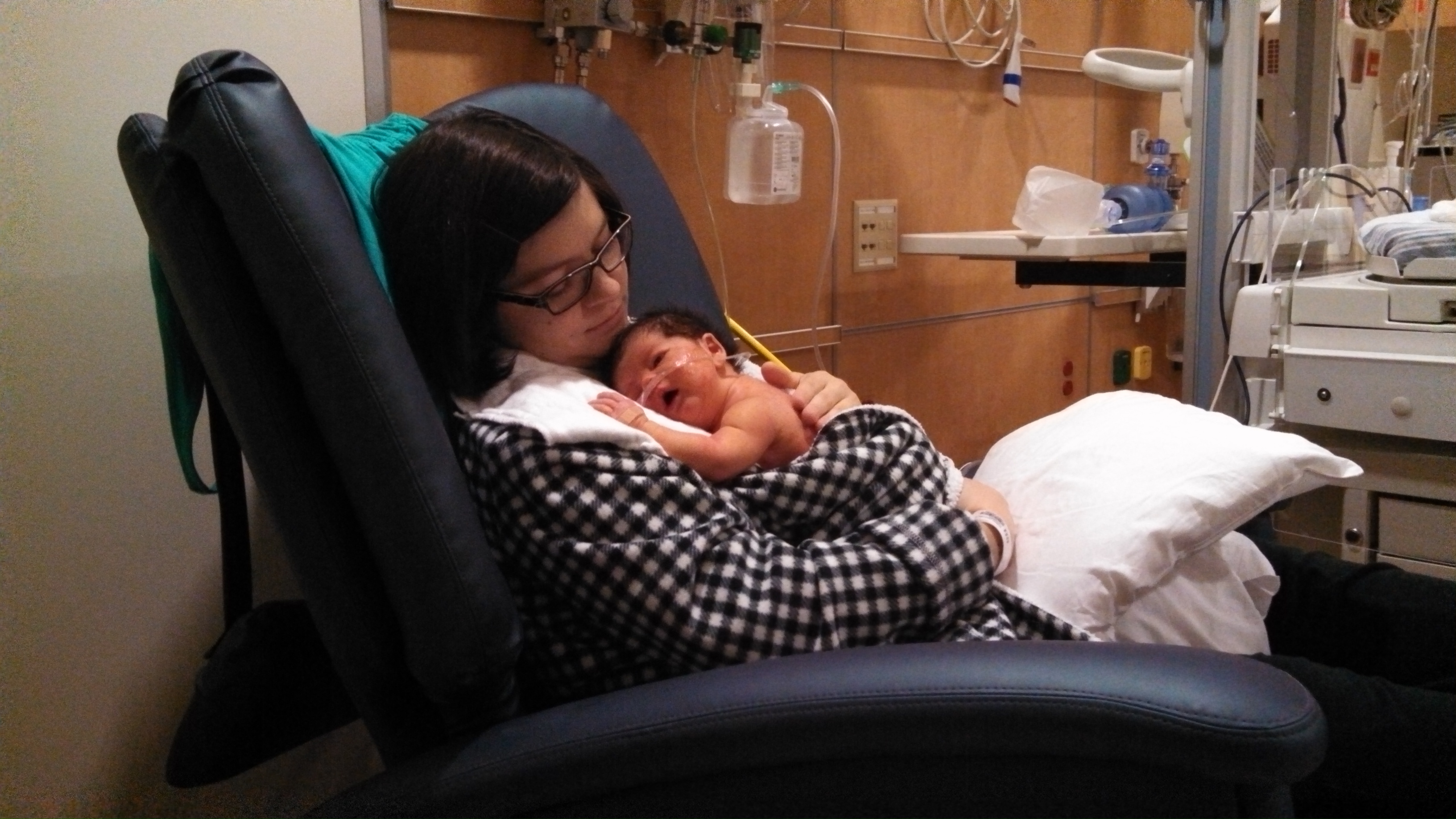
I sat in the armchair, surrounded by pillows, and offered Maddie my nipple for the first time.

She latched immediately, and tried a few, tentative sucks.  Her eyes rolled back in her head, and she took long, slow, deep swallows for five whole minutes until she fell off, exhausted and barely conscious.

I couldn’t stop laughing.  I finally felt like Maddie’s mother.  I finally felt it.

Normal.

Today is a good day.

Breastfeeding_1

Later, the neonatologist came into Maddie’s room.  I was surprised to see her.  She usually checked in during rounds, then didn’t come again unless something was needed or if there was a problem.  I was feeding Maddie again while my husband was getting us dinner.

She held up her hands, “Oh! I’m sorry to intrude.  Please, don’t stop.  I have a meeting across the hall in a few minutes, and I just thought I’d drop in.  I just wanted to see how everything was.”

I was too proud of my girl to be embarrassed.  “That’s okay.  Everything’s great.  She’s latching like a champ.  Even better than her big sister was at this age.”

We chatted about breastfeeding, and those first, difficult weeks, trying to learn about our selves, our bodies, and our babies all at once.

The neonatologist paused, and cocked her head to look more closely at Maddie, snuggled in my arms.  “You know, I love coming to this room.  Because every day is good news.  Every day is progress.  This is my favorite room.”

I smiled, holding those words down inside of me.  Letting them warm every part.

“What would you think about taking her home soon?  Like Friday?”  She had shifted her smile from Maddie to me.

My breath caught in my throat.  Home.  Home.  Home, home, home.  Yes, home.  Yes.  “Really?  Really?  Oh, my God.  That soon?”

“She’s doing great.  No promises, but she’s doing really great.  She’s pretty perfect.”

Today is a good day.

The neonatologist dimmed the lights for me as she left, and I wrapped Maddie up inside my robe, our two bodies hot and snug together.  I put my face in Maddie’s hair.  Funny.  Even after four days in a hospital, getting nothing but sponge baths, Maddie still had that incredible, newborn smell.  The smell of a brand new person.  Of a brand new soul.  I wanted to sit there and smell her forever.

Breastfeeding_4

Brenda was across the hall with the neonatologist and another doctor I didn’t recognize.

“. . . No, no change.”

“What was her gestational age?”

“30 weeks.”

They’re talking about that little girl.  The one across the hall.  I focus on the top of Maddie’s head.  I hear a sigh.

“So it’s been a week since her last change in head circumference?”

I hear Brenda click a few buttons on the laptop she brings with her everywhere.  “Yeah.  Well, six days.”

The other doctor speaks up, “I’d like to order an MRI to test for brain activity.”

I still don’t look up, but I know that the neonatologist is nodding.  The room is somber.  They ask about the little girl’s responses.  Brenda will have to retest her hearing and vision.  I hear the words “macular degeneration?”  Asked, like a question.  There seems to be no change.  No improvement.  No progress.  They can’t promise anything.

When the doctors leave, I look up and into the girl’s room.  Brenda is performing her “care.”  I glance quickly at the little girl.  I know she’s a girl because she wears a tiny, pink cap over her head.  She’s so small.  She doesn’t move when Brenda wipes out her mouth, changes her diaper.

She looks like a movie prop.  Like a doll, but less real.

I scan the room.  It’s empty.  Neat.  Perfectly clean and organized.  I see a package on the small table next to the untouched fold-out bed.  I recognize the package from the Riley welcoming staff.  It’s a knit blanket.  They brought Maddie one two days ago.  I have it draped across the arm of the recliner.  It’s soft and warm.  Pale, neutral pastel colors.  Across the hall, the little girl’s blanket is untouched, tied with a string, a note of welcome still attached to the bow.

I realize that I have never seen anybody but medical staff in her room.

I realize that the blanket draped over her incubator is not one of the bright, cheery blankets from home, but a plain white one.  Issued by the hospital.

I think about my first day here, when an administrative staff member pulled me aside, asked me if my child was a ward of the state. If I felt for any reason that I couldn’t care for her.  If my home wasn’t safe for her or for me.  Were there problems at home?  Was my husband safe?  Did anybody have any substance abuse issues?  Should they contact a social worker, or protective services?  I was shocked by her questions, thinking about my husband and his gentle, disarming smile.  No, no, of course not, no.  Do you really need to ask these questions?  Really?

Why hasn’t anyone opened that little girl’s welcome gift?

Why does she have a white blanket over her incubator?

Why isn’t her head growing?

Do you really need to ask these questions?

I put my face in Maddie’s hair, breathing deeply.

Today is a good day.

Today is a good day.

A good day.

Today is a good day.

Mother Mary

I don’t know her name.

I see her in the hallway, in the small lunchroom, by the sinks in the Milk Lab where we go to wash and sanitize our breast pump parts.

We have made eye contact. But never spoken. Never even smiled.

I can see she is Mexican.

In my mind, I call her “Maria.”

Maria.

Mary.

Mother.

By the second day at the NICU, my husband and I have fallen into a routine. Every three hours, we do Maddie’s “care.”  The “care” is when we get to fold down the plexiglass sides on her warming table, change her diaper, wash her face (paying special attention to the areas that are being rubbed raw by her ventilator and her feeding tube), move the sensors for her monitors (if you leave them on too long, the adhesive can start to tear her already delicate, papery skin), then feed her. 30 milliliters of breast milk, warmed to body temperature, placed in a large syringe and allowed to drip down into her feeding tube. Maybe tomorrow we’ll get to increase it to 45.  While Maddie eats (Can you call it eating? She doesn’t taste or swallow the milk. It just enters her, penetrates her. It’s sustenance, but a violation at the same time), I pull out the large hospital pump, take off my shirt, and start pumping breast milk. Sometimes I pull the curtain along the back of the room to get some privacy. More often I don’t.  What’s the use?  The doors don’t close.  The windows have no blinds.  The lights only dim.

When I finish pumping, and Maddie finishes eating and is wrapped in clean blankets again, my husband and I usually have a couple of hours of down time.  We spend most of it on our phones.  Friends, relatives, employers, insurance agents. Everyone needs regular updates.  When we finally catch up on the texts and phone calls, we have to deal with the aggressively friendly staff.

Come to the common room for some soda and desserts! 

Just wanted to drop off a flyer for this evening’s scrapbooking class!

We wanted to give your little one this blanket that one of our volunteers knitted.

Would you like to come to our breastfeeding support group?

We need to have a serious discussion about finances.  Can you come to my office and start the application process for Medicaid?

And they all smile. They’re all so nice.  So gentle.  Their gentleness grates on me like sandpaper.  Haggard, unshowered, and only able to manage two hours of restless sleep at a stretch, I snap several times. “Why, exactly, would I want to make a fucking scrapbook of this hell?”

“Oh, someday you might want to look back . . .”

“I don’t want to look back. Ever. I don’t want to make friends. I just want my family to go home.”

(I wasn’t invited to the next night’s class. I think it was for learning how to knit baby hats.)

Under the weight of these routines, the minutes drag while the hours fly by.  Days pass.  We often don’t eat our first meal until 1pm.  Eating and drinking are haphazard affairs.  We forget to do small things, like put on clean socks.  I forget to take my pain medication.  By the third day after my c-section, I just stop altogether, the hassle being worse than the soreness.

Every six hours, I have to take my pumped milk and all of my pump parts down the Milk Lab.  I drop off my milk, where it is processed and frozen for my daughter’s future use, and carefully and meticulously I wash and sanitize my breast pump parts.  Maria is the only other mother I have ever seen doing this.  I know that most of the other children on the floor are on our schedule.  I know that every three hours, they are also having “care,” but Maria and I are the only other mothers who have stuck it out with the breastfeeding.  Most of the other babies are fed formula, if they are taking any food at all.  I don’t judge those mothers who choose the formula.  The constant pumping, the sore nipples (I had weaned my oldest daughter just 10 months before, but my nipples still became painful, cracked, even bloody at times, as the strong hospital pump pulled and tugged on them relentlessly, regularly, every three hours), the trek to the Milk Lab with a bucket full of dirty parts, the trek back with clean ones, neatly lined up on paper towels in pinky flesh colored hospital tubs.  You had to leave the NICU to drop off your milk, so when you wanted to return to your child’s room, you had to stop and scrub in again—three long minutes at a large trough sink, scouring your hands, forearms, fingernails, while a small kitchen timer ticked down.  Any time you punch in your code to leave the NICU, you are required to wash upon your return, even if you only go down the hall.  And this is only the annoyance you have to endure if pumping breast milk is going well.  If you respond to the pump.  If you are able to produce enough for your child.  Maria and I are the success stories.  We can do it.  It’s hard, but at least we’re able to do it.  I overhear another mother in the lunchroom on her phone, quietly, so quietly I could barely make out her sorrow, talking about how her nurse had to put her child on formula after a week of her being able to pump nothing but steam. She tries to sound positive, “At least formula’s free here.”  I think she’s talking to her mother.  Aren’t we all?  I know I am.  Don’t you always talk to your mother in a place like this?

Mother.

Mother.

The NICU is full of mothers. Signs for mothers.  Classes for mothers. Services for mothers.  A sign in the lunchroom reads, “Please give seating preference to our NICU mothers.”  Mothers are sent free meals, delivered to the floor.  Brochures circulate, offering massages and laundry services for “our NICU mothers.”  I joke to my husband, “Dads are really getting the shaft here!  You have to sit on the floor and starve!”

He responds seriously, “The mothers are the important ones.”

I look at him.  Suddenly, I want to cry.  “Dads are important, too.”

He is calm, steady, and unflinching.  “Rachel, please. You know that here—especially here—mothers mean more.”

I don’t know why, but I know that he’s right.

By the third day, my husband and I are comfortable enough, curious enough, brave enough to walk the circuit through the entire NICU.  Starting at our room—the last door on the left of a long corridor—we walked straight to the end of the hallway of patient rooms, turned right, walked down another hallway full of open doors, large windows, and dim lights, and turned right again.  One giant trapezoid.  I can’t stop myself from looking in all of the windows.  Most of the rooms are eerily empty.  Babies sleep in incubators that have been covered with colorful blankets.  The NICU recommends that parents bring in blankets from home to cover their children. It protects their still-developing eyes from the lights.  And it’s supposed to look cheery.  A reminder of home.  A happy sight.

They look like sarcophagi.

There are very few parents on the floor.  Again, I don’t blame them.  Most of the parents have children who have been here for weeks, not days.  They have jobs.  Older children.  Homes in the area.  I know the pain they must feel, having to leave their babies behind as they move on with their daily lives, and I feel suddenly grateful. I’m in hell, but so long as my child is here, there is no other place I want to be.  Either I stay here and burn with her, or we all leave together.

The small scattering of parents don’t look up as we pass.

Only Maria makes eye contact.

I walk by her room, and I see her, sitting next to her baby’s incubator. I recognize the blanket that is draped over it.  It’s a receiving blanket with monkeys on it.  It came in a pack of 4.  I received one as a shower gift for my older daughter.  Maria is sitting in the blue recliner, looking out of the window.  Her hands are folded across her belly.  She looks as though she could be calmly taking in the view at a mountain resort on a still morning.  Thoughtful.  We look at each other.

And I feel it.

Every time Maria and I make eye contact, I can feel it.  There is no sadness.  No anger.  No frustration.  Just a resoluteness. She and I look each other fully in the face, without fear or embarrassment.  We take each other in.  And I feel it.  This is a good mother.   I can see it in her face.  Without fear.  Without reproach.  She will do anything for her child.  She will hike through hell.  For as long as it takes.  She’s here, and she’s not leaving.

The next day, around dinner time, my husband and I try to walk to the lunchroom to have dinner.  But the medical staff has a section of hallway closed off.  NICU nurses in their red scrubs, and medical residents in crisp white jackets swarm around outside of a single room.  There is even more medical equipment than usual in the hallway.  Two young nurses stand on either side of the room, shooing people away. My husband and I go the long way around.

We don’t say it, but the entire floor knows what has happened.

A child has died.

I don’t remember eating or talking the rest of that night.  I’m sure I must have.  At some point, I think I hear a wail. A cry.  I hope it’s one of the babies.  I hope it’s my imagination. I don’t think it is.

I started praying that night. I don’t even know if I believe in God.

Please be kind to our NICU mothers.

We love our NICU mothers.

Our NICU mothers are important to us. Please let us know if there is anything we can do to make your stay more enjoyable.

Late at night, I walk to the lunchroom to fill my water bottle (a gift for the NICU mothers).  The hallway is still blocked, though only four nurses now stand outside the room.  A curtain has been drawn across the doorway.  I can feel the anger, the frustration, the fear, the sadness coming from the nurses.  I’m afraid to make eye contact with them.

I enter the lunchroom just as Maria is leaving.  Again, our eyes meet, and we know.  Through hell. Through fucking hell. And back again.

I never told her.

I wish I did.

I wish I had to courage to tell her.

Maria.

Mary.

Mother.

You are a good mother.

A great mother.

I hope that she knows.

I’m taking a break from my “Perpetual Twilight” series to talk about something happy and awesome: Christmas crafts!  I don’t know if it was the Downgrade that was squeezing my budget, my new friendships with local moms who are always doing the cutest, most wonderful family crafts, or just my own incredible need to do something creative (yet feel productive at the same time. Blogging?  Super creative.  Not exactly recognizable as a productive activity, however), but I went a little nuts with the homemade this year.  Here are some of the Christmas Crafts we have undertaken in the Honest House.

This is going to be a picture-heavy post, and, sadly, the quality won’t be all that great because most of these shots were taken with my phone. I’m not one of those great DIY bloggers who take professional-grade pictures of their work.  But who cares? ‘Tis the season to turn the brown spot on the tree into the corner, and admire the green foliage before us!

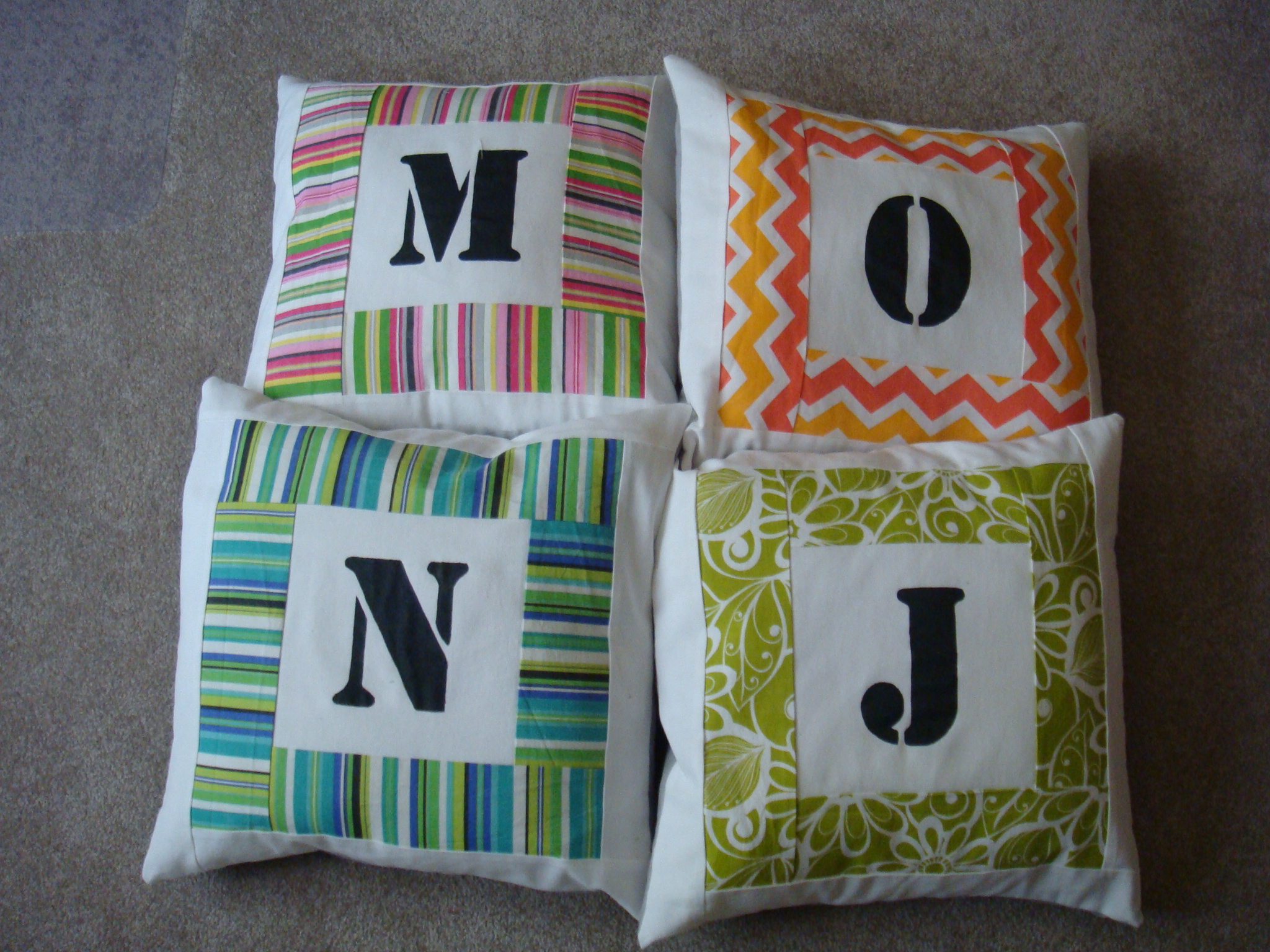
Christmas monogrammed pillows.

NOEL!

NOEL!

Honest Girl and Honest Baby have 10 “cousins” (most of whom are only the relatives of our choosing), and every Christmas, I usually get them all a little something. I am not the fun gift-giving Aunt. I usually get everybody a book and an article of clothing—pjs or a tee.  Snore. Yawn.  I mean, those were the gifts that I loved getting as a child, but I had a rock collection and read Crime and Punishment in the sixth grade, so what the hell do I know.

K & O are sister and brother. L & E are sisters. J & G are brothers.

K & O are sister and brother. L & E are sisters. J & G are brothers. I tried to coordinate patterns and colors according to family.

M & N are sister and brother. O & J are only children.

M & N are sister and brother. O & J are only children.

But this year, I decided to try and make something for all of the kids.  Again, nothing super exciting, but something that they could call all their own.  I know that Honest Girl is at that age where she likes to identify every item in the house according to who “owns” it (“Mommy’s pants.”  “Daddy’s nose.”  “Baby’s blanket.” “Girl’s shirt.” “Girl’s light.” “Girl’s cookie.” “Girl’s tree.” “Girl’s remote?”—She really tries hard to convince us that everything in the house is hers).  How cool would it be if I could manage to make something that could be displayed in a family room or sitting room (a “grown-up” space), but that was identifiable as belonging solely to the kids?  I decided to try two new things for these pillows: making quilt blocks, and fabric painting.  I used a stencil with a sponge brush, some matte charcoal grey fabric paint, and created 20×20” pillows with a simple log cabin quilted top.  I used some heavy cotton fabric so that they would be completely washable and super-durable.  Because kids.  The results aren’t perfect by any means, but I’m pretty proud of them!  Inspiration and basic pattern instructions found here: http://thehappyhousie.com/?p=2027.  Like her, I used Ikea pillow forms. Unlike her, I found the Ikea forms not exactly true to size. They were closer to 18×18″.  Still a sizable pillow, but it caused me a headache for the first couple of tries! Apparently Ikea is great for storage solutions for a 600 square foot apartment. Not so great with measuring. Who knew?

I wound up spending about $10 per pillow on these. Not a huge savings (I usually try to spend only about $15 per child for Christmas presents), but I like these better. I really tried to personalize every one.

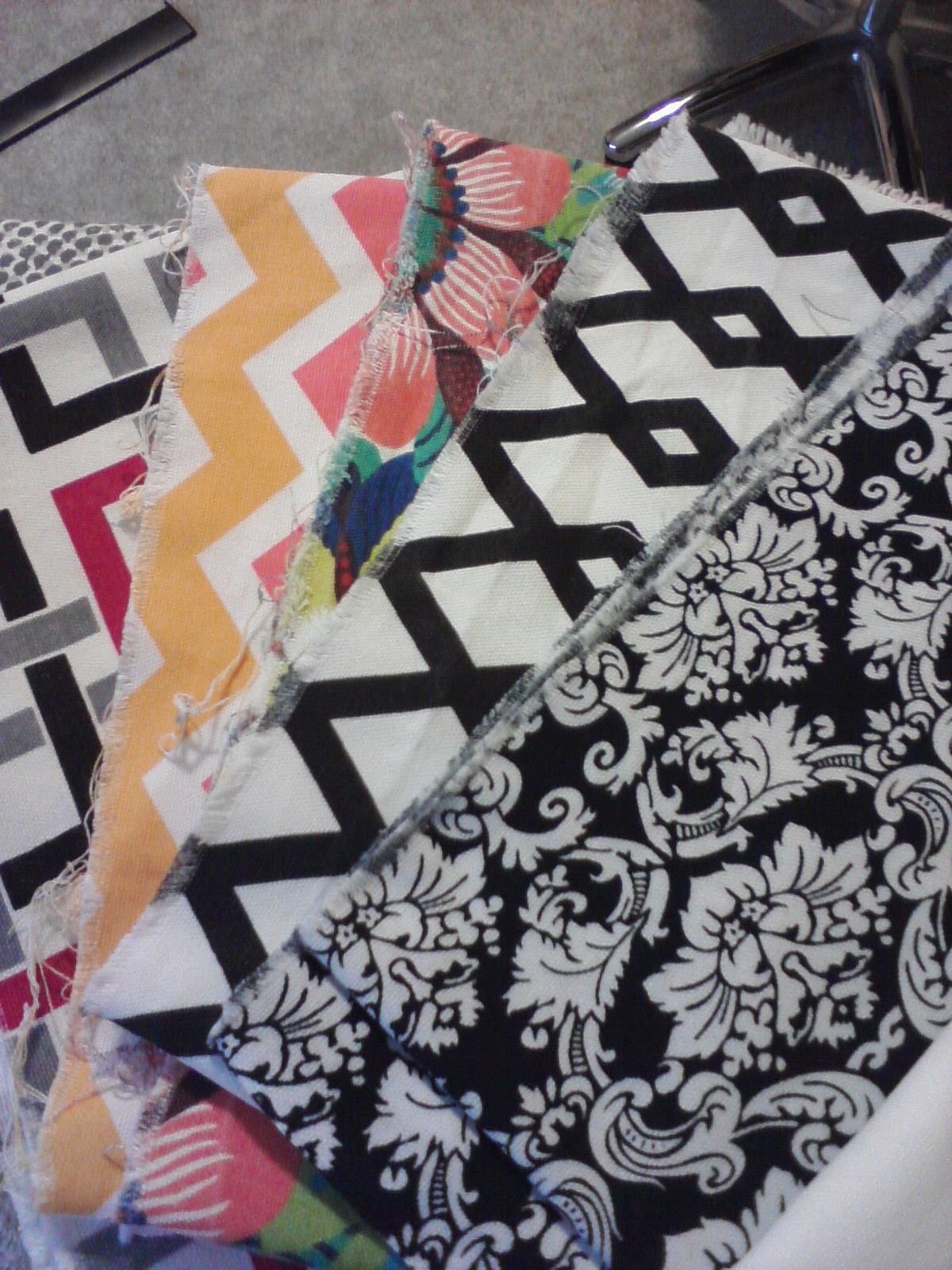
I spent a long time selecting fabrics that I thought reflected the personality of the children. K is a classic beauty. J loves superheroes. O is girly, and a little anal retentive. She'd respond to the precision of a nice, geometric chevron.

I spent a long time selecting fabrics that I thought reflected the personality of the children. K is a classic beauty. J loves superheroes. O is girly, and a little anal retentive. She’d respond to the precision of a nice, geometric chevron.

<Sidebar>Honest Dad is a crafting Fascist.  He’s a Craftscist.  He thinks that my stenciling is messy and unimpressive. I’d say it’s a “two-foot” job.  From two feet away, they look really good.  If I had used quilting cotton (finer and thinner woven cotton) they would have probably looked better, been smoother, etc. But I wanted to use a nicer, thicker fabric than that, because of this, you can see the way that the fabric paint really shows the texture of the fabric’s weave. But they’re for the under-ten crowd, so I’m not too worried about judgment and anal retentive nit-picking.  I say that the Craftscist is just too much of a stressed out perfectionist to see the beauty in my work. Relax, baby. It’s just fabric.</Sidebar>

See? About a two-foot job.

See? About a two-foot job.

Christmas dough ornaments. Oh, I had such plans for these. I remember my parents’ salt dough ornaments that they pulled out every year.  They made them in the winter of 1970, during their first Christmas as a married couple.  They were too poor to buy ornaments, so they made all of them instead.  Only a few remain from that first batch, but my mother puts them on the tree every year.  And here I was, with my own daughters, starting our family traditions. We would bake them, Honest Girl would decorate them.  Honest Baby’s chubby hand print would adorn them. I’d sign them “Christmas, 2013” on the back, and years from now, I’d pull them out and show them to my gorgeous, grown daughters.

I found the recipe online, and followed a commenter who suggested adding a half teaspoon of cinnamon to the batch to give it a nice smell (which is really noticeable after it sits packed away in boxes with the other ornaments for a whole year).  I mixed the dough, got Honest Girl to help me knead and work it.  She played with the flour while I rolled it out to a lovely, smooth consistency. Smiles all around.  Fun family times.

It was only after getting the dough all prepared that I realized I didn’t have any cookie cutters.  Any.  At all.  Not a star, not a heart, not a Santa, or a snowman, or even a circle.  And my neighbor—the baker.  That’s right.  She’s a baker.  Like, for reals.—didn’t have any either. Had no idea where they were.  Must’ve gotten lost in the move. Oh! Wait.  Here are some.  They’re a set of cookie cutters for a baby shower.  Here’s a baby carriage, and a onesie, and a teddy bear, and a rocking horse.  Can you use those? I looked down at my dough, rapidly drying out on the board before me.

I guess I have to.

So, we have a bunch of baby shower cookie ornaments.  Undecorated.  Why undecorated?  Because the dough made Honest Girl’s hands feel weird, and she didn’t like how cold the finger paints were, and Mommy kept telling her she couldn’t put the markers in her mouth, and she was exhausted, because the ornaments took about three times as long to bake and solidify as the recipe said they would, and they’re just cookie lies because they look like cookies but you can’t eat them!

Just cookie lies...

Just cookie lies…

She begrudgingly half-colored three cookies, threw another one on the ground and cracked it, then went down for a nap. I didn’t even try to put Honest Baby’s handprint on one.  Besides, it wouldn’t fit on any of them.  I’m going to buy some cookie cutters for next year, and make this happen, dammit.  But for now, those three are sure pretty on my tree.

I love this teddy bear Honest Girl decorated. It almost looks like he's holding a rose!

I love this teddy bear Honest Girl decorated. It almost looks like he’s holding a rose!

“Cannolirolls.”  I adore cannolis.  How could you not?  They’re so decadent, and rich, and heart-cloggingly bad for you.  But they’re a pain in the ass to make.  So I don’t make them.  Instead, a few times a year, Honest Dad and I will buy a couple from the bakery section at the grocery store.  Often, these won’t even make it home, and we usually walk through the door with our guts spilling over our belts, powdered sugar creased into the corners of our smiles.

But they’re expensive that way, and I wanted to make some cannolis this year as a little Christmas treat for Honest Dad (and for Honest Girl.  And for me.  Okay, mostly for me).  I started looking up easy cannoli recipes online, and came across this: http://www.braumeisterswife.com/2013/03/quick-phyllo-dough-cannoli-with-whipped.html.It was genius.  She took tin foil, rolled it into a long tube, coated it with non-stick baking spray (or just butter, y’all), and wrapped her dough around it to make the cannoli tubes.  She baked them as usual, then, while they were still hot, she just slid them off the tin foil and—voila!—cannoli shells!

Only I didn’t have any phyllo dough.  Or ricotta cheese (the traditional cannoli filling).  But I had Pillsbury rolls.  And cream cheese.  And chocolate chips.  Those three ingredients alone have to make something good, right?  I did the exact same procedure, but with the Pillsbury rolls, and made a cream cheese frosting (I tried to make it more cannoli-esque with the addition of nutmeg, as she recommends, though I didn’t use any milk in order to keep my filling as stiff as possible).  I put the frosting into a piping bag, and squirting it into the Pillsbury rolls.  Then, I made a chocolate ganache and drizzled it over the top.  My favorite recipe is from Martha Stewart.  It requires corn syrup, which, for all its faults, is great for a ganache because it ensures that it doesn’t harden.  The chocolate stays a little soft and pliable, so I think it sticks to the top better and doesn’t flake off while you eat it.

They’re not cannolis.  They’re cannoli facsimile.  But, shut the front door, they were good.  Next time, I may sprinkle a little sugar on either side of the Pillsbury roll before wrapping them around the tin foil, just to cut the buttery taste a little more.  Sorry I don’t even have a crappy picture of these.  They were gone too fast!

Stocking bags. The dilemma: no Christmas stockings.  The solution: Make Christmas stockings out of fabric scraps. Further dilemma: I have no idea how to make stockings.

But I know how to make bags.

Honest Dad, Honest Mama, Honest Girl, and Honest Baby's Christmas bags, respectively.

Honest Dad, Honest Mama, Honest Girl, and Honest Baby’s Christmas bags, respectively.

This was a quick solution I concocted while trying to decide how I was going to make sure we all had a least a little Christmas stocking, without spending a bunch of money on nice store-bought ones or devoting a lot of time to their construction. I made these between 1 and 2am last night. Because something was going to get hung by the chimney with care, dammit! And if there’s one thing toddlers love, it’s putting stuff into and taking stuff out of something. Over and over again. Bring on the Christmas bags!

Boom.

A temporary solution, but not an unpleasant one, if I do say so myself.

A temporary solution, but not an unpleasant one, if I do say so myself.

A close-up of Honest Girl's bag. You can see that I used scraps from my pillow project.

A close-up of Honest Girl’s bag. You can see that I used scraps from my pillow project.

Hooray for Crafty Christmas Goodness! I’m a crafty novice, so please bear with me if these are horrible, but they’re way more involved and awesome than anything else I’ve ever attempted before.  So I’m just rolling with it.

Merry Christmas, everyone.  And the happiest of New Years.  I have two healthy, beautiful, stubborn, willful girls, and a doting Craftscist by my side. It’s going to be a good year.

The Longest Night

The twilight continues with every piece of information you receive.  And you are constantly receiving information.  From the nurses.  From the specialists.  From the residents.  From the pediatricians.  From the financial administrators.  From the smiling, helpful staff.  Always so helpful.  Always smiling.  First, you’ll want to go left.  Then right.  Go down the green hallway.  Green.  You can’t miss it.

Except you do miss it.  You repeat their instructions, muttering them out loud while you try to navigate the labyrinth, but you still manage to walk right past your turn, your landmark. Even backtracking, nothing looks familiar, so you find another smiling staff member.  No, no, the orange hallway.  That will take you to the green hallway.  You can’t miss it.

Eventually, you stop asking directions, preferring aimless wandering to the constant feeling of being lost.

The doctors perform their rounds in the morning.  Six physicians, walking up and down the hallways in a pack, wheeling their laptops on special rolling carts.  They remain in the hallway.   They stand outside your child’s door and discuss her chart, her progress.  If you have found your way back to her room, you get to stand in the doorway with her nurse (one day, having just woken up, I stood in my socks while the well-dressed resident smiled down at me in her polished, sensible shoes) overhearing their updates that are obfuscated by your ignorance.  “Three litres per hour on a ventotherm.” “ Oxygen saturation levels remain normal.”  “Breathing rates still elevated.”  Nasal cannula.  Feeding tubes.  Monitors.  Radiant warmers.  Vents.  Bililights.  And all with their own sound, alert, rhythm, pulse, filling the background with a continuous, deafening chorus.  Something starts to beep persistently, alarmingly.  But nobody moves. Why is nobody moving?  Why do they never seem to respond?  You can barely hear the report the neonatologist gives.   You try to study her observant, patient face.  Try to read her lips as she calmly performs her assessment, gives her update.  Is this good or bad?  Is this progress?  What constitutes progress anyway?  Is the only movement forward a movement out the door?  A movement away from all of this noise?  And where do we go after we walk out of this room?  How do we get home?  Does anyone know the way?

Home.

Home.

That place we want to go.

You can’t miss it.

Sunday, September 1st: The first ten hours after my emergency C-section are a blur to me.  The anesthetic made me nauseous, and I spent most of the night vomiting into the blue bags the nursing staff were bringing me three and four at a time.  Sometime around 3am, I remembered that I had just gone through major abdominal surgery, and I began to hallucinate about splitting open as I wretched, my insides pulling the stitches and glue apart.  I was splitting down the middle.  I looked down at my incision and saw that it was intact.  But what about the inside?  They went through so many layers.  Maybe you just can’t see it.  Where I’m split.  I’m in two.  I’m torn apart.  Groggy, I asked the nurse if there was any danger.  She assured me that I would be fine—“That’s really strong glue they use!”—the anti-nausea medication was on its way, then she wheeled in the large, powerful hospital breast pump and told me that it was time for me to start pumping colostrum.  Maddie was still in the Special Care Nursery.  She had a ventilator taped over her mouth.  She couldn’t nurse.  If I wanted any chance of breastfeeding, I would have to pump every three hours to encourage my milk to come in.  The nurse suggested that I take a picture of Maddie to look at while I pumped.  “Sometimes it helps.  It makes your milk come in.  Reminds you why you’re doing this.”

The Special Care Nursery was at the far end of the maternity ward, at the end of a long hallway.  That first night, my husband pushed me to Maddie in a wheelchair while I held my catheter bag and IV.  Though the nurses encouraged me to remain seated, the bulky wheelchair wouldn’t let me get close enough to touch her.  I stood up and shuffled over to her, wheeling my IV and catheter behind me.  I was bent over, unable to stand up straight, and I couldn’t seem to convince my legs to swing from my hips smoothly.  They moved in halts and jerks.  I looked and felt like a crone, but the desire to hold my daughter for the first time was stronger than my discomfort.  I limped over and looked down at her.

Maddie_ventilator

She was swollen and red.  She felt hot to the touch.  Feverish.  Her umbilical cord had been cut short in preparation for an umbilical catheter (a direct line placed through her umbilical cord and into her artery.  It’s a painless way to draw blood in infants, and a way to directly pump oxygen into her system.  Maddie wound up not needing it, but her cord had been cut down to a flat scab over her bellybutton just in case).  The nurses had removed her hospital-issued blue and pink knit cap, and I could see her thick, black hair, still matted with afterbirth.  She had an IV in her left arm, which had to be immobilized with a soft cast over her wrist.  Her chest moved up and down rapidly.  Her nostrils and lips flexed with each shallow breath.  She was breathing fast.  Too fast.  They told me to look up at the screen above her head.  They pointed to a number.  It was hovering around 95, jumped to 110, then back to 89.  90.  94.  102.  98.  My husband leaned over to whisper.

“That’s her breathing rate.  They told me it should be between 40 and 60 for a newborn.  They’re trying to get it to slow down.”

107.  91.  96.

“There’s fluid in her lungs.  They started her on an antibiotic.  Just in case.  There’s no sign of infection right now, which is good.  They told me it was good.”

97.  100.  104.  104.  99.

As we left the nursery, we passed a little boy in a warmer.  I glanced up at his screen.  49.  51.  50.  50.  45.

I walked back to my room, dragging my IV behind me.  My husband pushed the wheelchair, ready to catch me in case my shaking legs finally failed me.  I tried to stand up straight as I walked, but I couldn’t.  I’m split.  I’m torn in two.  You just can’t see it yet.

In the morning, Maddie’s pediatrician visited.  “We’re all so surprised by this.  Nobody was expecting this.”  She told me something about oxygen percentages.  About oxygen mixtures.  She said Maddie’s lungs were “sticky.”  They were giving her medicine intravenously to flush the fluid from her lungs.  My usually smiling, warm pediatrician was frowning.  She had always looked so youthful and energetic.  Lines had appeared across her forehead.  I realized I had never seen her in surgical scrubs before.  Her thick hair was pulled back.  She looked paler than I remembered.  Paler than her Hispanic lineage.  “I have to stop at the office this morning for one appointment, then I’m coming right back here.  I won’t leave her.  I’m going to be with Maddie all day, okay?  She is my priority.”

I nodded.  The stitches have failed.  I’m split.  I’m torn.

———-

“This is going to be the best for Maddie.”

I think we were nodding.  I think we were understanding.  I don’t think I was crying.  Not yet.  I know that my husband was standing next to me.  I know that I was sitting on a hospital bed in a well-lit maternity ward, on a bright Sunday in late summer.  But everything was dark.  I was focusing on the pediatrician’s face.  I had to.  Everything else had gone black.  If I stopped looking at her, if I lost focus for an instant, I knew that the blackness would swallow everything.  I knew the dark would take over.  So I stared at her face.  Yes, it was pale.  Paler than usual.

“I have to be able to admit when a patient’s needs are out of my realm of care.  And hers are.  I can’t get her breathing under control.  If we try to take the vent away, she won’t have the energy to breathe on her own.  She needs to be with experts.  With specialists.  This is going to be the best for Maddie.  I promise.”

The pediatrician had called in a team from Riley Children’s Hospital in Indianapolis.  They would be here within the hour.  Maddie was going to be placed in an incubator—boxed up—and sent by helicopter to the NICU.  A pediatric respiratory nurse was coming as well.  She was going to quickly assess Maddie, prepare her to be air-lifted, make sure that she was stable enough for the transport, then take her away.  Away from me.  Away from us.  Maddie would be sent off on a seventeen-minute helicopter ride to a facility that was an hour drive away.

My husband and his mother immediately left.  Because Maddie’s delivery was an emergency, he didn’t have any clothes with him.  He ran to our house and quickly packed a bag for himself, then the two of them drove to Indy, fast, in the hopes of meeting Maddie there.  I was still recovering from the anesthetic, still being monitored for any signs of complications or infections.  I had to stay behind.  Alone.  In the maternity ward.  My husband balked at the thought of leaving me, but I wouldn’t let him stay.  I couldn’t endure the thought of her arriving at the NICU without someone, without one of us, without her family.  She had to know, even if she couldn’t open her eyes, that we were with her.

It hadn’t been twenty hours since I had delivered her, and I had never seen her eyes, had never held her.

After they left, I hobbled down to the Special Care Nursery to wait for the team from Riley’s.  I ran my hand through her dark, dark hair, and watched her chest move fast—too fast—up and down as she lay on the warming table.  She was panting with shallow, rapid breaths.  She was still hot to the touch, her body overworked just from the effort of breathing.  Don’t stop breathing.  Don’t stop. Just slow down a little.  Breathe, Maddie.  Breathe.  Breathe.  She was swollen and red, and every now and again her brow would furrow and she would shudder, like a person in a lucid dream trying to wake up, trying to respond to the voices that she could hear but couldn’t answer.  I had to believe that, even in her stupor, even with the ventilator hissing, and the monitors beeping and wailing and alerting, even with my blood pumping so loudly I was certain the whole ward was being deafened by it, that she could hear me.  “I love you.  Mommy loves you.”  I said it over and over again.

When the team from Riley’s showed up, it was as though the Marines had arrived.  Three specialists, all in matching black flight suits, wheeling clean, complicated machinery in front of them.  They were confident, efficient, but gentle.  They sent me back to my room, the respiratory nurse promising that she was going to bring Maddie to me once they got her into the mobile incubator.  While I waited, I filled out some paperwork, and told the nurse my cell number.  She assured me that she was going to call me, personally, the second they landed, and that she was going to stay with Maddie on the ground as well.  “I don’t have any other flights scheduled for tonight.  I’ll be with her.”  The nurse looked at Maddie’s chest x-rays, and quickly assessed her condition. They increased the pressure in her ventilator, forcing more air into her lungs, helping to open them.  The entire hospital staff seemed relieved that they had arrived.  The nurses in the Special Care Nursery looked thankful that someone was given them firm, sure orders, that someone seemed to have a plan.  My pediatrician respectfully stepped into the background, the lines never leaving her face.

They brought Maddie into my room, wedging the large, plexiglass incubator between my bed and the wall, trying to get her as close to me as possible.  One of the men in the flight suits (they never spoke to me.  Only the respiratory nurse ever said a word), opened the small, round porthole on the side, and let me put my hand inside to touch her.  The skin on her fingers and arms was wrinkled and soft, loose.  Her arms and legs were too skinny.  They didn’t have time in the womb to store up the fat needed to fill her out.  Even though she was puffy and swollen, I could feel all of her small, bird-like bones as I reached in and took a hold of her hand.  Her right hand.  Her left was still bandaged in the cast used to hold her IV in place.  The nurse was again assuring me that she’d call immediately.  I think she said that Maddie really did look good, or at least that the nurse had seen far worse.  Every part of me ached to hold Maddie, to climb inside the incubator next to her, to shield her with my body, to warm her with my hands, to breathe for her too.  If they asked me to, I would breathe for her for the rest of her life.  I would give every single breath for her.  Her small, delicate fingers wrapped around mine, and gripped me tight.

Then, they wheeled her away.  It was 4:30pm on Sunday, September 1st.

I began to sob.

I’m split.  I’m torn.

———-

The nurses tried their best to keep me entertained, or at least busy, that whole, long night.  They brought me a tray of food.  Meatloaf, I think.  I remember there were mashed potatoes.  I hadn’t eaten all day.  This was my first meal since having surgery.  I ate the food, not really tasting it.  I remember thinking it was strange that I didn’t feel hungry, but I ate it all anyway.  The nurses reminded me to “keep pumping!” in voices that sounded far too chipper.  I did.  I even dutifully washed and sanitized my pumping parts between every session, killing the time by running hot water over everything.  They brought me toiletries so I could have a shower.  They removed my IV and catheter, and checked on me every hour.  They told me that I would be discharged early the next morning, smiling, “You’ll have one of the shortest stays ever after a c-section!  That’s so great!”  They asked repeatedly if I wanted anything for the pain.  I didn’t know which pain they meant.  So I just said no.

The nurses had me fill out my discharge paperwork that evening.  They wanted to make sure that all I had to do in the morning was get the doctor’s approval and leave.  While signing the papers, someone from the Special Care Nursery appeared at the door.  She was hesitant.  She had Maddie’s ankle bracelet in her hand.  “I didn’t know if you wanted to keep this.  A lot of moms want to keep it for their scrapbooks and baby books.”  She handed it to me.  She had been able to slip it off Maddie’s too-thin foot without cutting it.  It was complete, but empty.  It froze me.  I held the small bracelet in my hand, trying to keep it warm, trying to keep it feeling alive and still connected to a hot, panting little body.  I rubbed my hands together, willing my nerves to remember the feeling of her soft, soft, loose skin, her bony grip. My hands shook as I held the bracelet.  I don’t remember asking them all to leave—I don’t remember being able to—but soon I was alone in my room, crying, sobbing, panting.  My breath came in fits and starts.  I couldn’t catch it. Couldn’t catch my breath.  I couldn’t fill my lungs.  I stared down at the bracelet. “I love you.  Mommy loves you.”

I said it over and over.

Maddies_bracelet

Eventually, the respiratory nurse called to let me know that Maddie was set up in a private room in the NICU, and that she had tolerated the helicopter ride well.  My husband also called, his voice hopeful.  “She looks so good.  Really.  She looks better already. I’m serious, baby. She looks so good.  They already have her looking better.”  I could tell by his voice that he wasn’t placating me.  And I was happy that he was there, along with his mother, and my parents, who stopped in Indy on their way down to see us.  Three of her grandparents were with her (my father-in-law was watching our older daughter), and her father.  That’s what I wanted for her.  To be overwhelmed with love.  To be full to the point of bursting with care and concern.  I turned on the television in my room, and watched HGTV until regular programming switched over to infomercials sometime around 4am.  By 7, I was showered, packed, wearing my street clothes, and seated in the rocking chair in my room, waiting to be discharged.  I was in the hospital 32 hours total, and when my husband arrived at 7:30, we didn’t even stop to pick up a change of clothes.  By 9am, I was once again running my hands through Maddie’s dark, dark hair, still matted with afterbirth.

“House (Ar)rest”

Having a child in the NICU is like living in perpetual twilight.  The windowless rooms.  The heavy curtain dividers.  The lights in your child’s room—dimmed for optimal “family rest”—that make you blink violently when you walk out into the bright hallway.  The nurses, always looking hurried, yet trained to be silent even as they quickly thud past in their thick-soled black shoes, trained to not disturb the sleeping, the resting, the grieving, the hopeful.  The continuous, 24-hour schedule, skewing any sense of time you may have been able to retain in the artificial environment.  The clocks that dutifully tell you times that mean nothing.  Is it two in the morning?  Or is it afternoon? What does it mean that the clock reads 2?  What does it matter?  Either way, it’s time for another feeding.  Another tube inserted into her.  Another moment, another minute, when you get to fold down the plexiglass divider and touch her.


Thursday, August 14th: I was clutching my husband’s arm, my eyes squeezed shut, as the pressure steadily mounted and peaked.  He was lying next to me, calm but alert, one eye on his phone, timing the contraction.

“Don’t forget to breathe, baby.”

His low, still voice reminded me that I was, indeed, holding my breath.  I slowly exhaled and opened my eyes as the pain subsided.  One minute long.  Twenty minutes after the last one.

“She’s coming.  She’s coming out of me.  I can feel it.  This isn’t normal.  I can feel her head pushing against me.  She’s coming.”

On Saturday I would be 35 weeks pregnant (I believed, though I would later learn that my calculations were off a day).  For the last two nights I had been experiencing contractions that were increasingly regular and painful.  I was being woken up throughout the night from the pain.  I tried to “drink a glass of water and lay down” (the usual advice for stopping preterm contractions), but it didn’t seem to be very effective.  I was told that the contractions were likely “false” labor, Braxton Hicks contractions, that helped to prepare my uterus for the task of childbirth, but didn’t actively advance labor, didn’t affect my cervix.  But these contractions didn’t feel like a general tightening in my midsection.  It felt like a downward push, hard, and insistent, and slowly rhythmic.

The next morning I called my OB, and was told to come to the office right away.  After a quick exam, it was easy to see that I wasn’t having “false” labor, or “unproductive” contractions.  I was in pre-term labor, 2 centimeters dilated, 70% effaced, and contracting every 15 minutes.  My OB put me on Procardia. (A blood pressure medication that some studies have shown helps to slow down contractions, though its efficacy for pre-term labor has really only been recorded for the first 24-72 hours after starting it.  It buys you a couple of days.  But, luckily, I was far enough along that all we really needed was a couple of days.)  Then he told me, “Your job for the weekend is to sit on your couch and time your contractions.”

“Like bed rest?”

He balked.  “I’m not going to tell you you can’t do things.  I’m not going to put you on bed rest.  Let’s call it couch rest.  House rest.  Just, don’t leave your house.  And don’t do much while you’re in it.”

“So, activity-wise…?”

“As close to nothing as you can manage.”

“For how long?”

“For as long as it takes.”

For two weeks, I slowly fused into my couch.  I dropped my daughter off with her grandparents.  I downloaded a contraction timing app to my tablet.  I ate everything out of a microwave.  I obsessed about every twitch, flicker, and tightening in my belly.  I watched my house succumb to the rapid entropy that comes when you have both a husband who works too many hours and a toddler whose idea of “helping” usually includes pulling all of the Kleenexes out of the box while laughing maniacally.  I watched way too many hours of “Criminal Minds” and “Law and Order” (because apparently marathons of violent TV dramas are the only things on in the middle of the day when you have basic cable. Who knew?).  I did nothing, except slowly, slowly, agonizingly slowly went insane.

I took the Procardia for five days.  After two, my “breakthrough” contractions had ramped up enough that the on-call physician told me to double my dose.  After two more days, I developed an allergy to the medication, and had to stop taking it immediately.  Without any medicinal intervention keeping my uterus from contracting, my “house rest” had morphed into house arrest.  I was told to stay hydrated, and keep my feet elevated.  No laundry.  No picking up my daughter.  No walking to the park.  No nesting.  I sat on my couch, thirty feet away from my newborn’s incomplete nursery, and was adamantly forbidden from working on it.

I was miserable.

Even though I kept telling myself that I was lucky (we had made it to 34 weeks with no complications, and if my daughter had been born at this point, the chances of her having long-term problems from being born preterm would be truly miniscule).  Even though I knew that it was temporary (I only had to wait until 37 weeks to be considered truly “full term” and therefore out of danger).  Even though I kept telling myself to be thankful for the outpouring of help I received (My good friends sent me flowers.  My parents drove 500 miles to be with me.  My sister visited from Chicago. My daughter essentially lived with her grandparents, enjoying way too much junk food, way too few rules, and bedtimes that were way too late, for almost the entire time.  I missed her until I ached, but I knew that she was happier being with people who could get down on the floor with her, instead of trapped in the living room with her mother, watching Cars and Up again).  In spite of knowing all of these things, I found myself crumbling every day.  Two o’clock would roll around, and I would sob, knowing that I had already sat like stagnant pond water for the majority of the day, but also knowing that I still had hours—long, long hours—before my husband would come home, before I could move off the couch and into the passenger seat of our minivan and enjoy fifteen minutes of bliss and freedom as he drove us to a local fast food restaurant for dinner.  I watched the clock, timed my contractions, played hundreds of hands of solitaire, and sobbed.

Sunday, August 25th-Monday, August 26th: I was 36 weeks pregnant.  I was 4 centimeters dilated.  Once again, I grabbed my husband’s arm in bed as he timed my contractions. Every 10 minutes.  I was certain that I was going to be having my baby.  “It’s happening.  It’s really happening.”  We dropped our sleeping daughter off with my mother-in-law, and drove to the hospital, getting there around eleven at night.

The nurses hooked me up to the monitors.  We all watched the needle swing wildly and regularly, showing my contractions.  I was effaced.  My baby had dropped.  One of the nurses, after checking me, exclaimed, “Your cervix is READY for birth!”  I was uncomfortable, but smiling.  It was over.  I was done.  I would no longer have to sit in misery.  I was going to have my baby.  She was a little early, but it’s okay.  She’d be fine.  She was measuring big, her heart rate looked great, and, being a girl, the odds of her having problems would be low.  The nursery wasn’t finished.  The laundry wasn’t done.  Nothing was ready.  But it didn’t matter.  She would be here.  Finally.  I breathed more easily, knowing that it was all over.

Then, the OB made the decision to stop my labor.  It was her medical opinion that we wait.  I was just 36 weeks.  It was cutting it too close.  She confessed to being overly cautious on such matters, but told me that being conservative would be a good thing for my baby.  Really.  I was given two doses of terbutaline to stop my contractions, spent 9 hours at the hospital, slept 20 minutes, and was sent back home early enough for my husband to go back to work after just a few hours’ nap.  I was left alone, pregnant, and in labor.  Again.

I couldn’t believe it.  I was told that after 36 weeks my labor would be allowed to progress.  That it was standard procedure to allow a woman that far along to give birth.  But I was still pregnant.  Still sitting on the couch.  Still crying at 2pm after realizing that I may have to deal with an entire month more of labor.  Still guilty for wanting my baby to arrive, not for her sake, but for mine.  I was being a horrible mother.  Selfish and whiny, I just wanted my discomfort to end, even though the possibility that my unborn child would have complications was very real.  I didn’t care.  I wanted my baby.  For me.  I wanted to feel better.  I wanted it to end.  I was angry at the OB.  I was angry at my body, which didn’t seem capable of holding on to her any longer.  I was even angry at my child, not because it was her fault, but because I knew that I couldn’t blame her.  I was angry at her, and I hated myself for being angry at her.  Because I knew that I had to sacrifice my comfort for her safety.  Because I knew that I’d always have to sacrifice my comfort for her safety.  Because it wasn’t fair.

So I cried.

Saturday, August 31st: I believed that I had made it.  According to my calculations, I was 37 weeks.  Full term.  Out of danger.  If my preterm labor ramped up again, my OB would not try to stop it.  I was freed from house arrest.

To celebrate, my husband and I decided to wander around the Fourth Street Festival, an art fair held every Labor Day Weekend in our hometown.  I was going to look at the handmade art, enjoy some people watching, maybe even have an ice cream cone.  I wasn’t going to be alone anymore.  After two weeks on my couch, it would be Heaven.

It was brutally hot.  We stopped and looked at the booths set up by local artisans and craftsmen, chatted with a few of them whose work caught our eye, and tried to turn our faces to the hot breeze that worked its way lazily down the street in between the crowds of people.  We spent most of the afternoon sitting under a tent, listening to Americana, sipping lemonade sold by the high school orchestra.  I began to really notice my labor. Whenever I had another painful contraction, I would grip my husband’s arm.  I seemed to be clutching him every song.

As we walked back to the car, I had to stop frequently and wait through another minute-long contraction.

“These are getting closer together.”  Once again, his voice was calm, but he was watching me intensely.

“No, no,” I gasped.  “It’s just the heat.”  Suddenly, I was aware that my newly acquired freedom was at risk.  It was my first day out of the house in weeks.  It might turn out to be my last.

We went back to my mother-in-law’s house to pick up our daughter.  There, in the cool of the air conditioning, my husband quietly timed my contractions while we sat around and chatted, trying to ignore the elephant of my impending delivery.  Every five minutes.  I somehow convinced him to take me home.  Somehow decided that my labor would stop if I was in my own bed, resting and watching cartoons with my daughter.  An hour later, they were four minutes apart.  I called my OB.

“Rachel, are you in labor?”

Gasping, “Yeah.  Yes.  I’m pretty sure I am.”

“Then get here.  Now.”

At 7:23 my OB checked my cervix.  “You’re 6 centimeters dilated.  Your baby is coming whether we do anything or not.  Within the half-hour, you will be having a c-section.  Okay?”

Joy, nerves, excitement, fear.  I had no time to truly feel any of them.  I called my family.  Everyone was at a barbeque at my aunt’s house.  They immediately started laughing and making guesses about the baby’s weight and the time of birth.  They started a friendly bet around the table.  I heard their overlapping conversations, their joy, as chaos and noise.  I was smiling and laughing.  I was still smiling and laughing, even when I was being wheeled, alone, into the OR.  I was still smiling and laughing, even when I started to tremble, shaking uncontrollably.  Am I cold?  I must be cold.  Maybe I should ask for a blanket. The nurses joked and smiled at me as they wrapped me in warmed blankets and tested my belly for numbness.  My husband came in, then, wearing blue scrubs.  I was still trembling.  Still smiling and laughing.  It was 8pm.

Maddie_birth

Ultimately the c-section was a wonderful experience.  It was fast, efficient, and without any complications.  I felt nothing but a slight tugging sensation, then I heard the roar of congratulations as the nursing staff and my OB welcomed my little girl into the world.  My husband, smiling behind his mask, was holding her in a tiny bundle.  It was 8:33pm.  She was born at 36 weeks, 6 days.  I had been one day off in my calculations.  She was the oldest a “premature” baby can be, though her size belied her early delivery.  6 pounds, 15 ounces.  We all laughed.  The OB joked, “If she waited three more weeks, she would’ve been HUGE!”  My husband placed her face next to mine, and I began to cry as I kissed her, the tears rolling back into my ears.  She was red and swollen, puffy from the strain of the birth, but I could see how she looked like her sister, her father.  Her eyes were closed, and her lips were pursed.  A frown was working its way across her forehead.

And she was quiet.

She wasn’t crying.  It wasn’t a cry.  More of a grunt.  A gasp.  One of the nurses appeared, hovering over my head and haloed in the bright spotlights above me.  “Rachel, she seems to be having a little trouble breathing.  We’re just going to send her to the special care nursery.  Just to get her some help.  She just needs a little help.”

I couldn’t look away from her, from my daughter.  I couldn’t stop kissing her.  My husband was looking up at the nurse.  Quiet and calm as always, but alert.  I didn’t notice him tensing up.  I was looking at my daughter’s chipmunk cheeks. Just a little help?  Just a little? I nodded.  “Okay.  Yeah, I understand.”

The nurse looked kind, but she wasn’t smiling and laughing anymore.  “What’s her name?”

“Madeline.  Madeline Louise.  Maddie.”

“You’ll be able to see Maddie soon, okay?  Daddy’s going to take Maddie the whole way.  He’ll be with her the whole time, okay?”  She looked down, “Maddie, give Mommy a kiss.”  The nurse put her hand on my husband’s arm, and he stood up, pulling Maddie away from me.

I twisted my head around, trying to watch her from where I was strapped to the operating table.  The last thing that I remember was my husband’s shoulder, in blue scrubs, hunched over our new daughter, as he turned away from me and walked out the door.